The headless commerce market is valued at $2.13 billion in 2026 and is projected to reach $7.24 billion by 2033, growing at a 22.6% CAGR.
That growth curve is exactly why you’re hearing about headless everywhere. Agencies pitch it. Dev shops sell it. Case studies from nine-figure brands make it look inevitable. So you’re wondering if your themed Shopify store is already obsolete.
Those case studies come from brands doing $10M+ with in-house engineering teams. The economics that make headless work at that scale actively work against you at $100K–$500K.
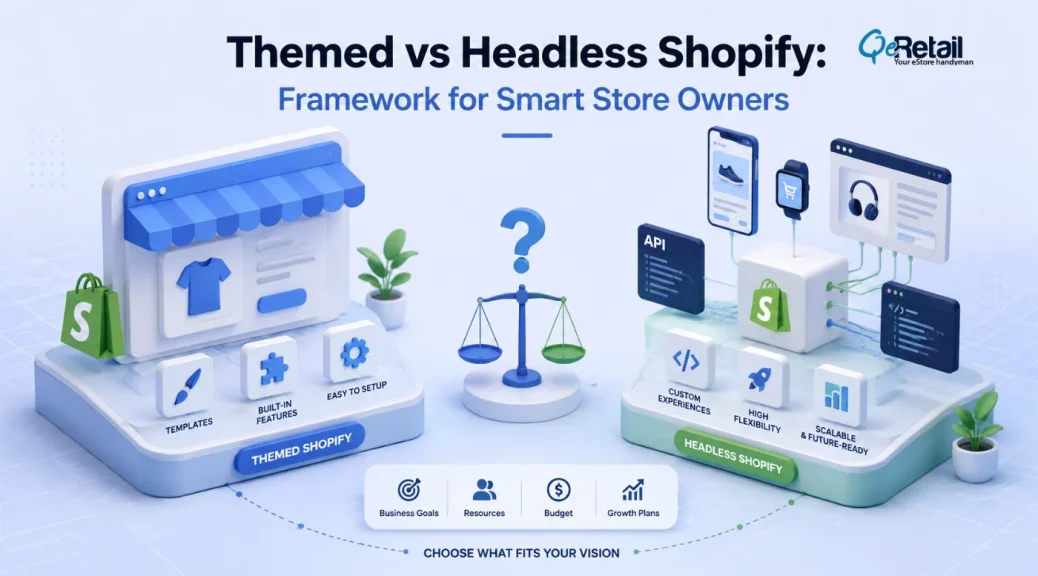
This piece gives you a decision framework built on four factors, scored honestly, so you choose architecture based on your numbers, not someone else’s case study.
Key Action Points:
- Score your store against the 4-factor framework before talking to any headless agency
- Fix checkout and page speed on your current theme first; cheaper, faster ROI
- Budget the full headless cost: build, hosting stack, plus 10–20 dev hours monthly
- Stay themed below $400K revenue unless custom UX is your proven conversion lever
- Track conversion lift per dollar spent, not architecture bragging rights

What is Headless Shopify (And What it isn’t)?
Headless Shopify isn’t a faster theme. It’s a rebuild of your entire storefront. In a themed store, Shopify controls both the backend (products, checkout, orders) and the frontend (what customers see) through a Liquid theme.
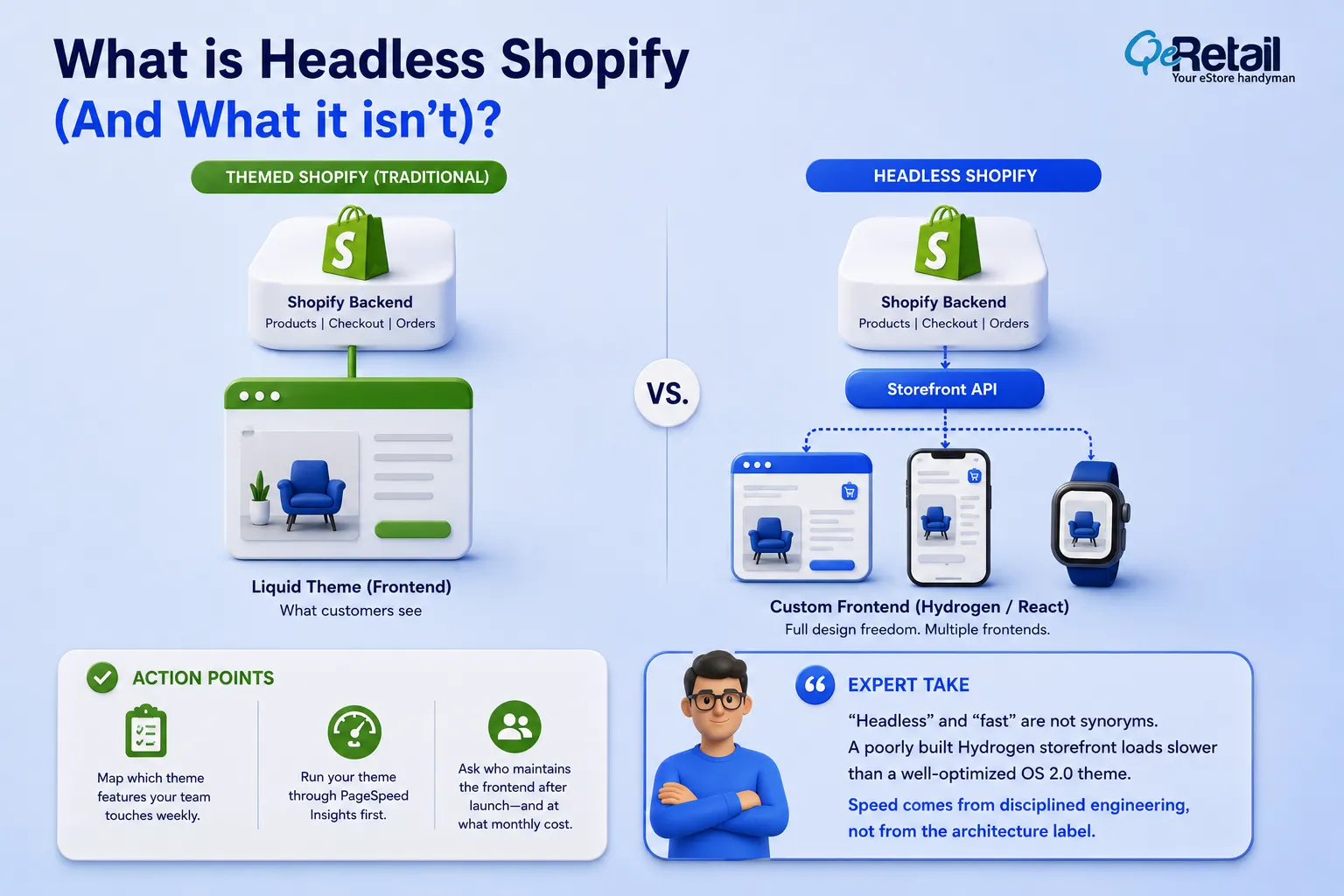
Headless decouples them: Shopify keeps running the backend, but your frontend becomes a custom application, usually built on Hydrogen, Shopify’s React framework, talking to Shopify through the Storefront API.
That decoupling buys you total design freedom, sub-second page loads when built well, and the ability to serve one backend to multiple frontends. It also means every feature a theme gives you for free (sections, app blocks, theme editor access for your marketing team) now has to be rebuilt in code and maintained by developers.
Expert Take:
“Headless” and “fast” are not synonyms. A poorly built Hydrogen storefront loads slower than a well-optimized OS 2.0 theme, and we see this in audits constantly. Speed comes from disciplined engineering, not from the architecture label on the invoice.
Action Points:
- Map which theme features your team touches weekly; each one becomes a dev ticket under headless
- Run your current theme through PageSpeed Insights before assuming architecture is your bottleneck.
- Ask any agency pitching headless who maintains the frontend after launch, and at what monthly cost.

Why do Most Shopify Stores Go Headless for the Wrong Reasons?
The most common headless trigger isn’t strategy. It’s envy. A founder sees a competitor’s slick custom storefront, reads a case study claiming 30% conversion lift, and concludes the architecture caused the result.
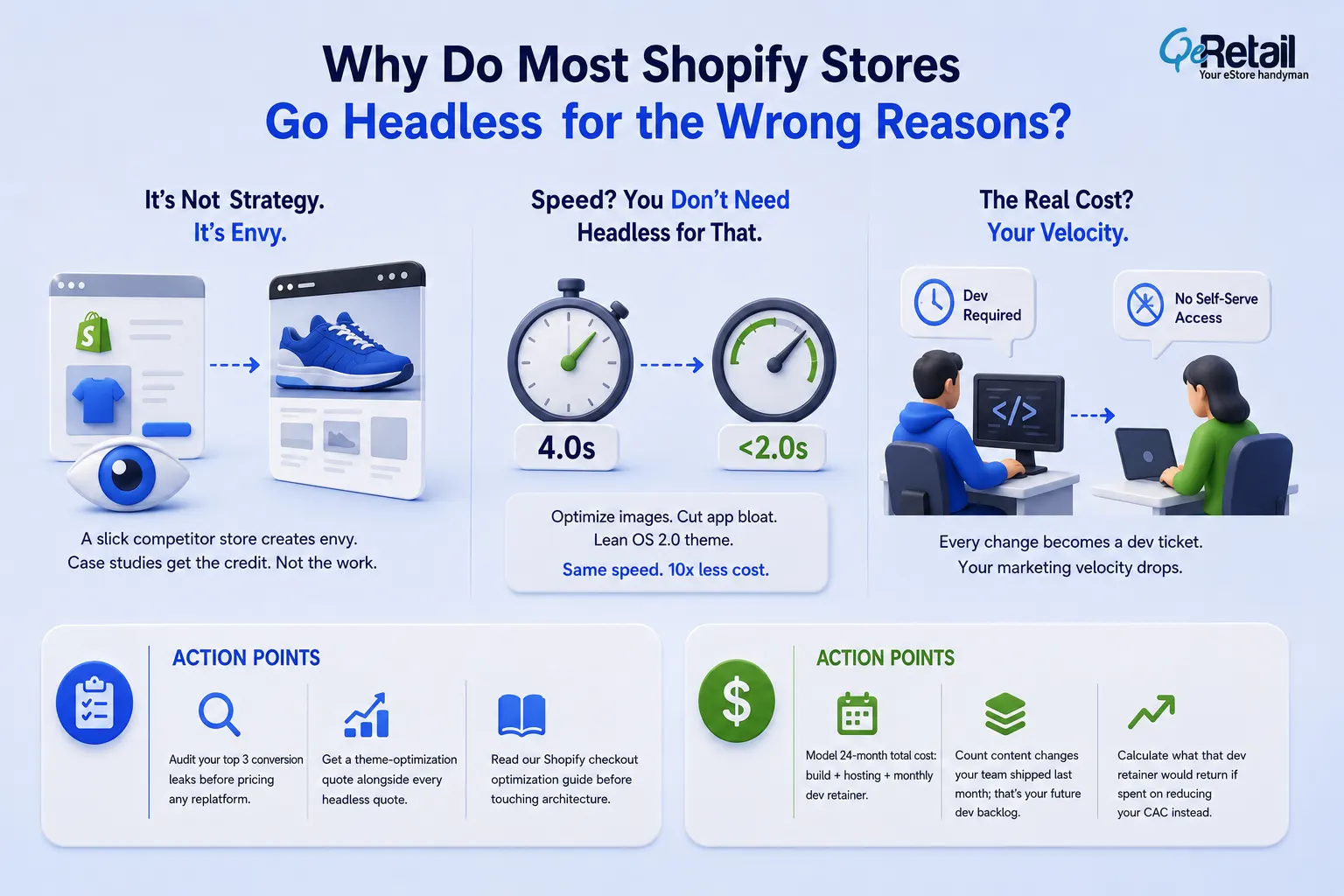
What the case study omits: the brand also rebuilt its entire UX, hired a CRO team, and spent six figures on the transition. The lift came from the work, not the stack.
The Speed Justification Falls Apart Under Math
Speed matters. A 0.1-second improvement drives 8.4% more retail sales, according to Deloitte’s study of 30 million sessions. But you don’t need headless to get fast. Compressing images, cutting app bloat, and upgrading to a lean OS 2.0 theme routinely takes stores from 4-second to sub-2-second loads for under $5,000. Headless gets you the same result for $50,000+.
Action Points:
- Audit your top 3 conversion leaks before pricing any replatform
- Get a theme-optimization quote alongside every headless quote; compare lift per dollar
- Read our Shopify checkout optimization guide before touching architecture
The Real Costs Nobody Puts in the Pitch Deck
For a themed store, your marketing team ships landing pages, swaps sections, and tests layouts in minutes without a developer. Under headless, every one of those changes becomes a sprint item. Your merchandising velocity drops the day you launch, and it stays down unless you keep paying.
Action Points:
- Model 24-month total cost: build + hosting stack + monthly dev retainer
- Count how many content changes your team shipped last month; that’s your future dev backlog
- Calculate what that dev retainer would return if spent on reducing your CAC instead.
The 4-Factor Decision Framework
Strip out the hype, and the decision comes down to four factors. Score each honestly.
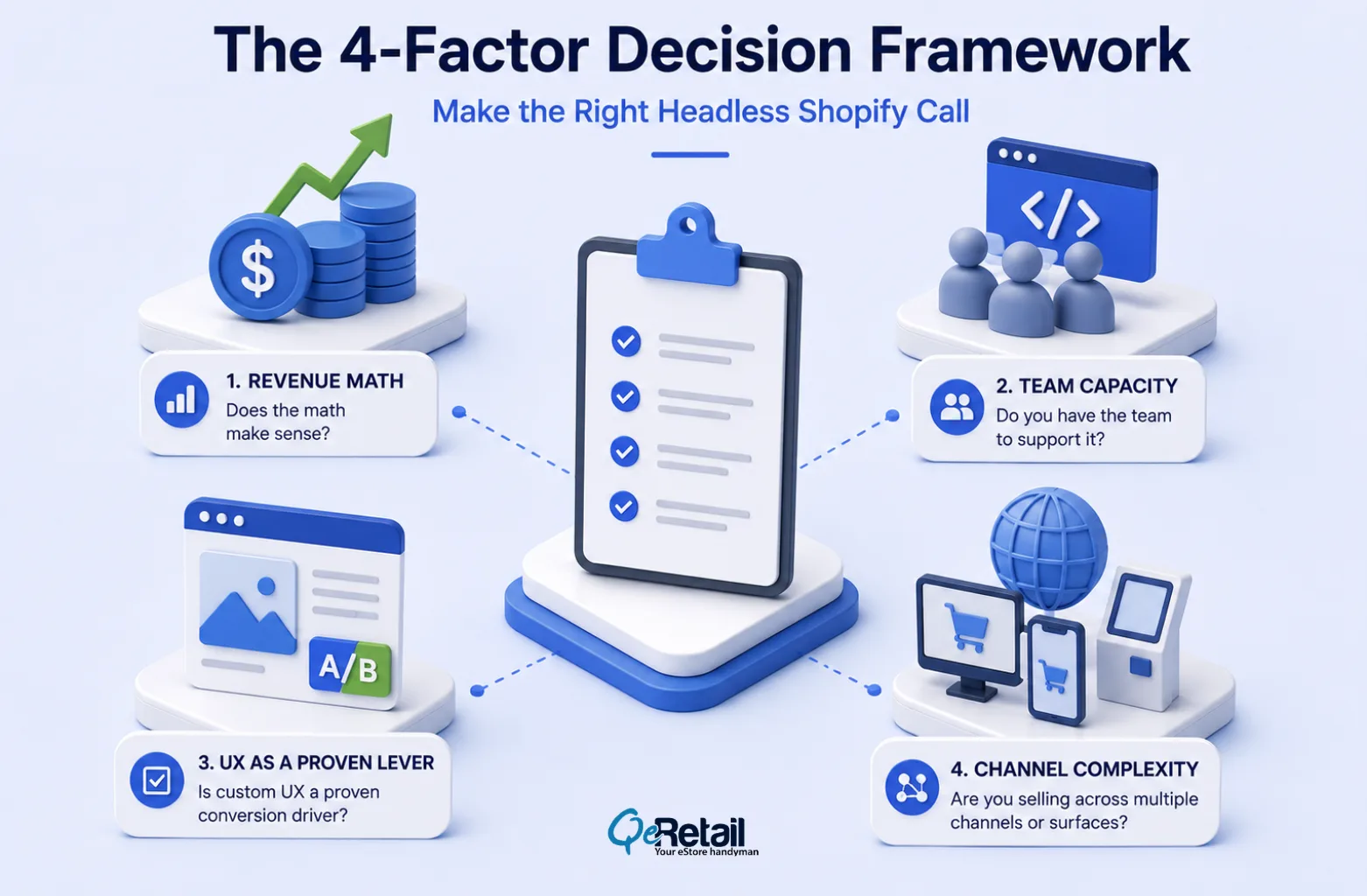
Factor 1: Revenue Math
Headless makes financial sense when a 0.5–1% conversion improvement pays back the build within a reasonable window, which in practice means $5M+ in annual revenue. At $300K revenue, a full 1% conversion lift earns roughly $3K–$5K annually. Against a $60K build, that’s a decade-long payback.
Expert Take:
Payback windows over 24 months kill compounding. Money locked in a headless rebuild is money not funding paid acquisition, retention flows, or inventory depth. Those are the three levers that actually move a sub-$5M store. If the math forces you to squint, the answer is no.
Action Points:
- Calculate your break-even conversion lift: (build cost ÷ annual revenue) × 100
- Reject any headless pitch that skips a written payback timeline
- Reinvest the equivalent budget into CRO on your current theme first
Factor 2: Team Capacity
Do you have engineering capacity in-house, or a budget for a permanent dev retainer? If your team is you, a VA, and a media buyer, the honest answer is no. Headless without owned engineering is a dependency, not an asset.
Expert Take:
A headless stack breaks in ways a theme never does. Deploy pipelines, API version drift, third-party app breakages, Core Web Vitals regressions. Without a developer on payroll or retainer, every fix becomes a support ticket with a 3–5 day SLA. That’s revenue leaking mid-campaign.
Action Points:
- Budget for a minimum $3K–$5K/month dev retainer before signing a headless build
- Document who owns the storefront when the launch agency walks away
- If neither is answerable, stay on a customized theme
Factor 3: UX as a Proven Lever
Is custom UX a demonstrated conversion driver for your brand, backed by A/B test data, or an assumption? If you haven’t exhausted what a customized theme can do, you haven’t proven the need.
Expert Take:
Most $100K–$500K stores blame their theme for conversion problems that are actually offer, pricing, or trust issues. A headless rebuild inherits those same problems on a more expensive foundation. Run the A/B test on the theme first. If custom UX moves the needle, you’ve earned the right to consider headless.
Action Points:
- Run 3–5 A/B tests on your current theme before entertaining headless
- Track PDP, cart, and checkout conversion separately. Themes rarely bottleneck all three
- Only greenlight headless if UX-driven lifts consistently beat 10% in tests
Factor 4: Channel Complexity
Selling through web, mobile app, kiosks, and emerging surfaces like agentic commerce from one backend? That’s Headless’s strongest legitimate case. One storefront on one domain? The factor scores zero.
Expert Take:
Channel complexity is the one factor where headless earns its keep. A single product catalog powering web plus native app plus agentic commerce endpoints is a real architectural win. But “we might launch an app someday” doesn’t count. Score this on shipped or committed channels, not roadmap fantasies.
Action Points:
- List every sales surface you’ll operate in the next 12 months
- Score 0 unless two or more surfaces are actively planned with a budget assigned
- Revisit when agentic commerce or a native app moves from idea to Q1 line item
What the Framework Says at Your Revenue Tier
The Growth Starter ($100K–$200K): Stay Themed, Fix the Funnel!
At this tier, every dollar competes with ad spend and inventory. Architecture is not your constraint. Conversion efficiency is.
- Optimize the theme you have: Cut unused apps, compress media, and upgrade to a lean OS 2.0 theme. Sub-2-second loads are achievable for under $5K.
- Fix checkout friction: Stores loading in under 2 seconds convert at 2.4% versus the 1.4% Shopify average. But checkout leaks cost more than slow pages.
- Build the funnel: Map your TOFU/MOFU/BOFU structure so traffic converts instead of bouncing.
What can Shopify store owners do?
Skip the headless conversation entirely. Put the $50K+ difference into paid efficiency and email. Both return faster than architecture.
The Scaling Operator ($200K–$400K): Build Theme Mastery, Not a Rebuild!
You’re feeling theme limits now, but most of what you’re feeling is customization debt, not architecture ceiling.
- Invest in custom theme development: A $5K–$15K custom theme unlocks most of the design freedom stores think requires headless.
- Systematize CRO: Run structured A/B tests. This builds the UX evidence base Factor 3 demands, before you spend on it.
- Document your bottlenecks: If you can’t name the specific revenue action your theme blocks, headless won’t fix it.
What can Shopify store owners do?
Exhaust the theme ceiling first. The test data you generate now is exactly what makes a future headless decision rational instead of emotional.
The Enterprise-Ready Brand ($400K–$500K+): Run the Framework Quarterly
When Headless Starts Making Sense
You’re approaching the zone where the math can work, if growth trajectory points past $1M and channel complexity is real. A lean Hydrogen MVP at $10K–$30K on a 4–8 week timeline becomes defensible when you have owned engineering and a proven UX lever.
The Hybrid Path Nobody Pitches
You don’t have to choose all-or-nothing. Keep your themed store and go headless on one surface: a high-traffic landing page system or a mobile experience, running on Hydrogen through a subdomain. You test the operational cost of headless before committing your whole storefront to it.
What can Shopify store owners do?
Re-score the 4-factor framework every quarter. The moment you hit 3/4 with real data behind each score, start scoping a hybrid pilot, not a full replatform.
Stop Chasing Architecture. Start Compounding Conversion.
Most store owners treat headless as a status symbol, proof they have graduated from “template” stores. That framing gets the causality backward. The brands winning with headless earned the architecture through revenue scale and engineering capacity. The architecture didn’t create the win.
The stores that compound at $100K–$500K are the ones shipping tests weekly: faster pages on lean themes, tighter checkouts, sharper funnels. Merchandising velocity beats architectural elegance at this tier, every quarter, measurably.
If you replatformed to headless and your conversion rate didn’t move, you didn’t upgrade your store. You just changed who you pay to maintain it. Before making a six-figure architecture decision, you need a partner who will run the actual math on your actual numbers.
Book your free eCommerce strategy session, and we will score your store against the 4-factor framework and show you where your next conversion dollar actually belongs
Frequently Asked Questions
Is Headless Shopify Faster Than A Regular Shopify Theme?
How Much Does Headless Shopify Cost Compared To A Theme?
At What Revenue Does Headless Shopify Make Sense?
Can I Go Partially Headless On Shopify?
How Long Does A Headless Shopify Migration Take?
Table of Contents