Your Meta CPMs went up from $50 to $120 in 2024
Your CAC has climbed 40-60% since 2023
Your ROAS is declining quarter over quarter, yet you fund the same strategy that is quietly eating your margin
And, you are not alone
Most Shopify stores between $100K and $500K in annual revenue run the same playbook, pouring budget into paid ads, watching costs rise, and discounting harder to protect conversion rate. And at the end of the quarter, these companies wonder why profit never catches up to revenue.
The reason is simple- A strategy that does not focus on the funnel
With a funnel-based strategy, Shopify store owners can improve conversions. So, what is a funnel-based strategy?
This piece answers it and also covers the TOFU, MOFU, and BOFU framework, breaking down each stage of the Shopify marketing funnel. And it’s not just a definition-based framework but offers insights into what to build, in what order, at what rhythm, and how to diagnose which stage is costing you the most money right now.
Key Action Points
- Stop running discount-only ads
- Identify funnel stages of your audience
- Build TOFU content to cut CAC
- Fix BOFU before pushing content for traffic
- Make sure all three stages run simultaneously

What is a Marketing Funnel for a Shopify Store Owner?
A marketing funnel is the structured path a potential customer takes from first interaction to the final purchase. For a Shopify store owner, the funnel is like an architecture that decides whether each marketing dollar compounds or evaporates.
Think of it like a Saturday market.
- Some people wander in with no purchase intent, just curious.
- Some are actively comparing options and mentally shortlisting.
- Some have their card out, ready to buy the first thing that earns their trust.
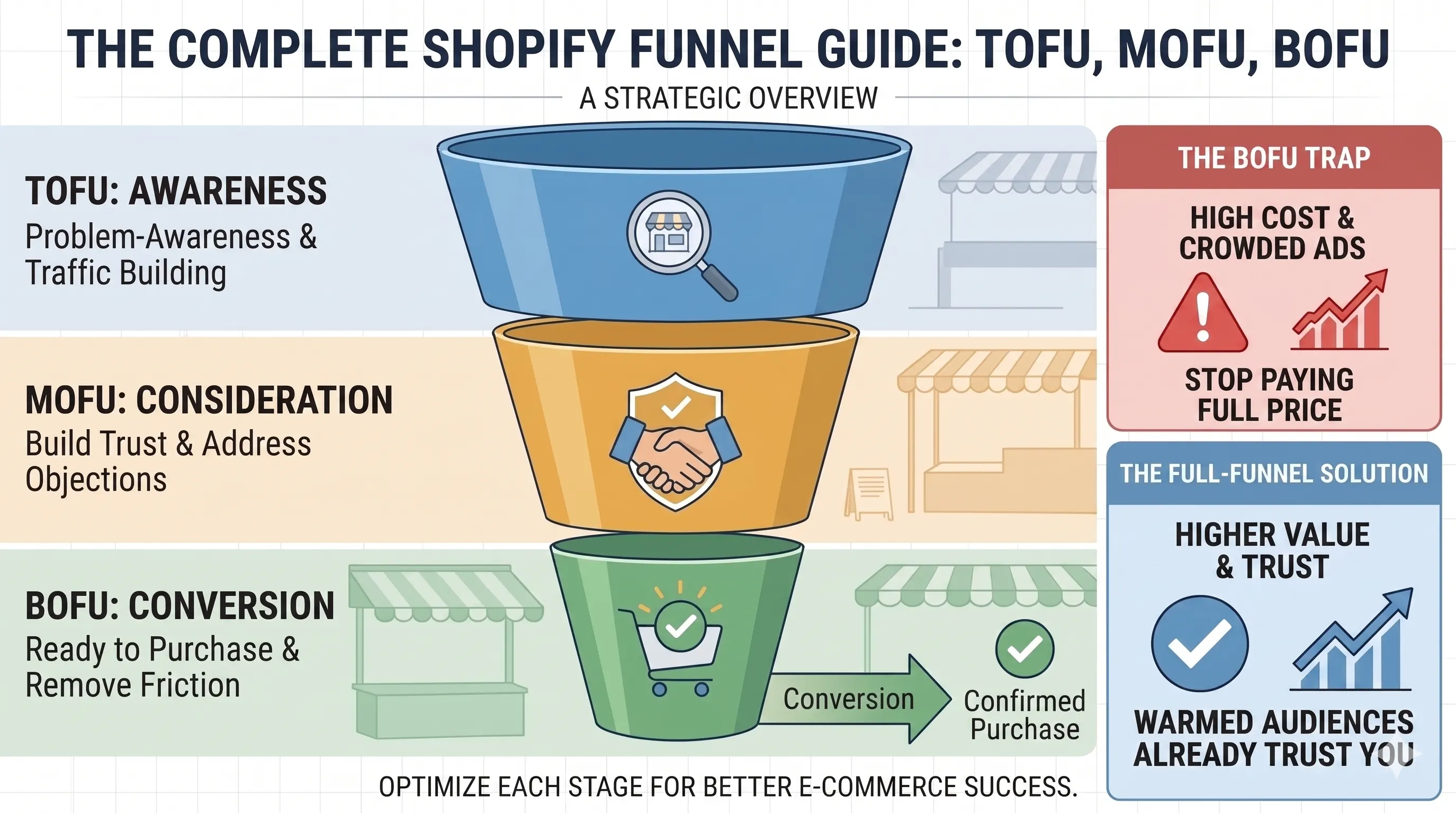
Most Shopify stores market exclusively to the third group, running discount-heavy ads to warm audiences already close to purchasing.
When you skip the first two groups entirely, you keep paying full price for attention that your competitors have already warmed up. Your CPMs rise because you are fighting in the most crowded, most expensive corner of the auction.
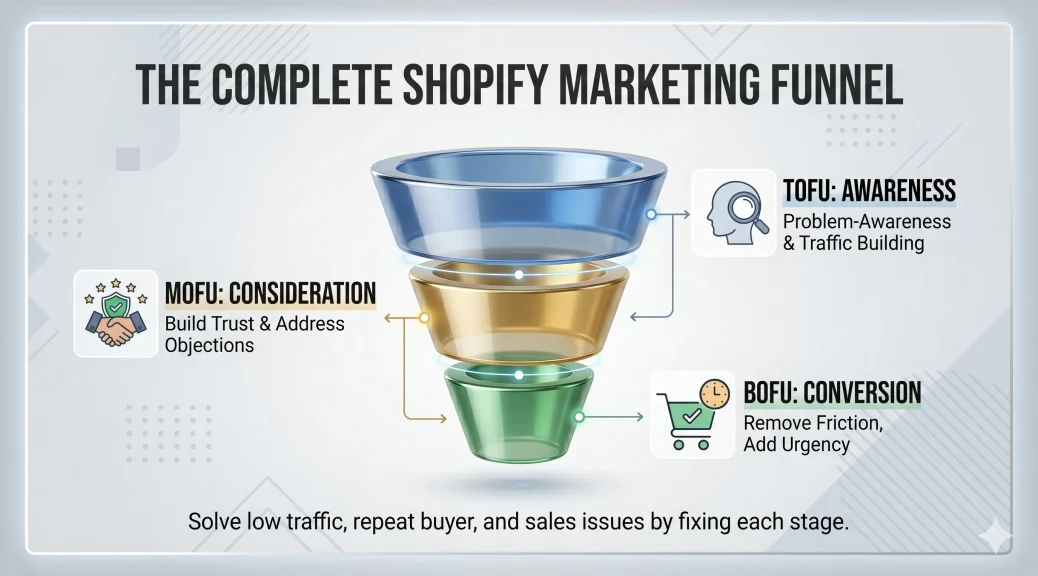
TOFU, MOFU, and BOFU give the Shopify marketing funnel its operating logic.
They are not separate campaigns or three different budgets.
There are three customer mindsets you need content and systems for simultaneously.
Expert Take:
Paid ads without owned content are a slow game, because every month you start from zero CAC. A well-structured Shopify marketing funnel cuts your blended CAC by compounding audience and trust assets that paid channels cannot replicate.
Basically, you need to know your audience well to determine at what stage they are and create strategies accordingly.
The first stage is awareness, which is right at the top of the funnel (TOFU)!
TOFU and the Shopify Marketing Funnel: Building Awareness That Compounds
TOFU is the stage where you reach people who have a problem but have not yet started shopping for a solution. They are not searching for your product. They are searching for answers to questions your product solves.
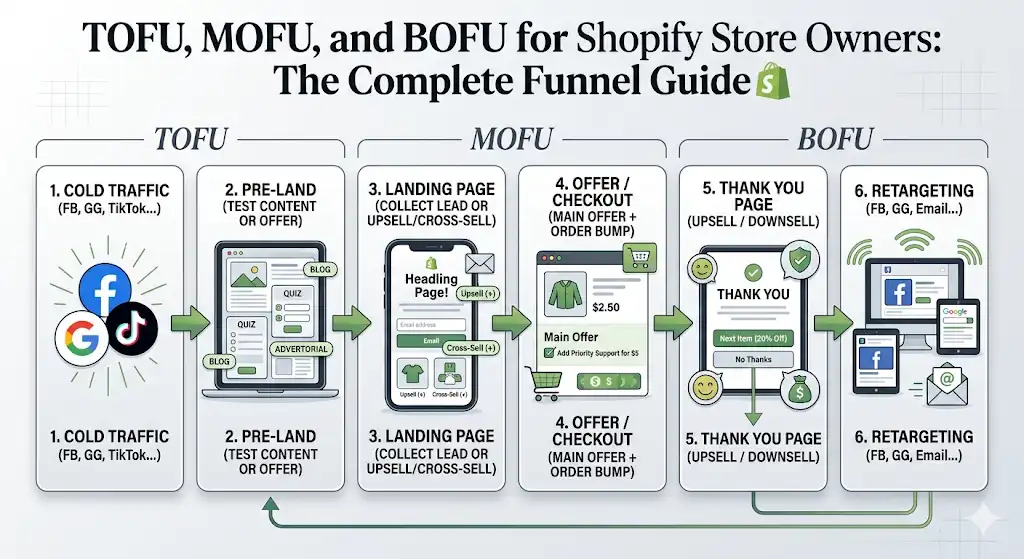
TOFU Content Types That Work for Shopify Store Owners
Strategizing TOFU MOFU BOFU for the eCommerce framework starts with content built for discovery, not conversion.
For Shopify store owners, effective TOFU content falls into five categories:
- Informational blog posts targeting problem-aware search queries,
- Short-form video on YouTube Shorts, Reels, and TikTok showing product application in real contexts
- SEO buying guides are structured around the questions your customer asks before they know your brand exists.
- Pinterest boards for visually driven categories, and user-generated content deployed to cold audiences on paid channels.
Expert Take:
SEO buying guides at TOFU are different from product pages. A buying guide answers the question before the customer knows which product they want. That intent gap is where organic traffic enters your funnel at near-zero marginal cost per visitor once the content ranks.
What a TOFU Win Actually Looks Like for Your Store?
Most Shopify store owners misread TOFU performance because they are measuring the wrong outcomes. A TOFU win is a new email subscriber, a social follower who did not previously know your brand, or an organic blog visit from a search term two levels above your product page.
Expert Take:
TOFU content is an infrastructure play, not a campaign. Two TOFU blog posts per month, sustained for six months, create a compounding organic traffic asset that continues to work after the ad budget ends.
MOFU and the Shopify Marketing Funnel: Where Most Stores Leak Revenue
MOFU is the consideration stage. Your potential customer knows they have a need. They are now evaluating how to meet it and which brand earns their trust enough to take their money. This is where most Shopify stores have the largest gap.
A prospect who enters your funnel through a blog post or a Reel does not automatically move to checkout. They need social proof.
They need to understand what makes your product the right choice over alternatives. Without deliberate MOFU systems, those prospects evaporate, and you end up paying again to reacquire them through retargeting.
Expert Take:
A well-built MOFU email sequence generates 25-30% of total store revenue without incremental ad spend.
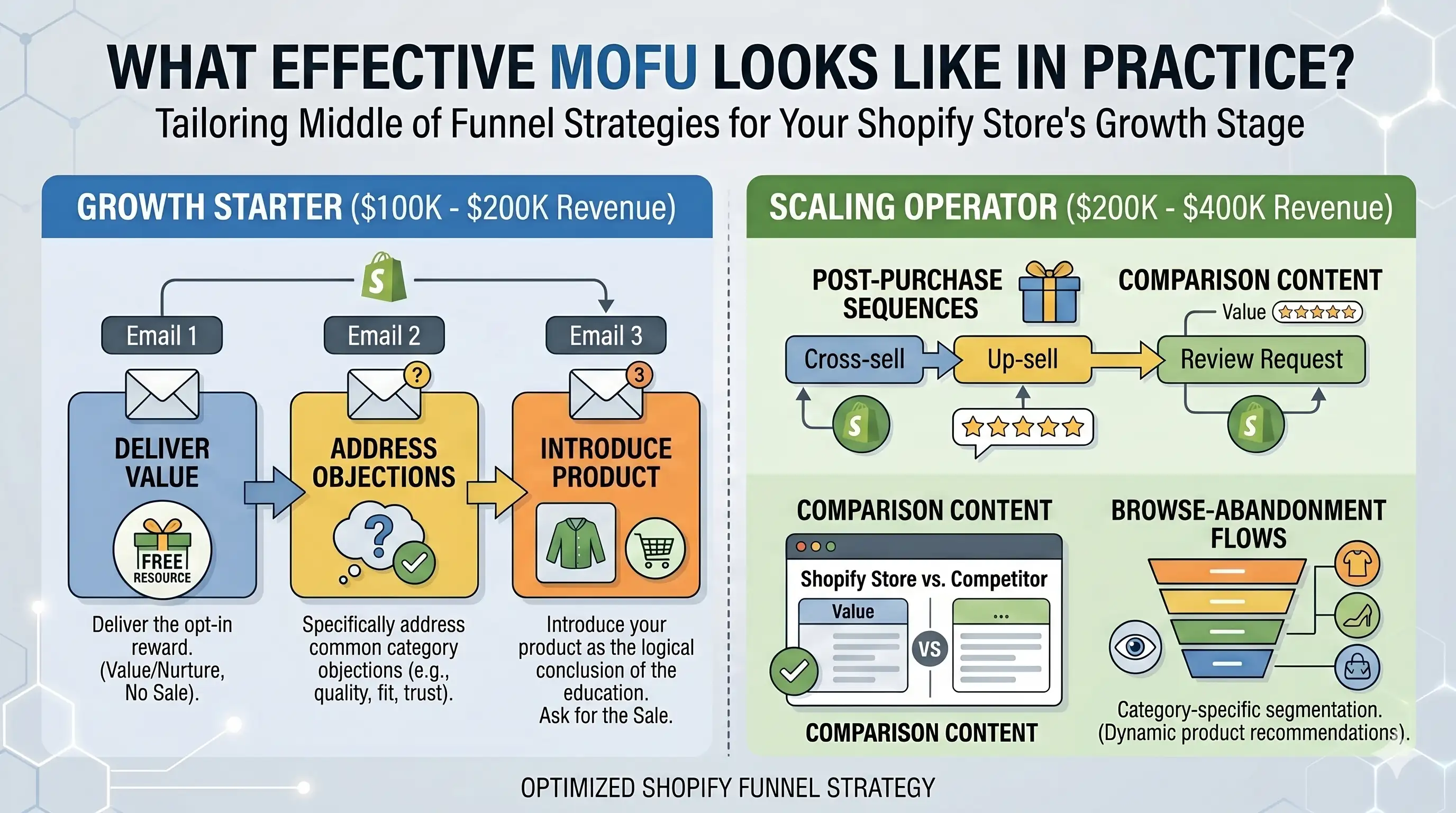
What Effective MOFU Looks Like in Practice?
For a Growth Starter ($100K-$200K), MOFU is a three-email educational sequence that does not ask for a sale until the third email.
- Email one delivers the value that earned the opt-in.
- Email two addresses, the most common objection in your category, with specificity.
- Email three introduces your product as the logical conclusion of what you taught them.
For a Scaling Operator ($200K-$400K), MOFU expands into post-purchase sequences, comparison content, and browse-abandonment flows segmented by category.
Expert Take:
Email campaigns that go straight to a discount offer are not MOFU. They are BOFU content sent to an MOFU audience. That mismatch trains your list to wait for discounts, compresses margin, and erodes brand authority over time.

BOFU and the Shopify Marketing Funnel: Converting Ready-to-Buy Customers
BOFU is best for enterprise-ready Shopify stores ($400K-$500K+), optimizing profitability per customer, not just top-line conversion. The bottom of the funnel is where conversion happens. Your customer is ready to buy. They need one final reason to choose you, delivered without friction.
The strategic mistake at BOFU is not usually the conversion tactic itself. It is building BOFU in isolation, without the TOFU and MOFU infrastructure that makes it cost-effective.
Without an owned audience built at TOFU and trust established at MOFU, every BOFU conversion requires cold-audience paid acquisition.
Practical BOFU Tactics That Actually Convert
Effective BOFU operates across three categories:
- Urgency and scarcity: limited-time offers, low-stock signals, countdown timers at checkout
- Trust builders: verified reviews on product pages, trust badges, prominent money-back guarantees
- Conversion architecture: one-click upsell at checkout, post-purchase sequences, win-back campaigns at 60 and 90-day lapse marks
Baymard Institute puts average ecommerce cart abandonment at 70.19% in 2025. For a store doing $100K per month, that is $165K in monthly revenue abandoned at the cart stage.
Expert Take:
At the $400K-$500K tier, declining profitability per customer is a BOFU architecture problem. Audit your discount trigger logic before touching your ad budget.
How to Run the Shopify Marketing Funnel as One Connected System
The full-funnel model delivers compounding advantages only when all three stages run simultaneously and feed each other. TOFU builds the audience. MOFU converts that audience into trust. BOFU converts trust into revenue and retention. Run only one or two stages, and the system breaks.
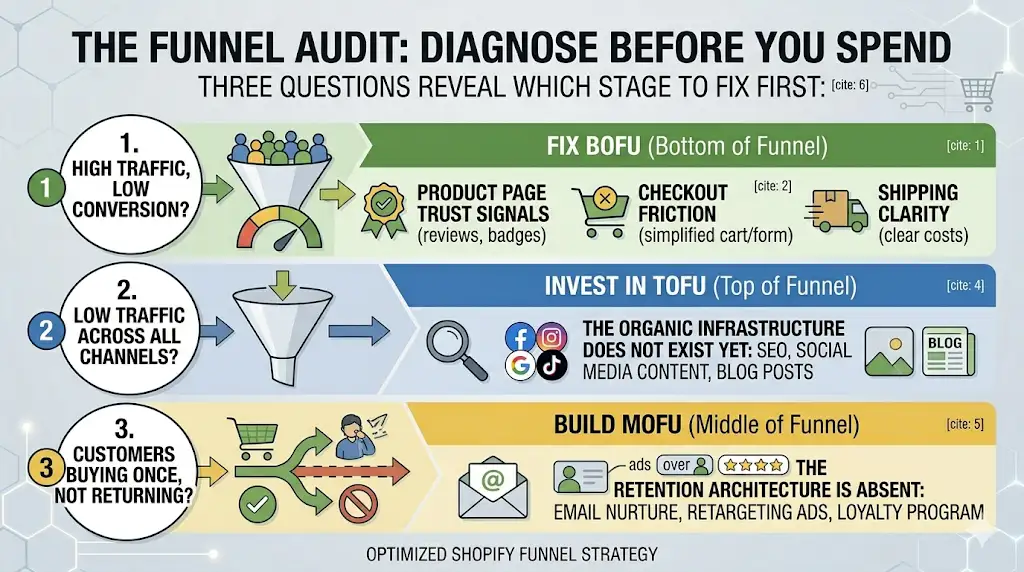
The Funnel Audit: Diagnose Before You Spend
Three questions reveal which stage to fix first:
- High traffic but low conversion? [Fix BOFU: product page trust signals, checkout friction, or shipping clarity is failing.]
- Low traffic across all channels? [Invest in TOFU: the organic infrastructure does not exist yet.]
- Customers buying once and not returning? [Build MOFU: the retention architecture is absent.]
Three Funnel Mistakes Shopify Store Owners Make (And How to Fix Them)
Here are some of the key funnel mistakes that you need to avoid as a Shopify store owner while creating a strategy for TOFU, MOFU, and BOFU content.
Mistake 1: Running Only BOFU Discount Ads
All budget goes to retargeting and lookalike audiences with discount offers. CPM rises, ROAS falls, margin compresses.
Fix:
Redirect 30% of BOFU ad spend into TOFU content production. Warm audiences cost less to reach and convert at higher rates. That shift improves ROAS without changing the ad platform at all.
Mistake 2: Email That Goes Straight to Selling
A promotional campaign sent immediately after opt-in treats MOFU prospects like BOFU buyers and burns the relationship before trust is established.
Fix:
A three-email educational sequence. It runs indefinitely at zero incremental cost and generates revenue from an audience you already paid to acquire.
Mistake 3: Blanket Pop-ups on First Load
Asking for an email address in the first five seconds is a BOFU move at TOFU timing. The visitor does not yet know why they should give you anything. Timing the ask to the right mindset stage is a TOFU/MOFU principle applied directly to on-site conversion.
Fix:
Remove the first-load pop-up entirely. Replace it with an exit-intent trigger that fires when the cursor moves toward the browser bar. Pair the ask with a specific value offer tied to what the visitor just read.
Stop Renting Revenue. Start Building a Funnel.
A Shopify store fully dependent on paid ads is not building a business. It is renting revenue from platforms that raise the rent every quarter. The Shopify marketing funnel is the architectural shift that changes that dynamic.
- TOFU builds an audience that compounds.
- MOFU converts that audience without incremental spend.
- BOFU closes warm buyers at a fraction of the cost of cold acquisition.
Most Shopify stores between $100K and $500K are one funnel audit away from finding $30K-$80K in recoverable revenue they are already paying to acquire.
QeRetail builds full-funnel growth systems for Shopify store owners: from TOFU content infrastructure to MOFU email sequences to BOFU CRO. If your ROAS is declining and your CAC is rising, that is not an ad problem. That is a funnel problem.
Talk to our eCommerce expert and find out exactly which stage is costing you the most. Book a free consultation with our expert Mr. Snehal Shah who has more than 25 years of experience in delivering scalable eCommerce solutions.
Frequently Asked Questions
What is a Shopify marketing funnel, and why does it matter at $100K-$500K revenue?
A Shopify marketing funnel is the system that moves customers from first awareness to repeat purchase using owned content and email sequences, not just paid ads. At $100K-$500K, it matters most because CAC is rising faster than revenue for almost every store in this tier, and a full-funnel strategy is the only operating model that reverses that without increasing ad spend.
How does TOFU MOFU BOFU for ecommerce differ from a standard content strategy?
TOFU MOFU BOFU for ecommerce maps every piece of content to a specific customer mindset rather than publishing without intent alignment. A standard content strategy produces blog posts without considering whether they reach problem-aware audiences at TOFU, consideration-stage prospects at MOFU, or ready-to-buy buyers at BOFU, which means most content produces traffic without conversion.
Why is MOFU the stage where most Shopify stores lose the most revenue?
MOFU is where prospects who entered through content or ads evaluate whether your brand earns their trust before purchasing. Most Shopify stores have no deliberate content or automation at this stage. The revenue loss is measurable: a missing MOFU email sequence means 25-30% of potential store revenue from an already-acquired audience never converts.
Which funnel stage should a Shopify store owner fix first if revenue has plateaued?
The diagnostic determines the priority: high traffic with low conversion is a BOFU problem, low overall traffic is a TOFU problem, and a first-to-second purchase rate below 27% is a MOFU problem. Fixing the correct stage first avoids the expensive mistake of buying more traffic when the conversion and retention architecture cannot yet turn that traffic into profit.
Can a solo founder or small team realistically run a full-funnel Shopify strategy?
Yes, and the minimum viable version is straightforward: two TOFU blog posts per month, one three-email MOFU sequence built once in Klaviyo, and BOFU CRO treated as an ongoing habit rather than a project. The compounding value comes from consistency over six to twelve months, not from volume or headcount.
Table of Contents