A store owner we worked with was about to make an expensive mistake.
He wanted to cut his SEO budget and pour all of it into AI search optimization.
ChatGPT was sending him traffic.
Everyone online kept saying SEO was finished. The move felt obvious.
Our team analyzed his site and conducted deep research.
Organic search, the free traffic that comes from Google, was his single biggest source of customers and revenue. It was beating every other channel he had.
Cutting that budget would not have pushed him forward. It would have quietly drained his sales for months before he ever noticed.
He is not alone. Around 32.9% of new shoppers first find a brand through a plain Google search. Yet store owners keep trying to replace SEO with AEO (Answer Engine Optimization) and GEO (Generative Engine Optimization), the newer tactics built for AI answers.
Here is the part most Shopify store owners miss. AI search does not invent its answers. It pulls them from websites Google already found and ranked. So replacing SEO with AEO and GEO quietly removes the very thing that feeds them.
This guide explains why, in plain language, with one real store’s numbers to prove it.
This guide covers:
- What SEO, AEO, and GEO actually are, in plain words
- Why AI search cannot work without SEO underneath it
- A real Shopify store’s numbers, shown in two screenshots
- What cutting your SEO budget really costs you
- The right order to build all three
Key Action Points
- Keep SEO as your base. Treat AEO and GEO as additions, never replacements.
- Fix the basics first. Make sure Google can find, read, and load every important page.
- Check your analytics before you move any budget. Find out what organic search actually brings in.
- Build one strong page that can serve Google, voice answers, and AI tools at once.
- Earn mentions on trusted outside sites. AI tools quote those far more than your own blog.

What Do SEO, AEO, and GEO Actually Mean?
Let’s understand each of these approaches individually.
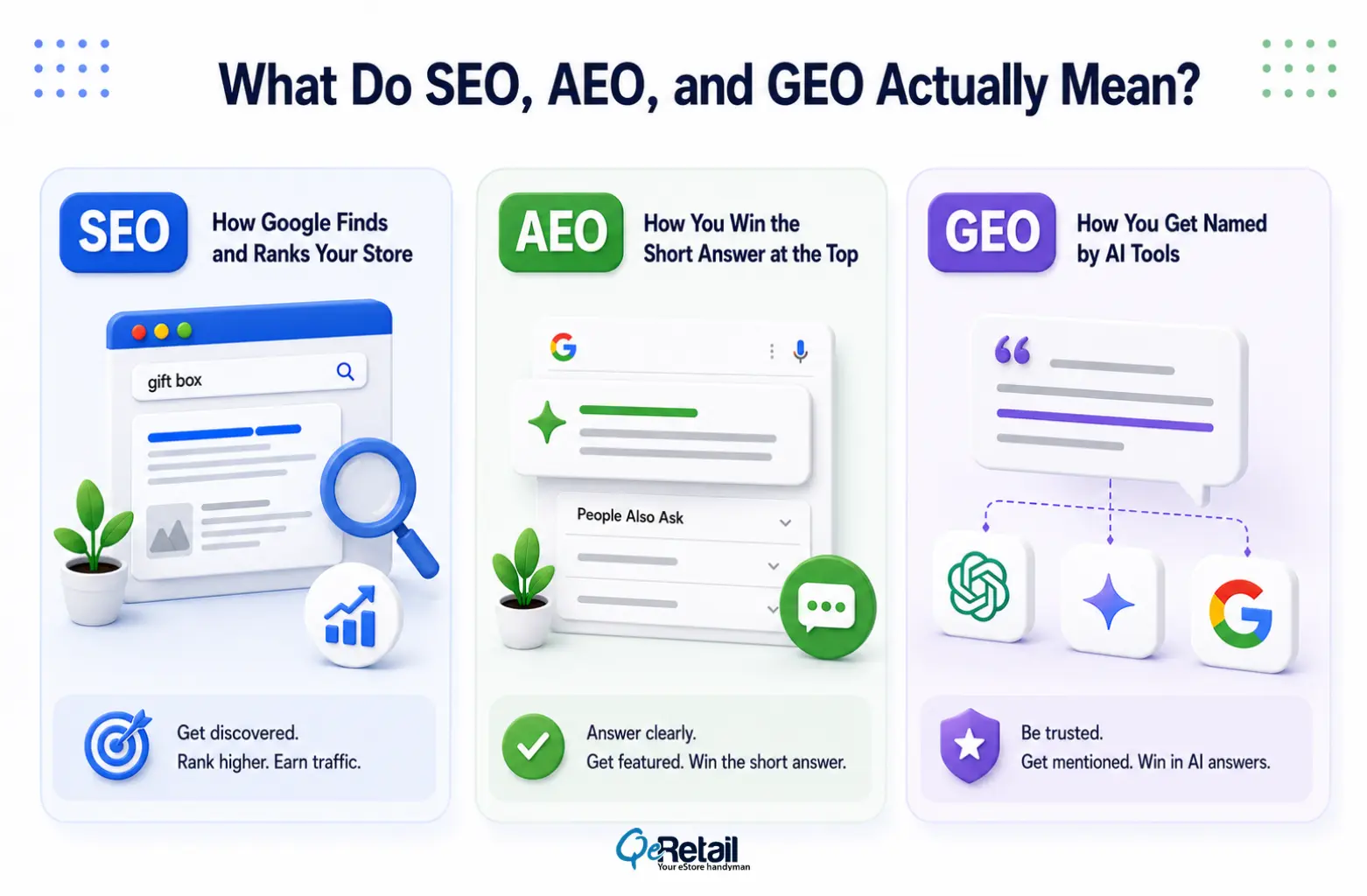
SEO is how Google finds and ranks your store
SEO (Search Engine Optimization) is the process of ensuring your web pages show up when someone types a question into Google. It is the reason a shopper searching for a gift box lands on your store instead of a competitor’s.
SEO is not a one-time setup. A page you rank today keeps bringing in free visitors for months or years after the work is done. That is why it pays back so well, and why losing it hurts so slowly that you may not notice until the damage is large.
AEO is how you win the short answer at the top
AEO (Answer Engine Optimization) is about getting picked for the quick answer: the box at the top of Google, the reply a voice assistant reads out loud, the ‘People Also Ask’ questions. You earn these by answering common questions directly and clearly, on pages Google already trusts.
GEO is how you get named by AI tools
GEO (Generative Engine Optimization) is about getting your brand mentioned and quoted inside answers from ChatGPT, Perplexity, and Google’s AI Overviews. AI tools quote sources they consider trustworthy.
Why AI Search Cannot Work Without SEO
Think of it as a three-floor building.
SEO is the foundation. AEO sits on the first floor: quick answers, voice results, snippets. GEO sits on the second floor: getting named and quoted by AI tools. Pull out the foundation, and both floors come down. There is no version where the upper floors stand on their own.
Here is the simple reason. When ChatGPT or Google’s AI responds to a shopper, it does not write that answer out of thin air. It grabs pages it already has on file, the ones Google found and saved, then rewrites them into an answer.
So what does that mean for your store?
If your site is slow, broken, or hard for Google to read, you have an SEO problem and an AI problem at the same time. You do not get to fix one without the other.
What One Real Store’s Numbers Show
Here is a real Shopify store we audited. The name is hidden for privacy, but the numbers are exactly as we found them.
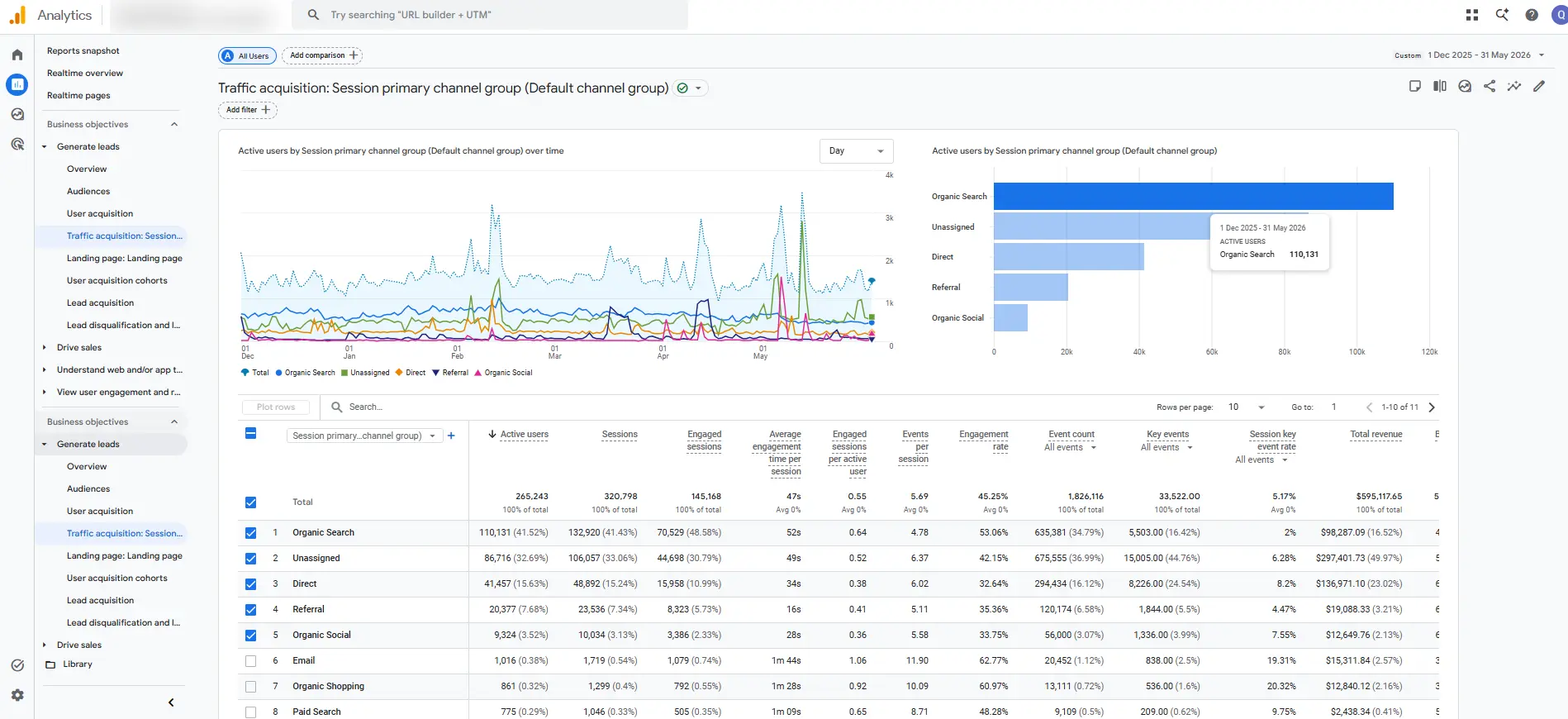
This is six months of traffic, sorted by where customers came from. Look at the top row. Organic search, the free Google traffic, brought in 110,131 visitors. That is 41.5% of everyone who reached the store, more than the next two sources combined. It also drove the most engaged sessions of any channel. This is not a small extra. It is the front door.
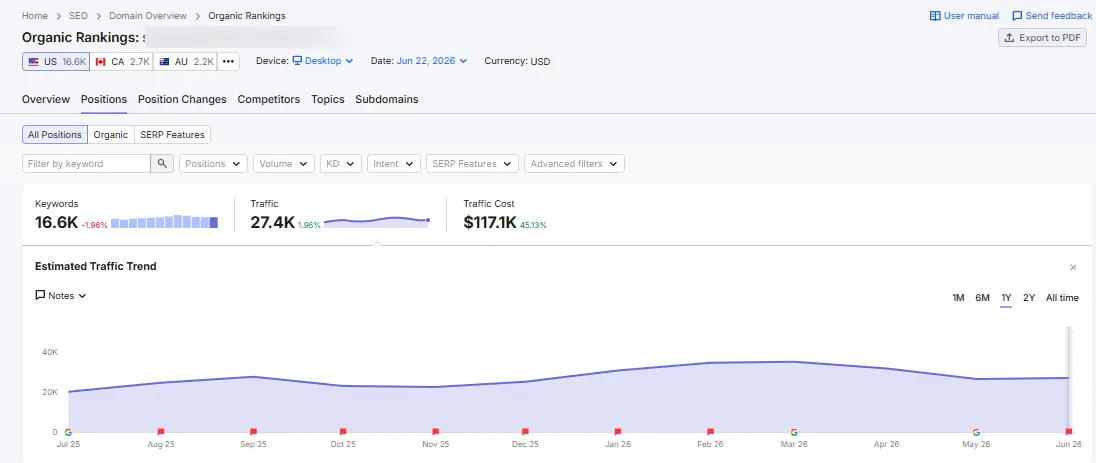
This second view shows why that traffic exists. The store ranks for 16,600 keywords on Google and pulls an estimated 27,400 visits a month from them. The line at the bottom is the last twelve months. It holds steady and even climbs. That is years of SEO compounding into a stable, growing stream of free customers.
Now, picture cutting the budget that built this. The rankings would not vanish overnight. They would fade slowly, month after month, while the dashboard still looked fine. By the time the drop became obvious, rebuilding it would take far longer.
Expert Take:
A store with 16,600 ranking keywords is not just collecting traffic. It is exactly the kind of trusted, established site AI tools prefer to quote. Replace the SEO behind those rankings with just AEO GEO, and you lose your Google traffic and your AI visibility in the same move, because both lean on the same foundation.

Why The Claim on SEO is Dead is Wrong?
Google processes approximately 14 billion searches per day. ChatGPT handles around 66 million search-like prompts daily, roughly 0.5% of Google’s volume. And, Google commands 90% of global digital queries. This means there is no point in avoiding Google.
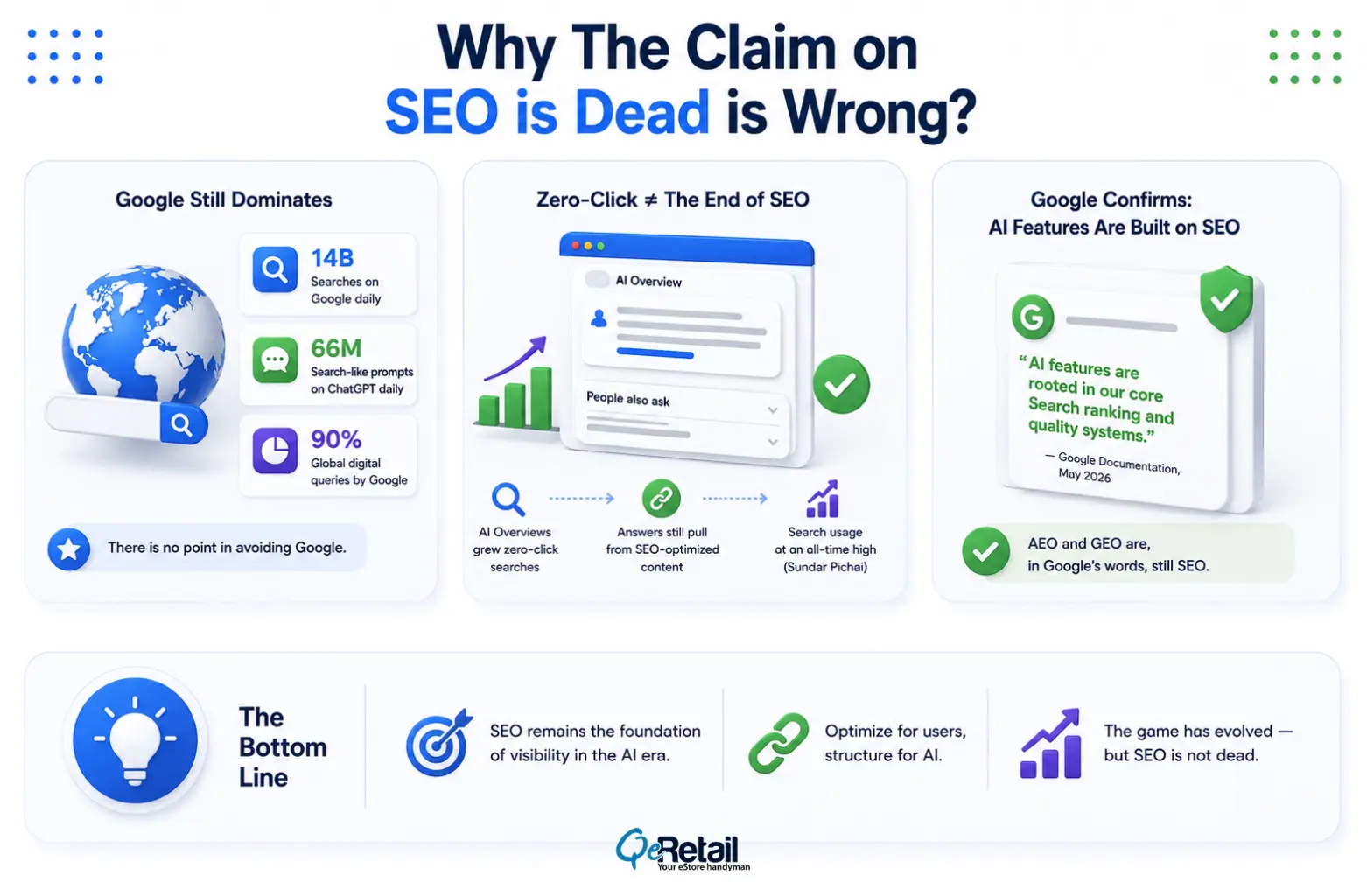
And yes, zero-click searches rose after Google’s AI Overviews launch. But it is not a shift away from SEO. It is a shift in how Google delivers answers. And those answers still pull from SEO-optimized content. Sundar Pichai confirmed on Google’s Q4 2025 earnings call that Search “had more usage in Q4 than ever before.”
More critically, Google’s own May 2026 documentation states that its AI features are “rooted in our core Search ranking and quality systems.” AEO and GEO are, in Google’s words, still SEO.
Experts Quote:
“We are very much thinking about AEO as an evolution of SEO,” said Aja Frost, Senior Director of Global Growth at HubSpot, in a Search Engine Land interview
“The what hasn’t changed, but the how has.” That distinction matters. SEO’s foundation relevance, authority, and structured content still drive what gets surfaced, whether in a blue link or an AI Overview.
What Cutting Your SEO Budget Really Costs
Take an example of a store doing $300,000 a year, that 23.6% is roughly $70,800 in orders coming from organic search. Cut your SEO, let organic traffic slip by even 30%, and you are staring at a $21,000 hole in yearly revenue.
There is a second reason this trade hurts. Shoppers still buy on Google. They may ask ChatGPT for ideas, but always choose to Google to buy. Pulling out of the channel where the purchase happens to chase the one where the browsing happens moves you backward.
And free traffic converts better anyway. Organic visitors buy at roughly 2.7%-3% on Shopify stores. Paid social sits between 0.7% and 1.2%. The same rising ad costs pushing you toward AI search are exactly why your free organic traffic is worth protecting, not cutting. (If ad costs are squeezing you, the fix is a leaner funnel, not abandoning the channel that already pays for itself.)
Expert Take:
SEO returns about 8x over time. Paid ads return about 4x, and only while you keep paying. You build SEO once, and it keeps working. You rent ads forever. No AI tactic changes that math.
Stack, Don’t Swap: The Right Order to Build
Here is the good news. You do not need three separate programs. You need one, built in the right order.
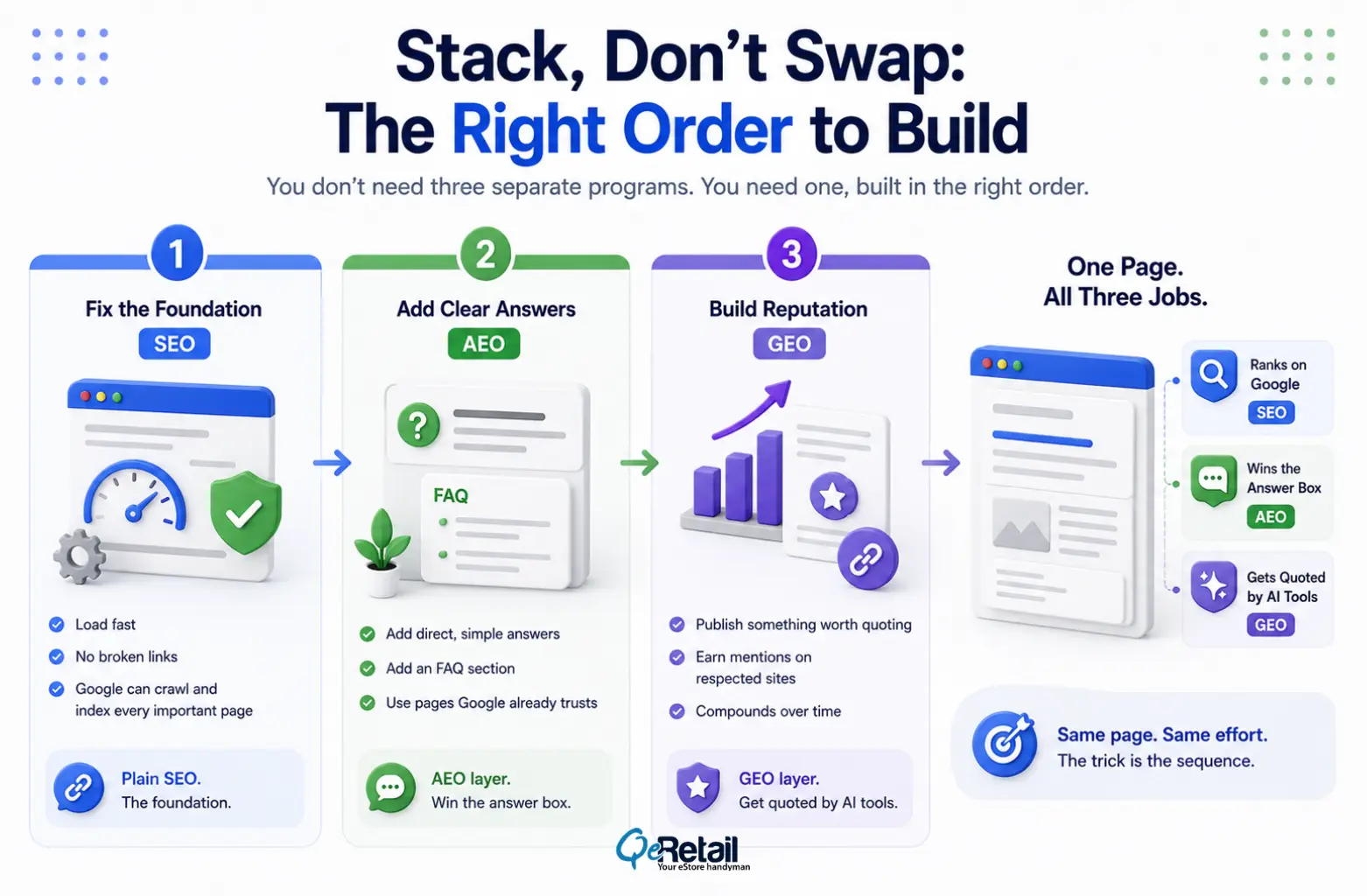
One well-made page can do all three jobs at once. It can rank on Google (SEO), win the answer box (AEO), and get quoted by Perplexity (GEO). Same page. Same effort. The trick is the sequence.
- Fix the foundation first. Make sure your store loads fast, has no broken links, and that Google can find and read every important page. This is plain SEO, and nothing above it works without it.
- Add clear answers on top. Take pages you already have and add direct, simple answers to the questions buyers actually ask. Add an FAQ section. This is the AEO layer, and it sits on pages Google already trusts.
- Build reputation last. Publish something worth quoting once a quarter, like original data or a real buyer guide, and earn mentions on respected sites. This is the GEO layer, and it compounds slowly.
Stop Chasing Channels. Start Building Foundations.
Most store owners treat SEO, AEO, and GEO as three separate races, then pick the newest one to run. That is the mistake.
There are not three races. They are one system, stacked, with SEO holding everything above it up. The stores winning search visibility in 2026 are not the ones that pivoted fastest to AI. They are the ones who kept their foundation strong and built the AI layers on top of it.
If you defunded SEO last year and now wonder why AI tools never mention you and never send you buyers, this is your answer. You did not upgrade your search strategy. You pulled out the foundation and waited for the upper floors to hold. They cannot.
You do not need a partner to chase every new channel for you. You need one that understands how SEO, AEO, and GEO fit together for a Shopify store at your revenue tier. QeRetail works with brands at the $100K to $500K stage to build search that compounds, not campaigns that expire.
Book a free consultation, and we will show you exactly what your organic search is worth before you touch a single budget line.
Frequently Asked Questions
Is SEO Still Worth Paying for in 2026?
Can AEO and GEO Work Without SEO?
Which Should I Do First: SEO, AEO, or GEO?
How Do I Know If My Store Shows Up in AI Answers?
How Long Before a Full Search Strategy Shows Results?
Table of Contents