You aligned your Shopify store marketing strategy according to the funnel,
Ensured every marketing effort focuses on awareness (Tofu), consideration (Mofu), and conversion (Bofu) stages.
And yet, something is killing your brand ROI!
What is it?
It’s the customer acquisition cost (CAC). In fact, CAC for most Shopidy store owners climbed to $68- $84 per order in 2026, with the average Google Ads cost per click increasing by 12.8% year over year.
So, playing by the same rules and running the same playbook that worked in 2024 will not work now.
What you need to understand is the changing customer behavior, platform preferences, and purchase patterns in 2026.
This piece is your next step towards Shopify profitability, once you have the TOFU, MOFU, and BOFU strategies ready.
Key Action Points:
- Send helpful follow-up emails after every purchase to bring customers back.
- Check how many customers buy from you again within 90 days.
- Promote products that customers usually come back to buy again.
- Keep product details clear, so AI shopping tools can easily find your store.
- Focus more on profit, not just getting more sales.
The Leaky Bucket Reality: CAC Rises Without Retention Infrastructure
The average Shopify store retains just 27% of customers for a second purchase. That means 73% of every dollar from an acquisition walks out the door after one transaction.
What this means is you pay full price to acquire them, deliver the product, and then see them disappear without any systematic effort to bring them back.
This is where retention systems become crucial!
Without retention systems, your CAC never improves. Each month, you start from zero, forced to re-acquire an audience you already paid for.
Your competitors who invested in retention are building cumulative customer bases, which means they can afford to outbid you in the same ad auctions.
LTV CAC Ratio eCommerce: The Metric That Reveals Whether Your Model Works
The Lifetime Value (LTV) to CAC ratio for eCommerce should be at least 3:1 for sustainable growth. Below 1:1, your business loses money on every customer over their lifetime.
Above 5:1, you are likely under-investing in growth and leaving market share open to competitors.
Most stores calculate this wrong, using projected LTV based on assumptions rather than actual cohort data showing behavior at 30, 60, and 90 days.
What can Shopify store owners do?
Check how many customers come back and buy again within 90 days. If most customers purchase only once and never return, your business needs a stronger retention strategy.
The Growth Starter ($100K-$200K): Focus on Post-Purchase Flow!
At this tier, 100% of customer acquisition flows through one or two paid channels. Any policy change or account suspension is existential. The fix is to build a three-email post-purchase sequence within 72 hours of purchase.
Post-purchase flows achieve 40-45% open rates and a 2-5x increase in 60-day repeat-purchase rates.
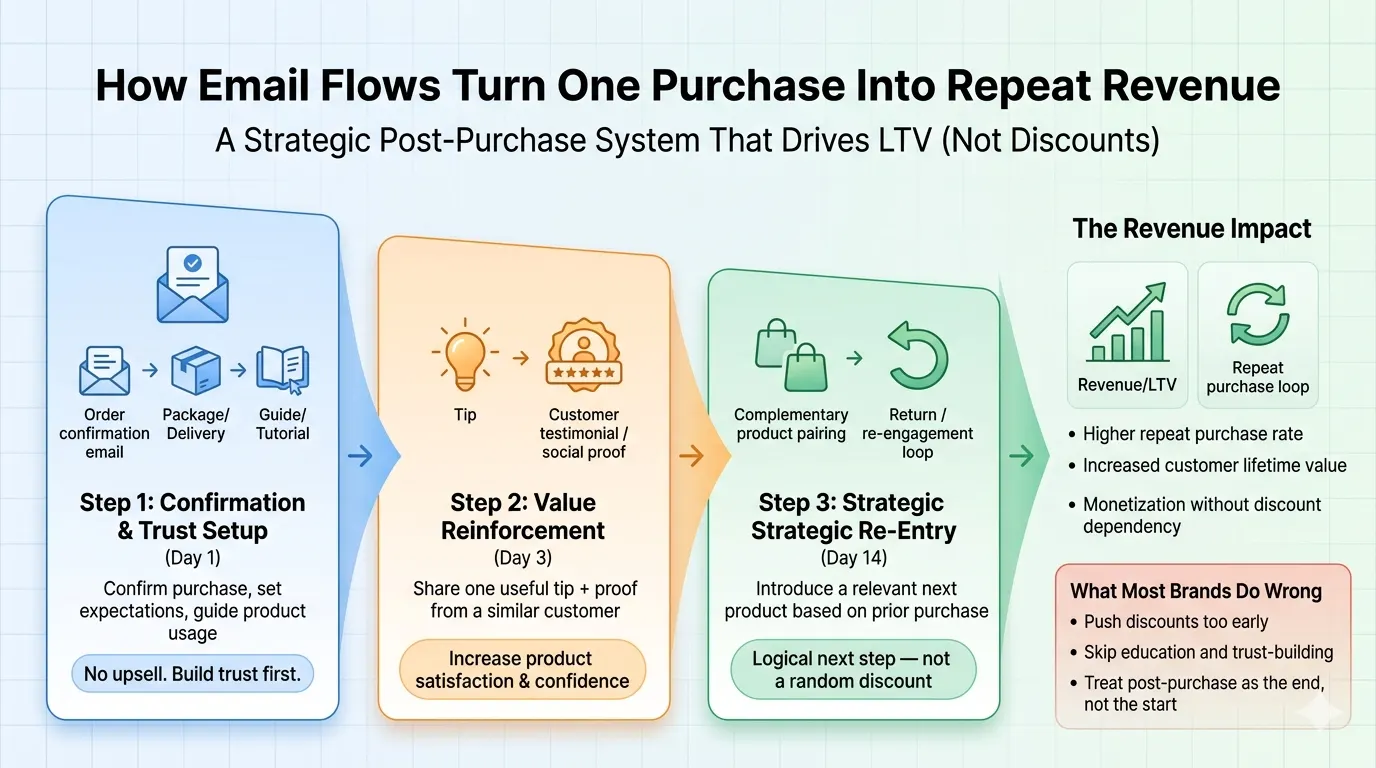
Email flows help you convert more and improve revenue.
- Email 1 (Day 1): Confirm purchase, set delivery expectations, and link a usage guide. No upsell.
- Email 2 (Day 3): Share one specific tip with social proof from a similar customer.
- Email 3 (Day 14): Introduce a complementary product with a logical, time-limited reason to return -not a blanket discount, a strategic next step based on what they already bought.
The gap between having a retention system installed and having a functioning post-purchase sequence is where most growth starters lose potential revenue.
The tool exists. The automation exists. Implementation is where most of them falter.
What can Shopify store owners do?
Create follow-up emails that genuinely help customers after they make a purchase. Share useful tips, product guidance, and relevant recommendations instead of sending only promotional offers.
The Scaling Operator ($200K-$400K): Create Data-Driven Email Marketing Plan!
At this tier, revenue grows, but profit does not.
You increased ad spend, revenue grew, but margin compressed because incremental customers cost more to acquire and purchased fewer times.
That revenue-profit divergence requires cohort-level analysis to diagnose, not creative iteration.
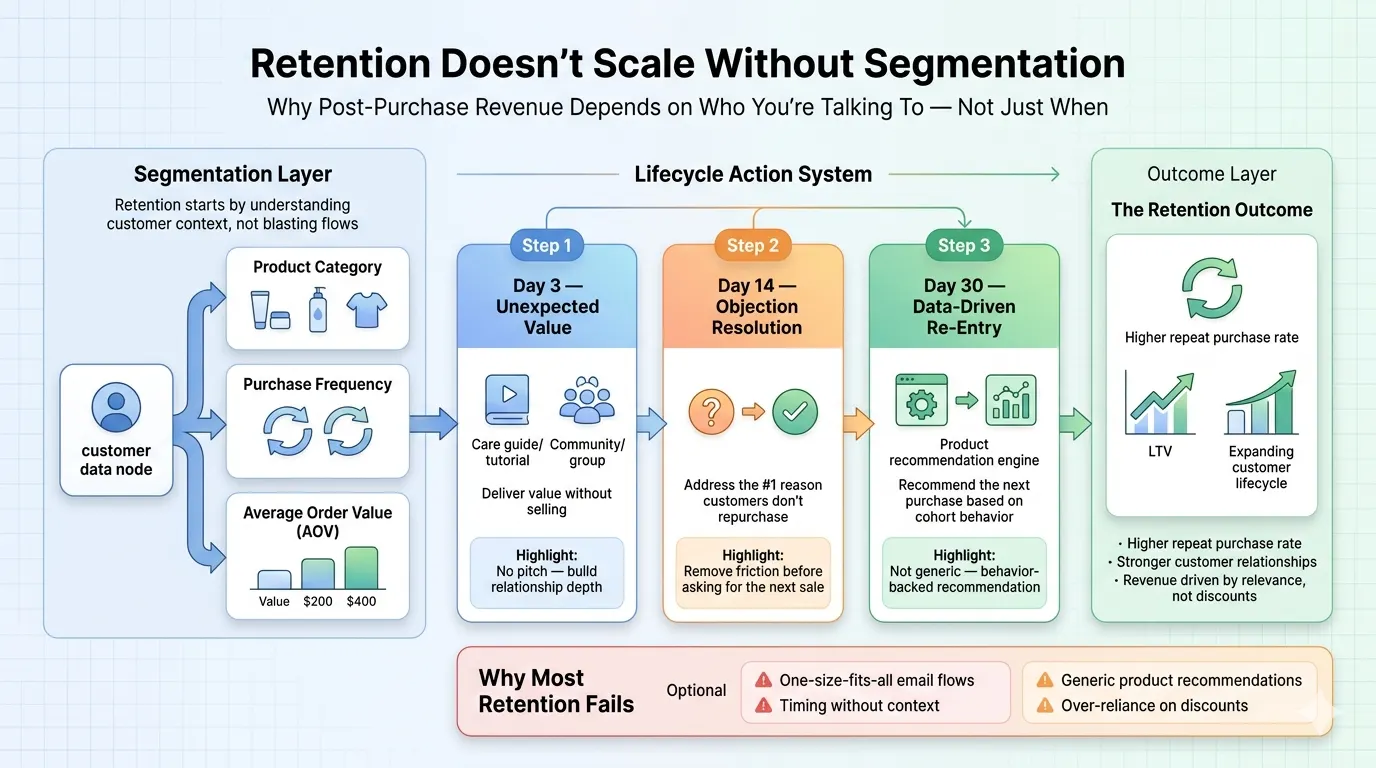
Retention here requires segmentation. Post-purchase flows must segment by product category, purchase frequency, and average order value.
- Day 3: deliver unexpected value – a care guide or community invitation, not a sales pitch.
- Day 14: name and resolve the single most common objection to a second purchase in your category.
- Day 30: present the logical next purchase based on actual cohort data, not a generic recommendation.
What can Shopify store owners do?
Identify which products drive repeat purchases. Then focus your email marketing and retention efforts around those products first.
The Enterprise-Ready Brand ($400K-$500K+): Focus on Data-Driven Investment & Agentic Commerce
Two compounding threats emerge at this tier. First, discount-driven acquisition trains customers to wait for sales, compressing margin on every subsequent order. Second, agentic commerce invisibility.
Audit Before You Invest
Gartner’s marketing technology research shows martech utilization dropped to 33% of stack capabilities. For brands running 15-20 apps, that means paying for tools producing no measurable revenue. Audit whether your existing stack functions as a connected system before adding another subscription.
Focus on AI-driven Traffic
Since January 2025, AI-driven traffic to Shopify stores has grown 8x year-over-year, and orders from AI-powered searches increased 15x, per Shopify’s agentic commerce momentum report.
AI agents in ChatGPT, Google AI Mode, and Microsoft Copilot now recommend products directly in conversations. If your product schema is not optimized for machine readability, your store is invisible to the fastest-growing acquisition channel in eCommerce.
What can Shopify store owners do?
Write clear product descriptions with accurate details, sizes, materials, and practical use cases so both customers and AI shopping tools can easily understand your products.
Retain Smarter, Not Acquire Faster
McKinsey’s personalization research confirms that companies that execute advanced personalization generate 40% more revenue than competitors, with revenue lifts of 5-15% and marketing efficiency gains of 10-30%.
Customer acquisition cost in eCommerce will not decrease in 2026. Platform consolidation, privacy regulation, and auction inflation show no signs of reversing. The stores that survive this cycle are the ones that start treating retention as the foundation on which everything else builds.
And if you are one of them, our eCommerce expert can help you overcome the challenges of higher CAC. All you need is a consultation call. So, book a call now.
Frequently Asked Questions
What is a healthy LTV to CAC ratio for Shopify stores in 2026?
A healthy LTV CAC ratio for eCommerce benchmarks is 3:1, meaning every dollar spent on acquisition generates three dollars in customer lifetime revenue. Ratios below 1:1 indicate structural loss per customer, while anything above 5:1 signals underinvestment that competitors will exploit.
How does agentic commerce reduce customer acquisition cost for DTC brands?
Agentic commerce allows AI shopping agents in ChatGPT, Google AI Mode, and Microsoft Copilot to recommend products directly within conversations at zero media cost per impression. DTC brands with structured product data and machine-readable policies become discoverable without entering paid ad auctions, creating a near-zero-marginal-cost acquisition channel.
Why is the post-purchase email sequence the highest-ROI retention tactic?
For stores under $200K with no existing retention infrastructure, this single automation converts customers already acquired who would otherwise never return.
Can a Shopify store reduce CAC without cutting ad spend?
Reducing customer acquisition cost in eCommerce without cutting ad budget requires building owned channels, email, organic content, and referral systems that acquire customers at near-zero marginal cost after initial setup.
Which retention metric should Shopify store owners track first when profit margins decline?
The first retention metric to track is the 90-day repeat-purchase rate, segmented by first-purchase product category, because it reveals both post-purchase system health and which product lines naturally generate repeat buyers.
Table of Contents