What Shopify stores are missing right now is that most BFCM buyers for a hero product are already inside the funnel. Since last year, the share of shoppers planning to start holiday shopping before Black Friday has jumped from three in four to nine in ten, according to Accenture’s 2026 holiday survey. And this is why your top seller has been price-compared for weeks before a single code goes live.
Deloitte’s 2025 survey found that 49% of shoppers rank a great deal as the top attribute when choosing where to shop. Most stores answer that by slashing the hero product’s price, because everyone expects it. A discount rarely creates that buyer, though.
It lowers the price for a buyer already in your funnel (an inference, so test it on your own data).
So, what should a store settle before it touches a discount code?
The variable that decides BFCM pricing is the margin left on each unit, not the revenue target most stores price against. Especially running that margin math on the hero product before the sale opens is what keeps a busy week from turning into a loss.
The three-step contribution margin test helps you find your unit margin, calculate break-even unit lift, and check it against the lift your last sale proved. What comes out is a green, amber, or red answer, and it arrives before you touch a discount code.
Key Action Points
- Take the hero product’s selling price and subtract variable costs per unit: product cost, fulfillment, payment fees, and a returns allowance. What remains is the profit each sale actually earns.
- Multiply the discount per unit by the units you would have sold at full price anyway, and you have the profit handed to shoppers who would have bought regardless.
- Each discount under consideration (10%, 15%, 20%) needs its own number: the extra units required to recover the giveaway cost.
- Last, check how much unit sales rose during your previous sale, then measure that against each break-even figure.

Why Do Most Shopify Stores Discount Their Hero Product by Reflex?
A hero-product discount is not a promotion. It is a price cut handed to every buyer who was already coming.
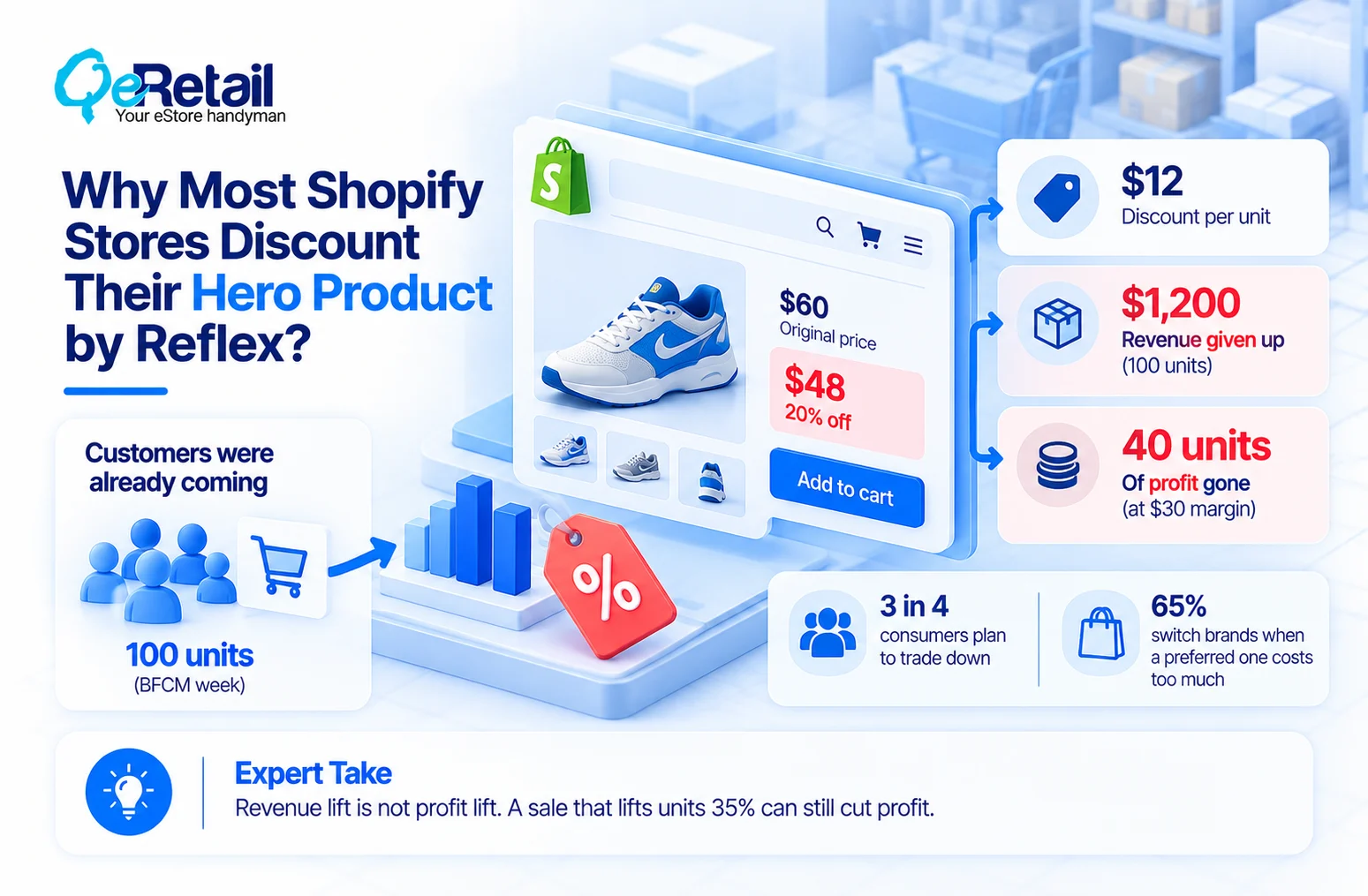
The discount in dollars multiplied by the units you would have sold anyway. Say a $60 product sells 100 units over BFCM week. A 20% discount costs $12 a unit, so you hand back $1,200 before one new customer arrives.
At a $30 margin per unit, that is 40 units of profit gone.
Sometimes you should discount anyway. McKinsey’s 2025 holiday research found three in four consumers plan to trade down, and Deloitte found 65% switch brands when a preferred one costs too much.
So the question is how deep, and whether your margin survives it.
Expert Take:
Revenue lift is not profit lift. A sale that lifts units 35% can still cut profit, and a dashboard that tracks revenue will call it a win.
The 3-Step Contribution Margin Test
Run this on your hero product before you set a BFCM price. The figures below are an illustrative example, not store data. Swap in yours.
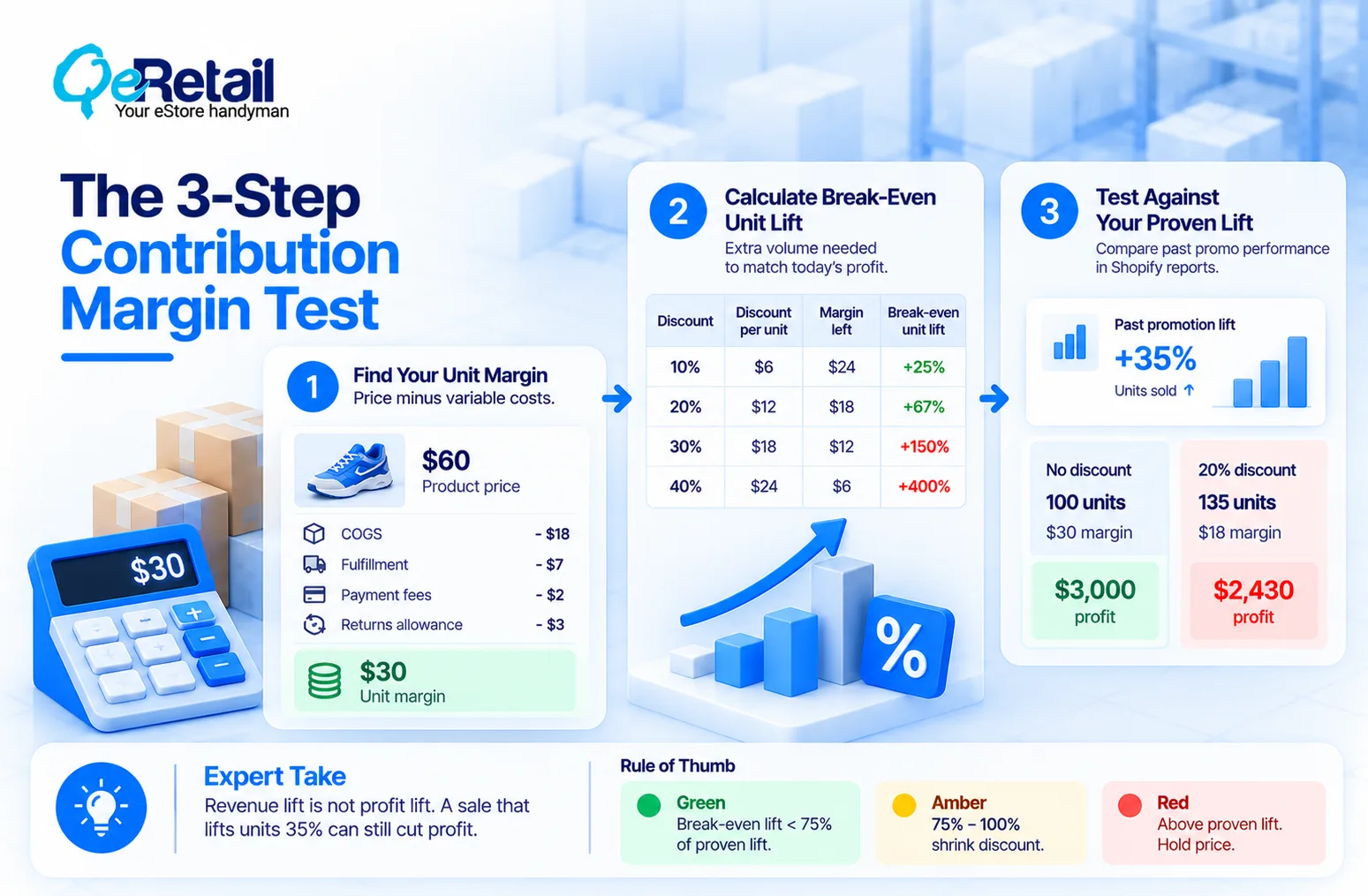
Step 1: Find Your Unit Margin
Contribution margin is what each unit leaves after the costs that move with it. Take the price, then subtract COGS, fulfillment, payment fees, and a returns allowance. Leave ad spend out for now.
Example: $60 price, minus $18 COGS, $7 fulfillment, $2 payment fees, and $3 returns allowance leaves $30.
Step 2: Calculate Break-Even Unit Lift
Divide the discount in dollars by the margin left after it. The result is the extra volume you need to match today’s profit, with costs held constant.
| Discount | Discount per unit | Margin left | Break-even unit lift |
| 10% | $6 | $24 | +25% |
| 20% | $12 | $18 | +67% |
| 30% | $18 | $12 | +150% |
| 40% | $24 | $6 | +400% |
At 40% off, you need five times your normal volume just to break even.
Step 3: Test Against Your Proven Lift
Compare units sold in your last promotion with an equal period before it in your Shopify reports. Say it lifted units 35%. Run 20% off again, and you sell 135 units at $18 margin, or $2,430. Without the discount, 100 units at $30 earn $3,000. The sale “worked” and cost you $570.
Use this rule of thumb (a working hypothesis, not a benchmark).
- Green: break-even lift is under 75% of your proven lift.
- Amber: 75% to 100%, so shrink the discount or change the mechanic.
- Red: above your proven lift, so hold price. Our example is red, since 67% beats 35%.
Three things can move amber to green: repeat purchases from first-time buyers, stock that covers the lift plus reorder cash, and a code limited to new customers.

How Should Each Revenue Tier Run the Test?
The test is the same. The constraint changes.
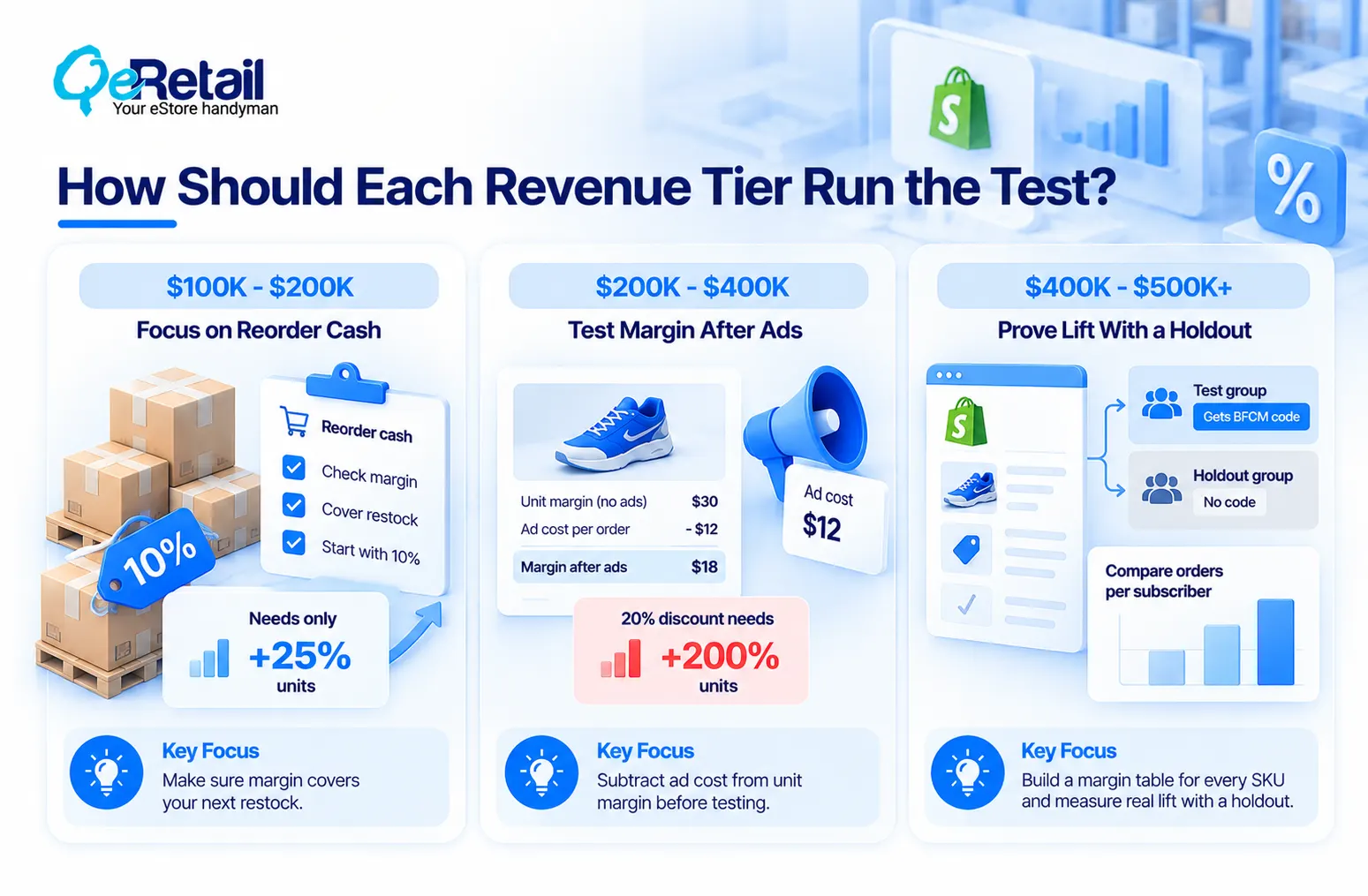
If You Have 100K-200K Revenue, Focus on Reorder Cash!
Your risk is cash, not conversion. If the discount leaves less margin than your restock bill, you funded a sale you cannot repeat. Start with the 10% row, which needs only +25% units.
If You Have 200K-400K Revenue, Test Margin After Ads!
For ad-driven sales, subtract your cost per order from unit margin first. At $12 ad cost, margin drops to $18, and a 20% discount now needs +200% units. Our guide to reducing Shopify customer acquisition cost covers the ad side.
If You Have 400K-500K Revenue, Prove Lift With a Holdout.
Build a margin table for every SKU, then hold back a random email segment that gets no code. The gap in orders per subscriber is your real lift.
What to Offer Instead of Percent-Off?
So what do you do when the test says red and competitors shout 30% off?
(Your price is not the only lever. Your mechanic is.)
Try these,
- Bundle: pair the hero product with a slower SKU and discount the bundle, so the hero’s price stays intact.
- Gift with purchase: a free item costs you its COGS, not a price cut on every unit.
- Spend threshold: reward a set cart value to lift order size, not cut unit price.
- Subscriber early access: give your list first access to stock, not a lower price.
Stop Discounting out of Habit. Start Pricing for Profit.
Most stores cut hero-product prices because it feels expected. The dashboard shows revenue up, so nobody checks the cost.
If you discounted without knowing your break-even lift, you did not run a promotion. You gave away margin and called it growth. The decision is not whether to run BFCM. That decision is made. The decision is whether your hero product earns its discount.
Frequently Asked Questions
Should I Discount my Top-Selling Product on Black Friday?
How Much Discount Can a Shopify Store Afford on BFCM?
How do I Calculate Break-Even for a BFCM Discount?
Can a Small Team run This Before BFCM?
Table of Contents