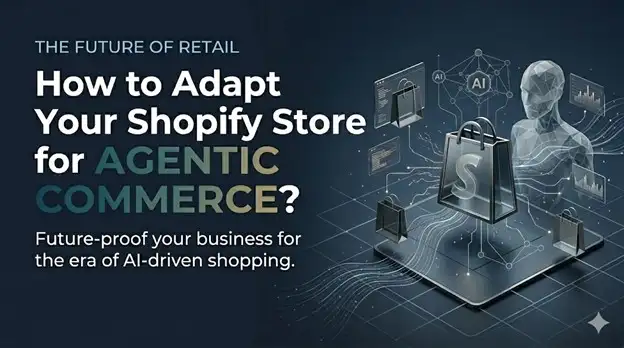
Since January 2025, AI-driven traffic to Shopify stores has grown 8x year over year. Orders from AI-powered searches increased 15x.
This is not a forecast. It is happening right now, while most Shopify store owners are still optimizing for Google clicks that are quietly losing relevance. ChatGPT, Perplexity, Google AI Overviews, and Amazon Rufus now recommend products directly inside conversations.
A consumer asks, “What’s the best sunscreen for sensitive skin under $30?” and AI agents return specific product names without requiring a search results page. Your store is probably invisible to all of them.
Not because your SEO is bad, but because your product pages were built for humans clicking links, not machines reading structured data.
This piece breaks down what agentic commerce is, why AI agents cannot find most Shopify stores, and how to fix it with a concrete 30-day framework.
Key Action Points:
- Understand that AI-driven traffic is already here, not a future consideration
- Add JSON-LD product schema to every product page
- Build FAQ structured data targeting “best X for Y” queries in your category
- Create comparison content that AI agents pull from when answering shopping questions
- Monitor AI referral traffic separately in Google Analytics 4 using UTM parameters
- Treat agentic commerce optimization as the new TOFU

What Is Agentic Commerce?
Agentic commerce is the shift from consumers using search engines to find products to AI agents doing that search on their behalf. Instead of typing “best running shoes for flat feet” into Google and clicking five product pages, the shopper asks ChatGPT. The AI reads, compares, and recommends specific products in a single response, citing only sources it can parse and trust.
Key Platforms Reshaping Discovery Right Now:
- ChatGPT Shopping – Product recommendations appear directly in chat, with product cards linking to store pages
- Perplexity Product Search – Shopping queries return cited product recommendations pulled from structured data
- Google AI Overviews – AI-generated summaries appear above organic results, reducing click-through on standard listings
- Amazon Rufus – Amazon’s AI assistant recommends products using catalog and review data within the app
Expert Take: Agentic commerce is not replacing SEO. It is a layer on top. Stores with structured data, entity-rich content, and machine-parseable product pages will win traffic from both traditional search and AI agents simultaneously.
Why Most Shopify Stores Are Invisible to AI Search?
The gap between the AI agents that store recommendations and the stores they ignore stems from the agents’ limited machine readability. AI agents cannot read a hero image, interpret styled fonts, or decode visual design. They need structured, tagged, machine-parseable data.
Most Shopify stores have not built that infrastructure.
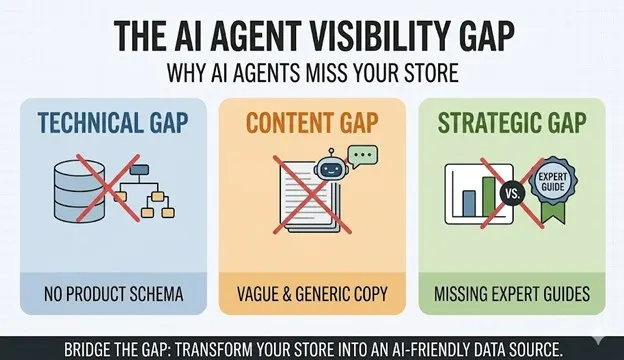
Here is exactly where they fail:
Problem 1: No JSON-LD Product Schema
Without it, an AI cannot reliably extract your product name, price, availability, or reviews. It sees unstructured HTML and moves on to a competitor whose data is clearly labeled.
Problem 2: No FAQ Structured Data
The FAQ schema signals to AI agents that your page directly answers specific questions. Without it, your product page has nothing to offer in response to a conversational search query.
Problem 3: Generic Product Descriptions
“Great quality. Fast shipping. Loved by thousands,” tells an AI agent nothing. It cannot extract ingredients, materials, use cases, or specifications from marketing copy. Every vague description is a missed data point.
Problem 4: No Comparison Content
AI agents that answer “best X for Y” queries draw on comparison articles and buying guides. If your site has no content answering “best [your product] for [specific use case],” the AI has nothing to cite.
Expert Take: Most Shopify themes generate zero structured data by default. The page a shopper sees looks complete. The data structure an AI agent reads is nearly empty. That gap is where your agentic commerce visibility lives or dies.
The 3-Layer Agentic Commerce Optimization Framework
Layer 1: Product Schema (Technical, One-Time)
JSON-LD product schema is the foundation. Every product page needs it. Include: product name and brand, price and currency, availability, aggregate rating, attribute-rich description (150+ words minimum), SKU and GTIN, and at least three product image URLs.
Install a dedicated schema app or add custom JSON-LD via a Liquid snippet in your theme. The Liquid approach gives full control but requires developer involvement.
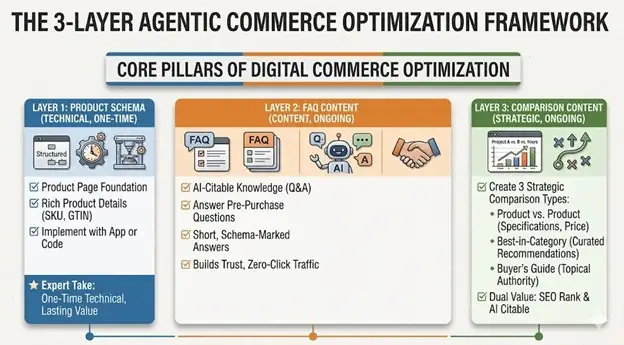
Layer 2: FAQ Content (Content, Ongoing)
The FAQ schema converts your product knowledge into AI-citable Q&A pairs. Start with the ten most common pre-purchase questions:
- “Is [product] right for [specific skin type/use case]?”
- “What is the difference between [Product A] and [Product B]?”
- “How long does [product] last with daily use?”
- “Is [product] safe for [specific concern: sensitive skin, pregnancy, children]?”
Each entry should be 80 to 120 words, in plain language, marked up with the FAQ schema. AI agents love this format. It is exactly how they process and cite information.
Layer 3: Comparison Content (Strategic, Ongoing)
Create three types:
- Product vs. Product – specifications, price, and use-case fit side by side
- Best-in-Category – positions your product within curated recommendations for a specific use case
- Buyer’s Guide – entity-rich content that builds topical authority in your category
This content does double duty: it ranks in traditional organic search and gets cited in AI agent responses.
30-Day Agentic Commerce Implementation Roadmap
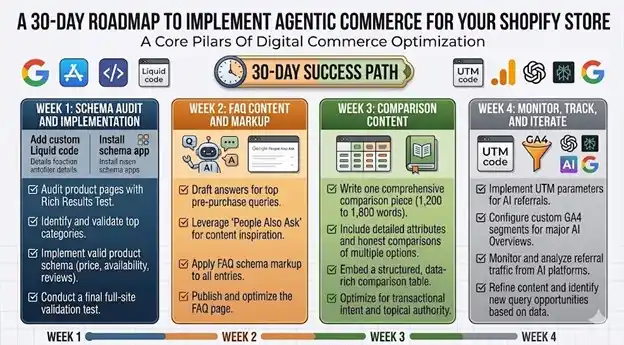
Week 1: Schema Audit and Implementation
Audit every product page using Google’s Rich Results Test. Install a schema app or add custom Liquid code. Prioritize bestsellers first. Deliverable: schema validated on top 20 products, each returning a “Product” rich result with price, availability, and reviews.
Week 2: FAQ Content and Markup
Build 10 FAQ entries targeting the highest-volume pre-purchase questions. Start with queries appearing in Google’s “People Also Ask” boxes, as those are exactly what AI agents are fielding. Deliverable: an FAQ page that returns a rich result with individual Q&A pairs visible.
Week 3: Comparison Content
Write one comparison piece targeting a “best [product] for [use case]” query. Use real attributes and honest comparisons. Include your product, but not as the only option, since AI agents distrust obviously promotional content. Target 1,200 to 1,800 words, include a structured comparison table, and add FAQ schema to the article’s Q&A section.
Week 4: Monitor, Track, and Iterate
Set up UTM parameters for AI platform referrals. In GA4, create a custom segment for traffic from ChatGPT, Perplexity, and Google AI Overviews. Check these platforms weekly for your category queries, and iterate on content based on which queries are most likely to cite your store.
Expert Take: Weeks 1 through 3 have clear deliverables and completion states. Week 4 is where most stores drop off. The stores that treat monitoring as a monthly habit compound their AI visibility. Stores that stop after Week 3 get outpaced.

Stop Paying for Costly CPMs. Start Winning AI Traffic.
Agentic commerce is the answer, but only for stores that build the infrastructure now. The stores that implement product schema, FAQ content, and comparison assets in 2026 will capture zero-click traffic at zero marginal cost. The stores that do not will keep paying full price for shrinking returns.
Agentic commerce is the new TOFU. If you want to understand how it fits into your full-funnel strategy, from AI discovery to email nurture to checkout, read our complete TOFU, MOFU, and BOFU guide for Shopify store owners.
And if rising CAC is already squeezing margins, see how agentic commerce fits into a full CAC reduction strategy in our guide to reducing customer acquisition cost for Shopify stores.
Not sure where your store stands?
Book a free consultation, and we will audit your Shopify store to identify the exact gaps that are making you invisible to AI agents.
Frequently Asked Questions
What Is Agentic Commerce and How Is It Different from Traditional Ecommerce SEO?
Traditional ecommerce SEO optimizes for human searchers who click on Google results. Agentic commerce optimizes for AI agents such as ChatGPT, Perplexity, and Google AI Overviews that recommend products directly within conversations.
How Long Does It Take to See Results?
Schema implementation is fastest. Google typically crawls updated schema within 1 to 4 weeks. FAQ and comparison content take 4 to 8 weeks to appear in AI-generated responses. Meaningful AI referral traffic typically becomes measurable within 60 to 90 days of full implementation.
Do I Need a Developer to Implement JSON-LD Schema on Shopify?
Not necessarily. Apps like Schema App and SEO King add product schema automatically without code changes. For full control over schema fields, including GTIN, custom attributes, and specific review data, a developer implementing a custom Liquid snippet can achieve greater precision.
Will Agentic Commerce Optimization Hurt My Existing Google SEO?
No, it strengthens it. Product schema, FAQ markup, and structured comparison content simultaneously improve rich result eligibility in traditional Google search. The only caution is thin comparison content written purely for AI citation without genuine value, which risks a quality penalty. Every piece should serve the reader first.
Table of Contents