Shipping is still the biggest fixable leak in ecommerce. Baymard Institute puts the average cart abandonment rate at 70.22%, and once you set aside shoppers who were only browsing, extra costs like shipping are the largest reason people quit at checkout.
Most stores answer with one free shipping threshold and one flat rate, then absorb every exception by hand.
That holds until your policy stops being a number and becomes a condition. Free shipping over $75, except for furniture. $8 for apparel, freight for glassware.
Wholesale buyers on different terms than retail. Those are not rate problems. They are logic problems, and Shopify’s shipping settings were never built to hold logic.
So the question is not “what are Shopify Functions?” It is this: what shipping rule can your settings not express, and is fixing it worth the cost?
This article answers all your questions by providing
Key Action Points:
- Export 90 days of orders and count the carts your threshold subsidized incorrectly.
- Separate rules that hide a rate from rules that change one. Different APIs.
- Check your plan first. Custom app Functions need Plus.
- Price the leakage in dollars per year before approving a build.
- Test the app route first. Most conditional rules cost under $75 a month.
- Retest every rule against mixed carts before launch.

Where Shopify’s Native Shipping Settings Stop Working
Native shipping does more than most owners credit it for. Shopify supports flat rates, free shipping, price and weight conditions, zones, and carrier-calculated rates inside shipping profiles. If your policy is unconditional, you do not need a developer. You need thirty minutes in settings.
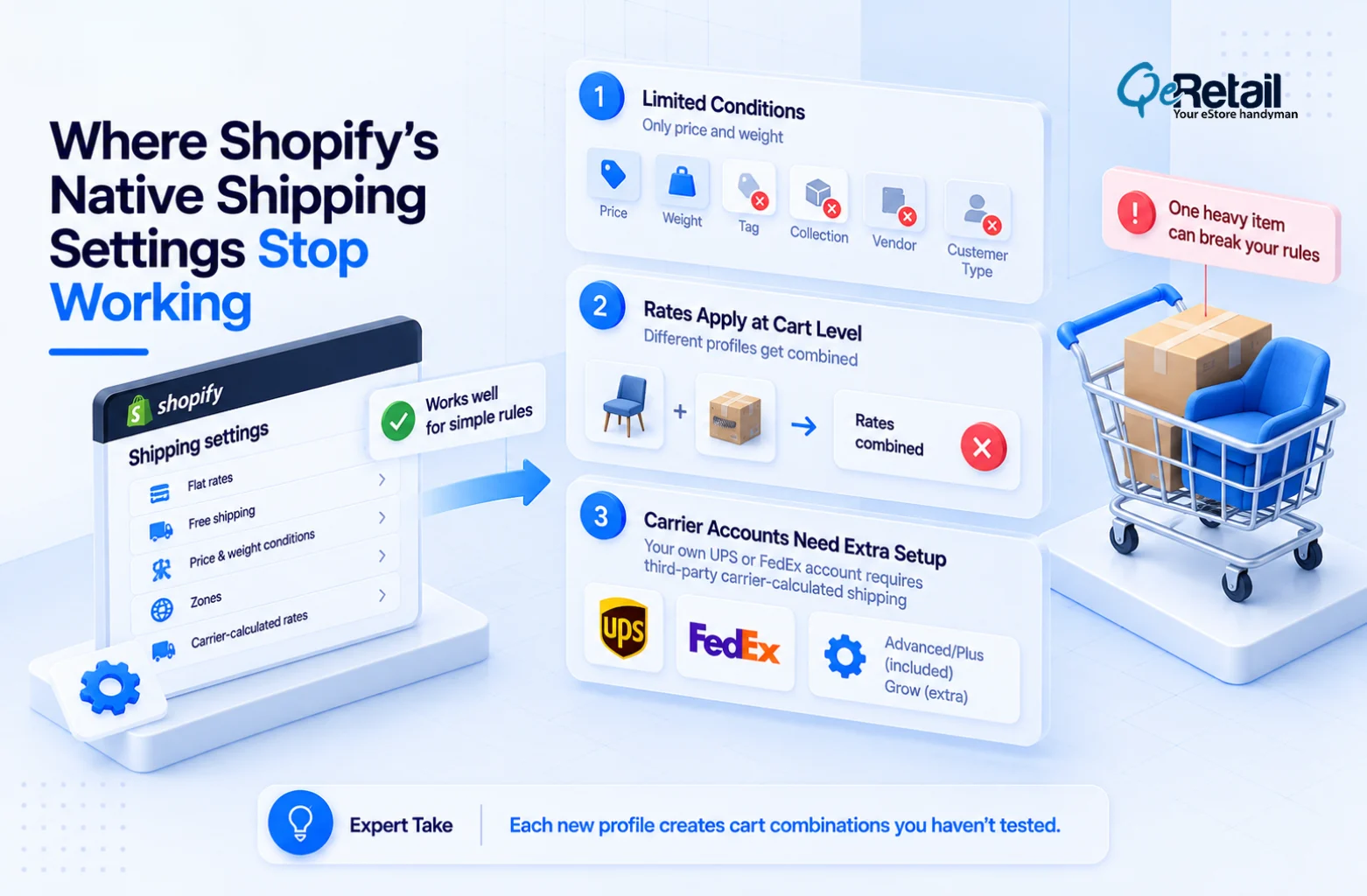
It breaks in three places. Conditions are limited to price and weight, with nothing native for product tag, collection, vendor, or customer type.
Rates apply at cart level, so when products from different profiles land in one cart, Shopify combines the rates instead of isolating them.
And your own UPS or FedEx account needs third-party carrier-calculated shipping, included on Advanced and Plus, extra on Grow.
That second one is the classic failure. One 40lb item joins a $90 order, and your threshold eats a freight charge.
Expert Take:
Stacking profiles feels like progress because each one solves the rule in front of you. It is not. Every profile creates cart combinations you have not tested, and the ones that break are the ones nobody checks until a customer gets free freight on a sofa.
What Shopify Functions Actually Control at Checkout
Here is the distinction that decides your whole build scope: hiding a rate and creating a rate are different jobs, run by different APIs.
The Delivery Customization Function API renames, sorts, and hides delivery options at checkout, reading buyer identity, delivery groups, addresses, and cost.
Hiding options for certain products, customers, or PO Box addresses is documented, capped at 25 active customizations per store. What it cannot do is invent a rate or change what one costs.
Changing a rate’s cost is a shipping discount job. Producing a new calculated rate is a Carrier Service API job, where Shopify posts the cart to your callback URL and shows whatever rates you return.
Map your rules that way and scope gets honest fast,
- Hide freight from apparel-only carts: delivery customization. Cheap, contained.
- Free shipping only with qualifying products: a shipping discount, not a customization.
- Rates from dimensions or live margin: Carrier Service. An integration, not a rule.
One caveat the vendor decks skip: the PO Box case only works for rates coming from carrier services or third-party apps. On built-in rates, the address data your function needs may never arrive.
Expert Take:
If a developer quotes a “custom shipping function” without asking whether the rule hides an option or changes a price, they are guessing at scope. Those builds do not cost the same, and they do not fail the same way.
The Plan Gate Most Stores Hit Before They Build
Check this before anyone writes code. eCommerce businesses with any plan can use public App Store apps containing Functions, but only Plus stores can use custom apps containing Function APIs.
Read that again if you are on Basic, Grow, or Advanced. A bespoke function built for your store alone cannot be installed. Your options are Plus, a public app, or a Carrier Service integration, which needs Advanced or higher unless you pay to add it.
Scripts are not a fallback. Shopify Scripts ended on 30 June 2026, with editing switched off that April, so shipping logic is now a checkout architecture decision.

Do the Shipping Math Before You Brief a Developer
Now the part most content avoids. Nobody should build shipping logic they have not priced.
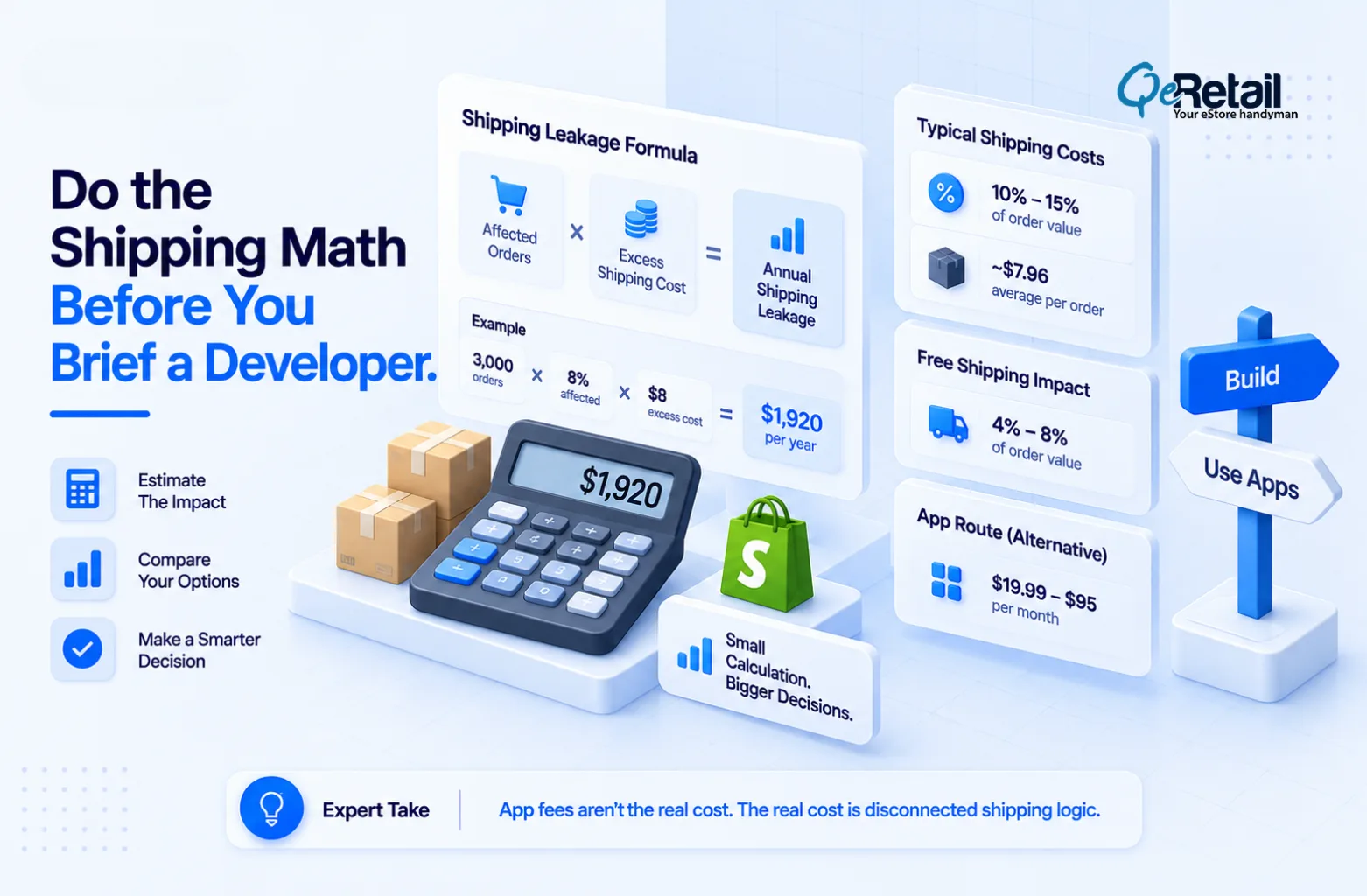
Annual shipping leakage = affected orders x average excess shipping cost
Take a store at $300,000 in revenue and 3,000 orders. If 8% of carts trigger the wrong rate at $8 of excess cost, you leak about $1,920 a year. That justifies a better threshold, not a build. Move the affected share to 25%, and the loss hits roughly $6,000, which changes the conversation.
Anchor the inputs. Shipping typically runs 10% to 15% of order value at a base rate averaging $7.96 per order, and free shipping costs most brands 4% to 8% of order value, with orders that barely clear the threshold often losing money.
Then price the app route beside it. Conditional rate apps run roughly $19.99 to $95 a month, so three stacked is $1,080 to $2,700 a year. That is the number your build quote competes with.
Expert Take:
App fees are not the real cost of the app route. The real cost is that each app owns a slice of your checkout logic, and none of them know what the others are doing. That is how stores end up with shipping rules nobody on the team can fully explain.
Final Thoughts
Most stores treat shipping exceptions as an ops chore. A refund here, an edited order there, one more app to cover the gap. If your team still corrects shipping by hand after checkout, you did not fix your shipping policy; you just moved the cost into someone’s afternoon.
The stores that get this right do something duller. They write down every rule, count the orders each exception touches, then decide whether settings, an app, or a function should own it.
That advantage compounds, because their logic stays explainable while everyone else’s becomes a stack nobody wants to touch. It shows up in margin and in customer acquisition cost, since a checkout that prices delivery correctly converts more of the traffic you already bought.
The decision is not whether your shipping rules need logic. They already do. It is who owns that logic and what it costs you each year. Not sure which rule is leaking?
Book a free consultation, and we will audit your shipping profiles, quantify the leakage, and tell you whether you need a build or a better threshold.
Frequently Asked Questions
Do Shopify Functions Require Shopify Plus?
Can Shopify Functions Create New Shipping Rates?
Can I Hide a Shipping Option For Specific Products Or Customers?
What Replaced Shopify Scripts For Shipping Logic?
How Long Does a Custom Shipping Rule Take To Implement?
Table of Contents