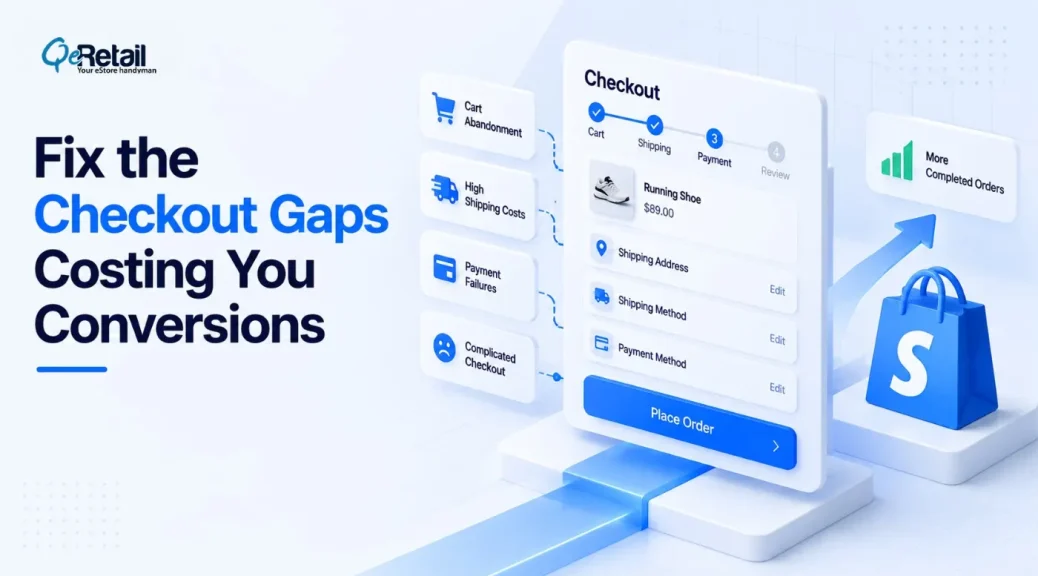
For online shoppers, shipping often becomes a conversion problem at the exact moment customers are closest to completing an order.
A shopper can spend time evaluating products and building a cart, only to reconsider when delivery costs, arrival dates, shipping options, or other fulfillment details become difficult to understand.
The issue is not always the shipping price itself. Uncertainty can be just as damaging.
Unexpected charges, vague delivery estimates, unavailable shipping methods, incorrect rates, and complicated checkout choices can create hesitation when purchase intent is already high.
For Shopify stores, these problems can become increasingly difficult to manage as product catalogs, fulfillment locations, markets, carriers, and shipping rules grow more complex.
Research shows that 39% of shoppers abandoned an order because extra costs such as shipping, taxes, and fees were too high, while 21% abandoned because delivery was too slow.
Reducing shipping friction therefore requires more than changing a shipping policy. Stores need to examine how shipping data, rate calculation, delivery information, and checkout functionality work together.

Key Action Points Summary
- Make shipping costs visible before customers reach the final checkout step
- Show realistic delivery expectations instead of vague shipping-speed labels
- Configure shipping rules according to products, locations, and order conditions
- Prevent incorrect or missing shipping rates from disrupting checkout
- Make shipping options easy to compare and understand
- Use accurate product weights, dimensions, inventory, and fulfillment data
- Review shipping experiences separately across markets and devices
- Use free-shipping thresholds strategically instead of applying them blindly
- Test mixed carts, multiple locations, and edge-case shipping scenarios
- Connect Shopify with carrier, fulfillment, inventory, and logistics systems where required
5 Shipping Fixes To Reduce Cart Abandonment Rate
Shipping friction rarely comes from one problem.
A customer may abandon because the shipping cost feels unreasonable, the delivery date is unclear, the correct rate does not appear, or the checkout presents too many confusing choices.
These five fixes focus on different parts of the shipping journey, including three areas where technical Shopify implementation can directly influence the customer experience.
1. Show Shipping Costs Before They Become A Checkout Surprise
Customers are more likely to reconsider an order when shipping costs appear only after they have invested time in the checkout process.
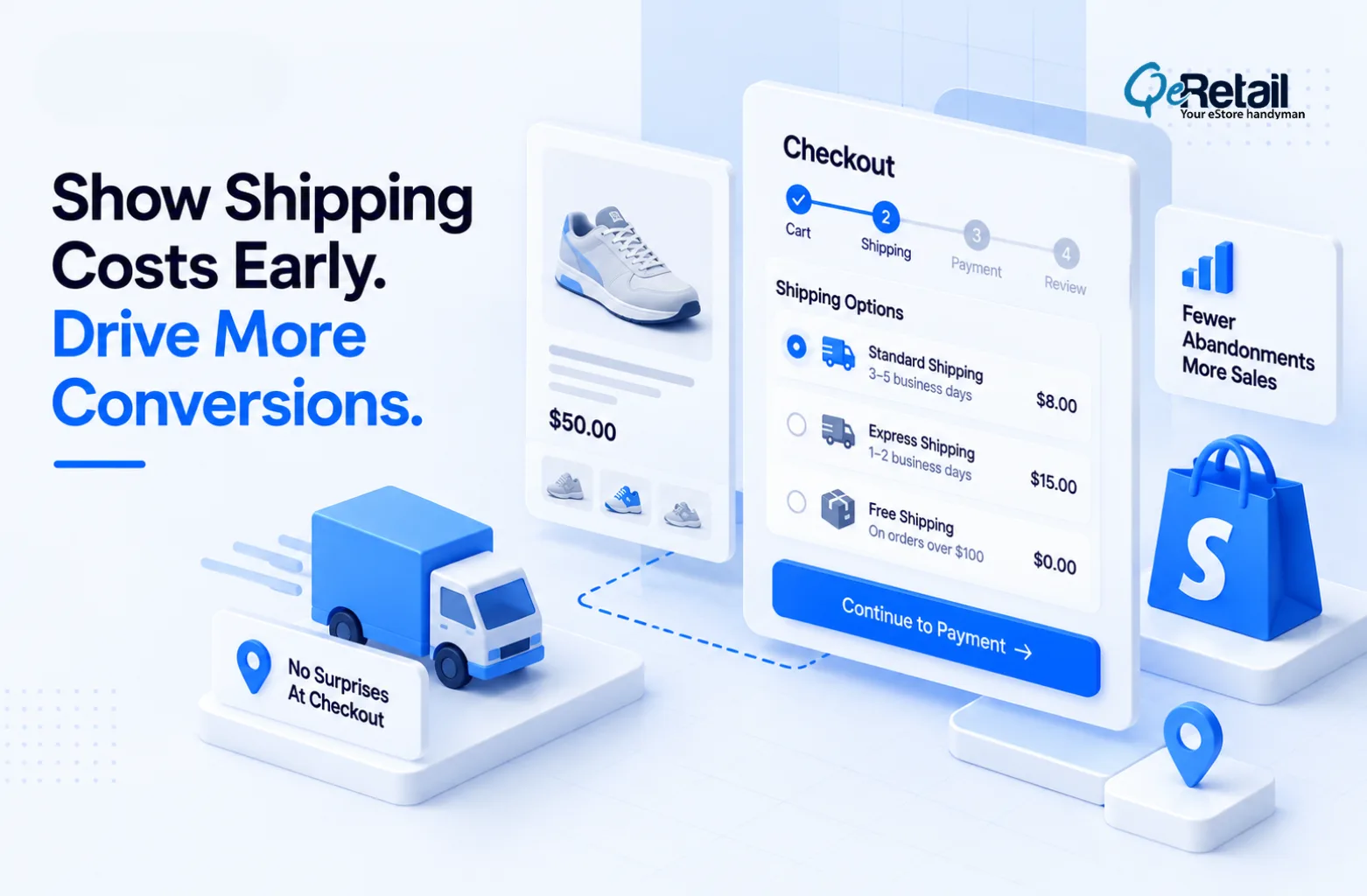
A product priced at $50 may feel reasonable until the customer discovers another $15 or $20 in delivery charges.
The solution is not automatically free shipping.
The more important objective is to set an accurate expectation before the customer reaches the final purchase decision.
For stores with more complex shipping requirements, the challenge is determining which rule should apply to each product, destination, order value, or fulfillment scenario.
What Should Shopify Stores Do To Improve?
- Display relevant shipping costs before final checkout
- Create clear shipping rules based on order conditions
- Use free-shipping thresholds where commercially appropriate
- Review shipping rates against actual fulfillment costs
- Test shipping costs across common customer locations
Quick Win:
Create test carts using different product combinations and order values, then compare the shipping rate returned for each scenario. Check whether the rate changes as expected when products, quantities, destinations, or cart values change.
2. Replace Vague Shipping Timeline With More Accurate Delivery Expectations
“Standard Shipping: 5–7 Days” may not give customers enough confidence to complete an order. Delivery expectations become more useful when they reflect processing time, inventory availability, fulfillment location, carrier transit time, and the customer’s destination.
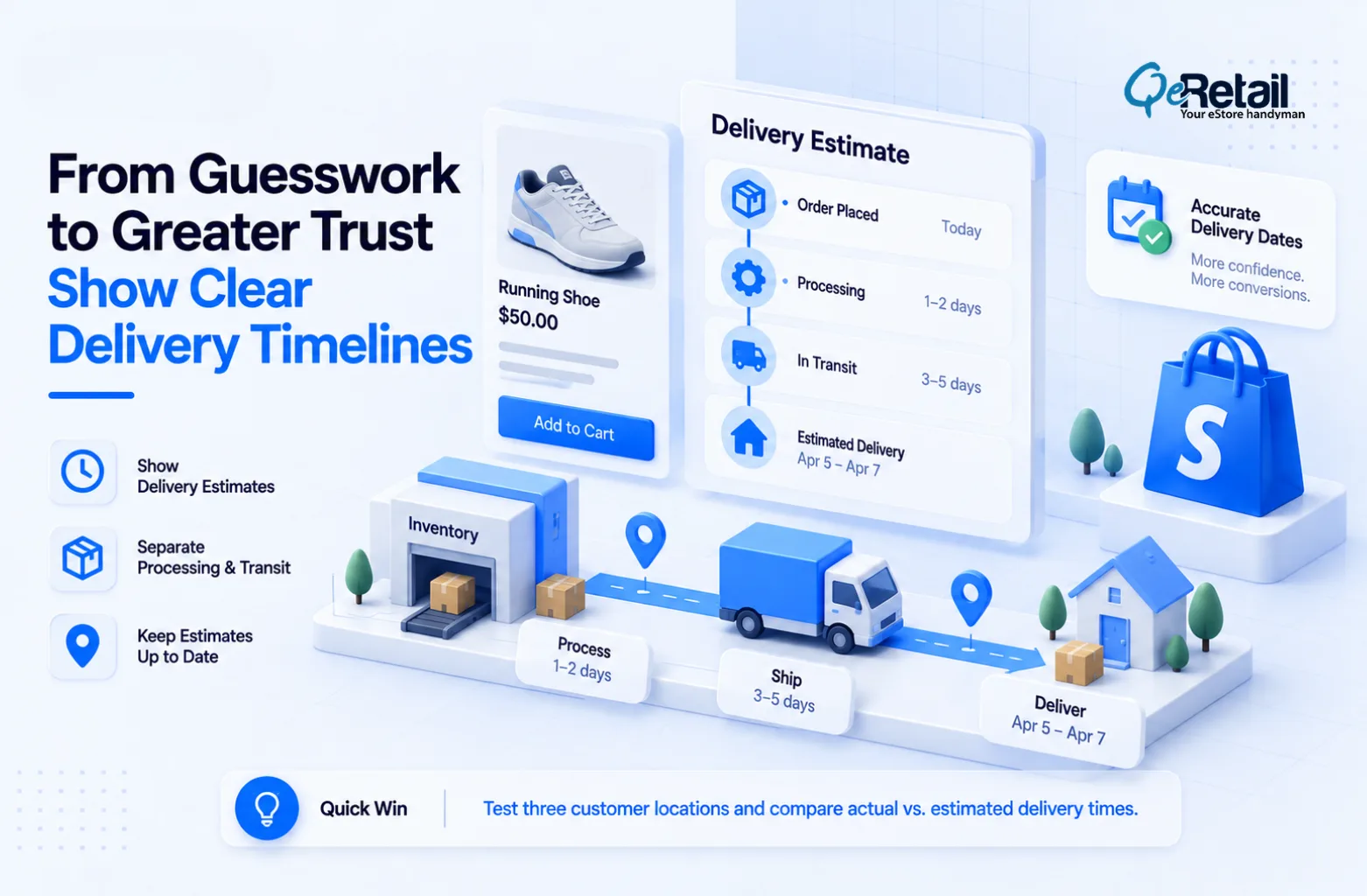
For stores with multiple fulfillment locations or changing inventory availability, accurate delivery messaging can require more than changing the text displayed on a product page.
The underlying data needs to support the promise being made to the customer.
What Should Shopify Stores Do To Improve?
- Show delivery estimates where customers make shipping decisions
- Separate processing time from carrier transit time
- Keep delivery estimates aligned with fulfillment capabilities
- Review delivery messaging across major locations
- Update estimates when fulfillment conditions change
Quick Win:
Pick three customer locations where you receive regular orders and trace the delivery timeline from inventory location to carrier handoff. Compare the actual fulfillment timeline with the delivery estimate shown to customers and flag any mismatch.
3. Fix Shipping Rate Calculation And Checkout Failures
Shipping rates can become technically complicated as a Shopify store grows.
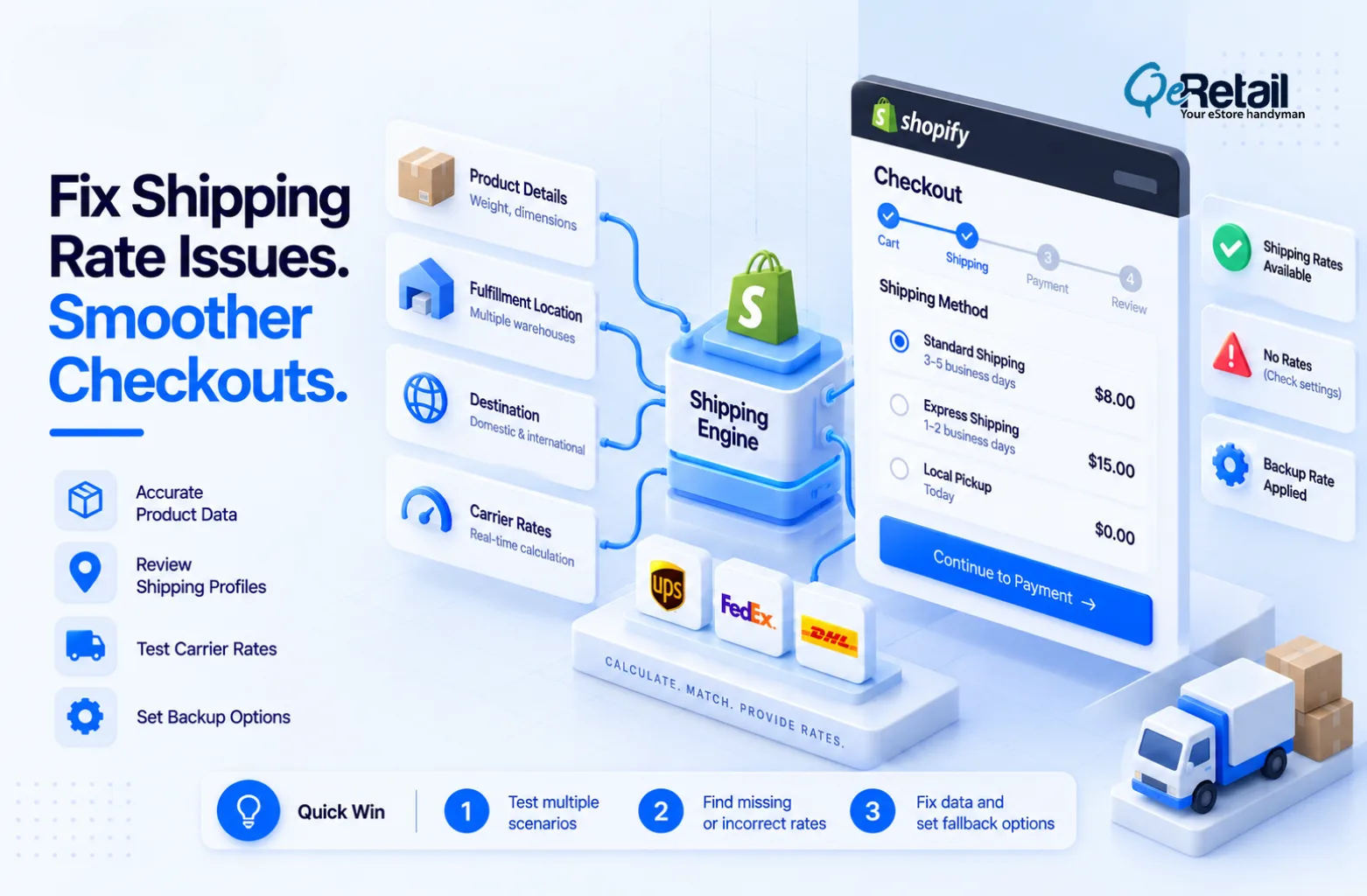
Different products may require different shipping profiles. Some products may ship from different locations, while carrier rates can depend on package weight, dimensions, destination, and delivery speed.
However, incorrect product weights, missing dimensions, conflicting shipping profiles, unsupported destinations, or carrier-rate failures can produce incorrect or missing options at checkout.
What Should Shopify Stores Do To Improve?
- Audit product weights and package dimensions
- Review shipping profiles and location assignments
- Test carrier-calculated rates across major destinations
- Configure appropriate backup shipping rates
- Monitor checkout failures caused by unavailable rates
Quick Win:
Run a shipping-rate test matrix using different product weights, dimensions, quantities, destinations, and fulfillment locations. Record every scenario where Shopify returns no rate, an unexpected rate, or the wrong shipping method.
4. Make Free Shipping Thresholds Work For The Customer And The Business
Free shipping can reduce the psychological resistance associated with an additional delivery charge, but offering it without considering order economics can create unnecessary margin pressure.
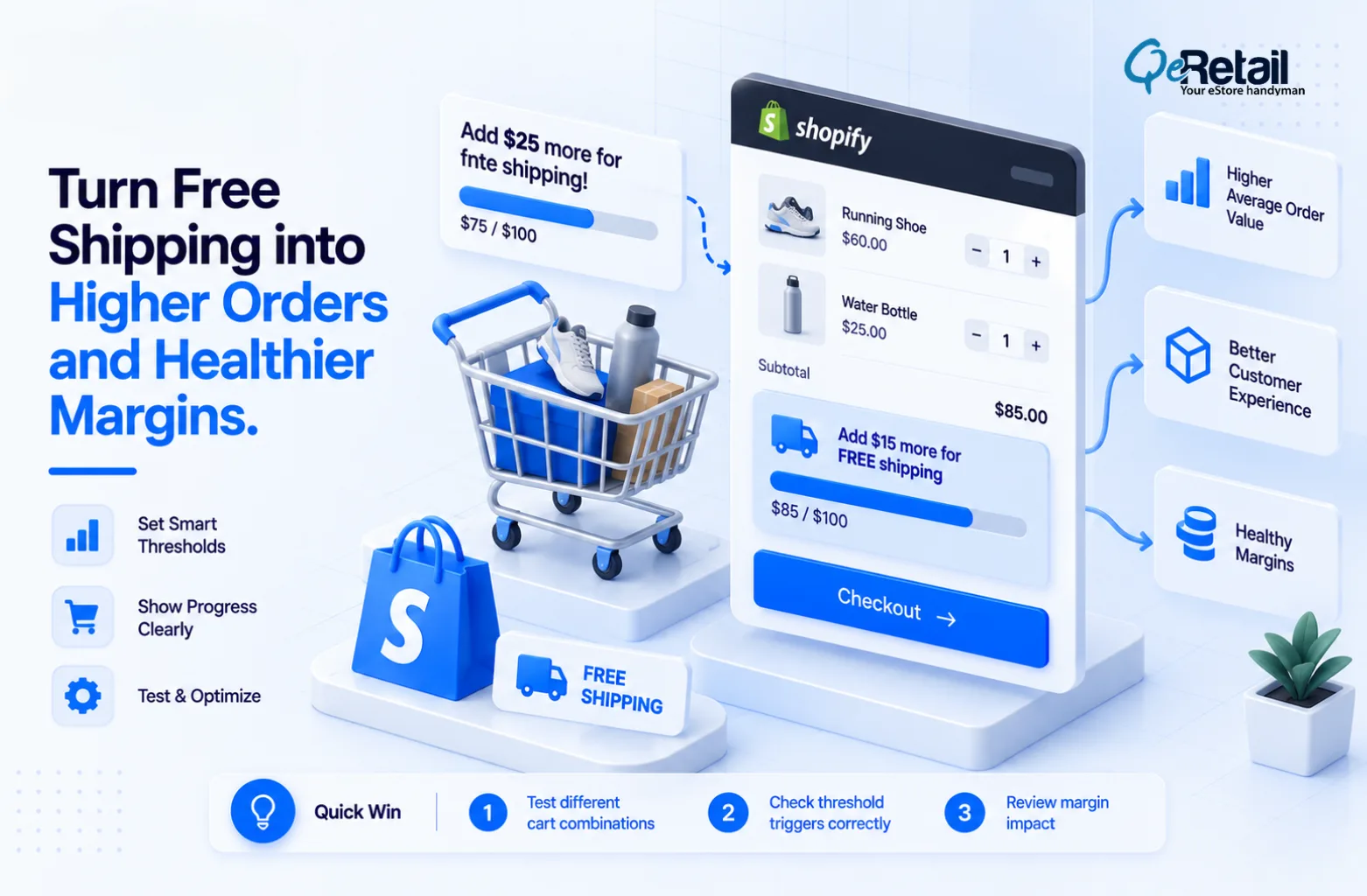
A better approach is to connect free shipping with order value, customer behaviorbehaviour, product margins, and average order value.
For example, instead of offering free shipping on every order, a store may provide it above a specific basket value.
The important part is determining whether the threshold encourages customers to add another relevant product rather than simply reducing the store’s shipping revenue.
What Should Shopify Stores Do To Improve?
- Set thresholds based on actual order economics
- Make the remaining amount for free shipping clear
- Test thresholds against average order value
- Avoid thresholds that are unrealistic for typical customers
- Review margin impact before expanding free-shipping offers
Quick Win:
Review your free-shipping logic against different cart combinations rather than testing only a single order. Check whether mixed products, discounted items, subscriptions, or excluded products trigger the threshold correctly.
5. Simplify Shipping Choices At The Point Of Purchase
More shipping options do not automatically create a better checkout experience.
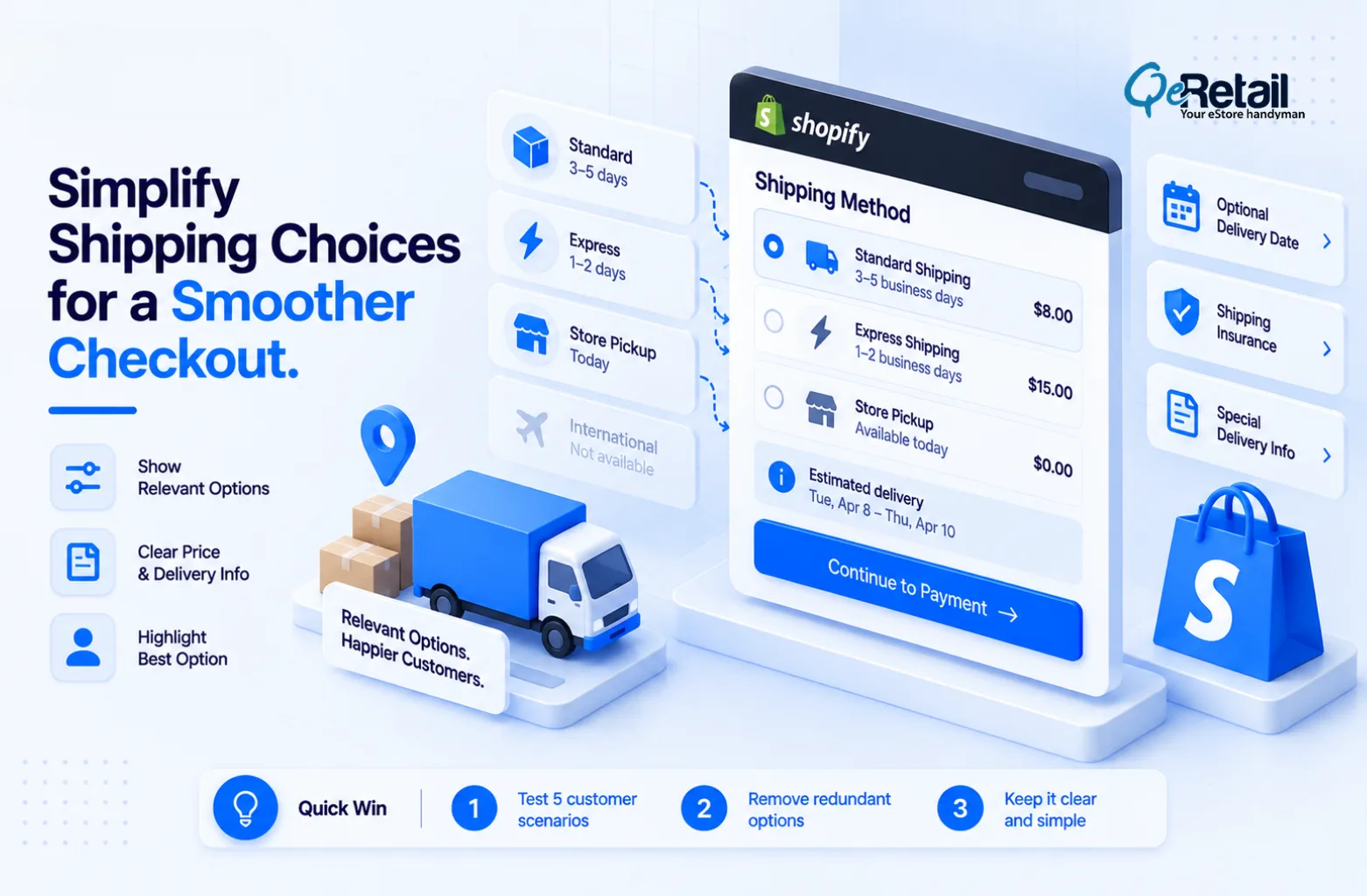
Customers may be presented with multiple carriers, speeds, prices, insurance options, pickup choices, or delivery methods without understanding which option is actually appropriate.
The objective should be to present relevant choices with enough information to make the decision quickly.
For more advanced implementations, Shopify’s checkout extensibility also supports shipping-related experiences such as delivery-date selection, shipping insurance offers, delivery-region messaging, and split-shipment guidance.
That creates opportunities for custom shipping experiences, particularly when standard configurations cannot adequately explain a complex fulfillment model.
What Should Shopify Stores Do To Improve?
- Keep only relevant shipping methods visible
- Clearly communicate price and delivery expectations
- Prioritize the most appropriate shipping option
- Explain unusual shipping conditions before purchase
- Test shipping selection across different customer scenarios
Quick Win:
Inspect the shipping methods returned for five different customer scenarios, including different locations and cart types. Identify shipping options that appear repeatedly but are unavailable, redundant, or poorly differentiated from another option.
How QeRetail Helps Shopify Stores Fix Shipping Friction
QeRetail helps Shopify businesses identify shipping-related conversion barriers and improve the technical infrastructure behind shipping rates, delivery information, checkout interactions, and connected fulfillment experiences.
1. Shopify Shipping Configuration And Optimization
We review shipping zones, profiles, rates, product conditions, locations, and market-specific requirements to identify configurations that may create unnecessary customer friction.
2. Custom Shipping Rate Integration
Our team can integrate Shopify with carrier systems, shipping platforms, logistics providers, and custom rate services when standard shipping configurations do not adequately support your business requirements.
3. Real-Time Delivery And Shipping Experiences
We can connect relevant inventory, fulfillment, carrier, and location data to create more accurate shipping and delivery experiences across the storefront and checkout journey.
4. Shopify API And Third-Party Logistics Integration
We integrate Shopify with shipping carriers, inventory systems, order management platforms, fulfillment providers, and other business systems to create a more connected shipping workflow.
5. Custom Checkout And Cart Experiences
Where supported by Shopify’s capabilities, we can improve how shipping information, delivery options, and relevant messaging are presented during the cart and checkout journey.
6. Shipping Performance And Conversion Optimization
We analyze shipping-related customer behaviour, checkout friction, rate issues, and purchasing patterns to identify which technical or UX improvements should be prioritized.

Conclusion
Customers rarely think about shipping as a technical system.
They experience it as a price, a delivery promise, and a set of choices presented at an important moment in the purchase journey.
That means shipping problems can originate far deeper than the checkout screen, involving product data, shipping rules, inventory locations, carrier integrations, fulfillment systems, and storefront implementation.
QeRetail helps Shopify businesses identify these underlying issues and build more reliable shipping experiences through Shopify customization, integrations, technical optimization, and conversion-focused digital solutions.
Contact us to identify where your Shopify shipping experience may be creating unnecessary cart abandonment.
Frequently Asked Questions
Why Does Shipping Cause Shopify Cart Abandonment?
How Can I Reduce Shipping-Related Cart Abandonment On Shopify?
Can Shopify Automatically Calculate Shipping Rates?
Why Are My Shopify Shipping Rates Sometimes Incorrect Or Missing?
Can Custom Shopify Development Improve The Shipping Experience?
Table of Contents