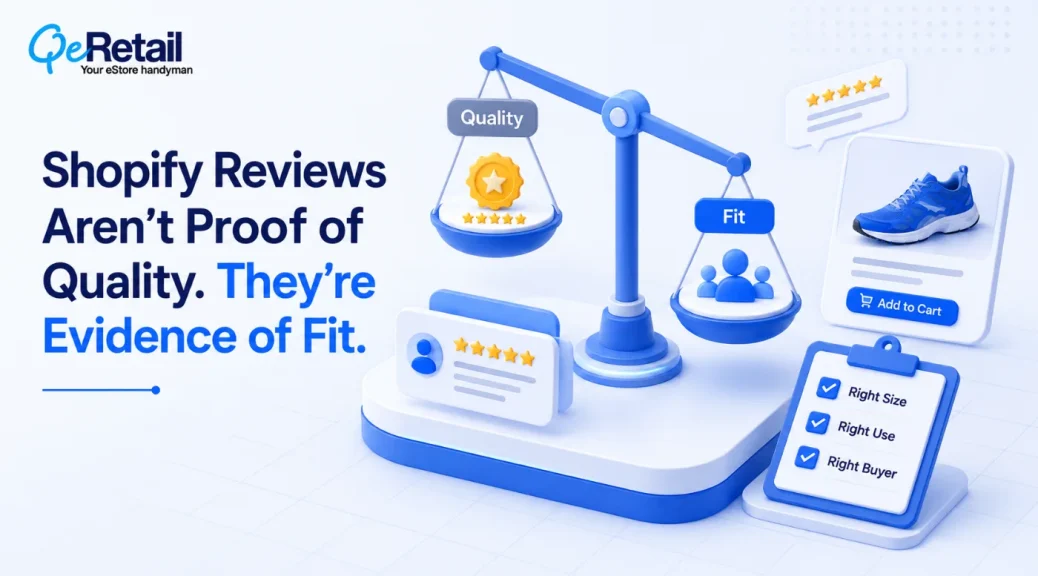
Shopify’s 2025 Global Holiday Report found it: 64% of shoppers say they’re likely to use AI at some point in their purchase journey, climbing to 84% among 18-to-24-year-olds. Your store isn’t just competing for search rankings anymore. It’s competing for a spot on a shortlist inside a conversation you never see.
Most Shopify owners still write product pages for a shopper who scrolls, filters, and compares ten tabs. That shopper is disappearing. In their place: someone who asks an AI assistant one question and gets a shortlist of two or three, already narrowed down.
Fewer products on that shortlist means each one has to prove itself faster. And the fastest proof you already have sitting on your site is your reviews, real customers describing whether a product actually fit their situation. This piece is about turning that evidence into a strategic asset instead of decoration under the buy button.
Key Action Points:
- Rewrite your review request to ask about use case, fit, and surprises, not just satisfaction
- Track the percentage of reviews with usable detail, not just star count
- Keep negative reviews visible and respond to them instead of hiding them
- Segment your review system by revenue tier
- Feed recurring review themes back into product pages every quarter

What Evidence Does AI Shopping Run On?
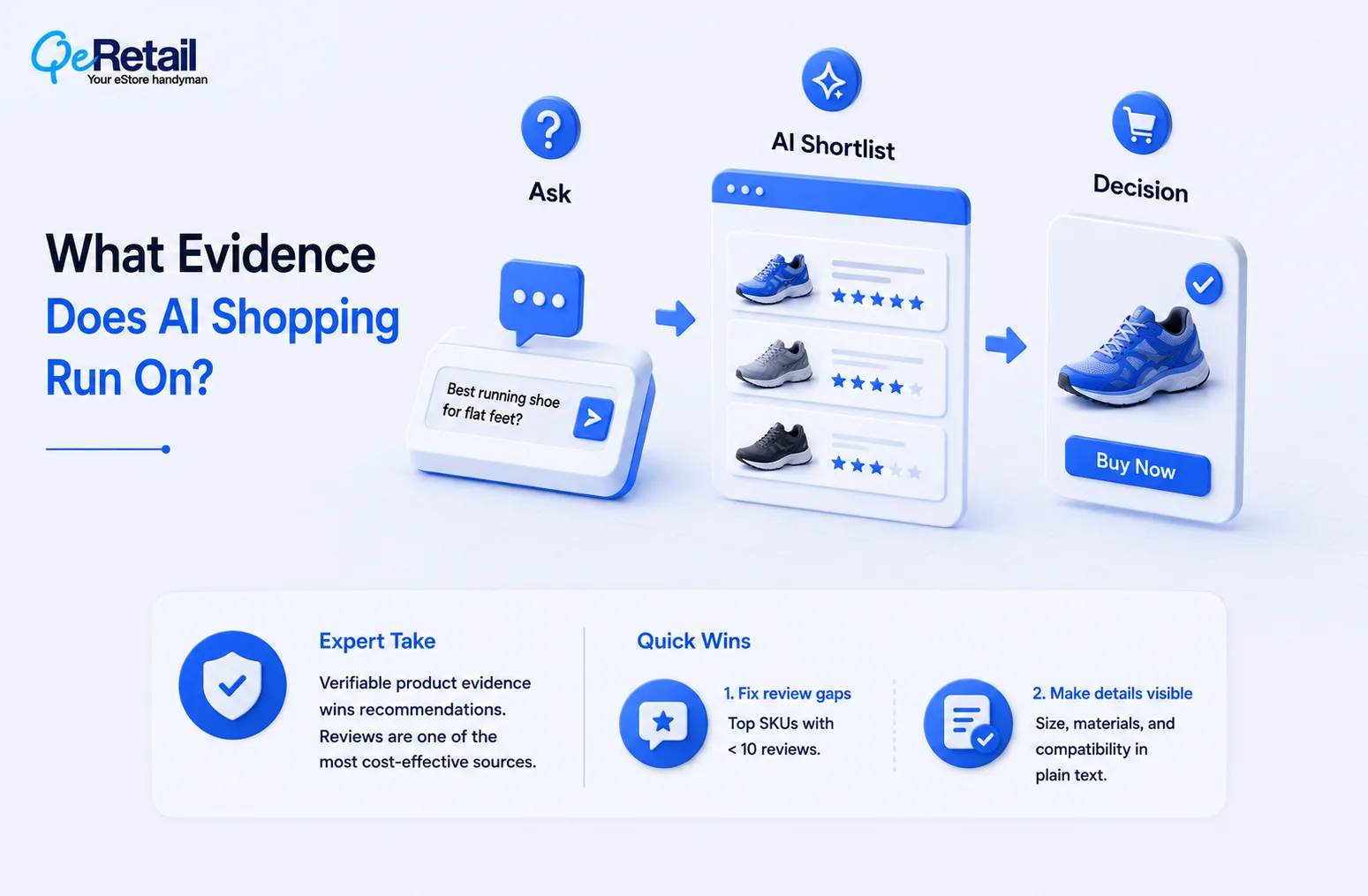
AI shopping isn’t a new traffic channel. It’s a new filter between your product and every customer who used to browse your site directly. The old path: search, land, open five tabs, compare, buy. The new path: ask, get a shortlist of two or three, evaluate, buy.
This is important when 58% of shoppers use generative AI instead of traditional search for recommendations, especially when the interface hands a shopper fewer products; everything attached to those products has to work harder.
From Search to Recommendation
Traditional search rewarded whoever ranked highest. Here’s our read: recommendation increasingly rewards whoever gets verified fastest. Call it agentic commerce or something else entirely, the pattern holds. Keyword coverage matters less than how quickly a system can confirm your product does what you say.
Per Microsoft data cited in Shopify’s research, Copilot shoppers with purchase intent already in mind are 194% more likely to complete their sale than non-Copilot shoppers. On a shortlist of two or three, there’s nowhere for a weak product to hide.
Expert Take:
Chasing a ranking trick for AI answers is the same mistake as over-optimizing for 2015-era SEO. There’s no keyword to stuff your way into a recommendation. Verifiable product evidence is what seems to matter most across the AI tools we’ve looked at, and reviews are one of the most cost-effective sources of it you already have.
Quick Wins:
- Audit which top SKUs have fewer than 10 reviews and fix that gap first
- Confirm size, materials, and compatibility appear in plain text, not just images
Why More Reviews Don’t Automatically Mean More Trust
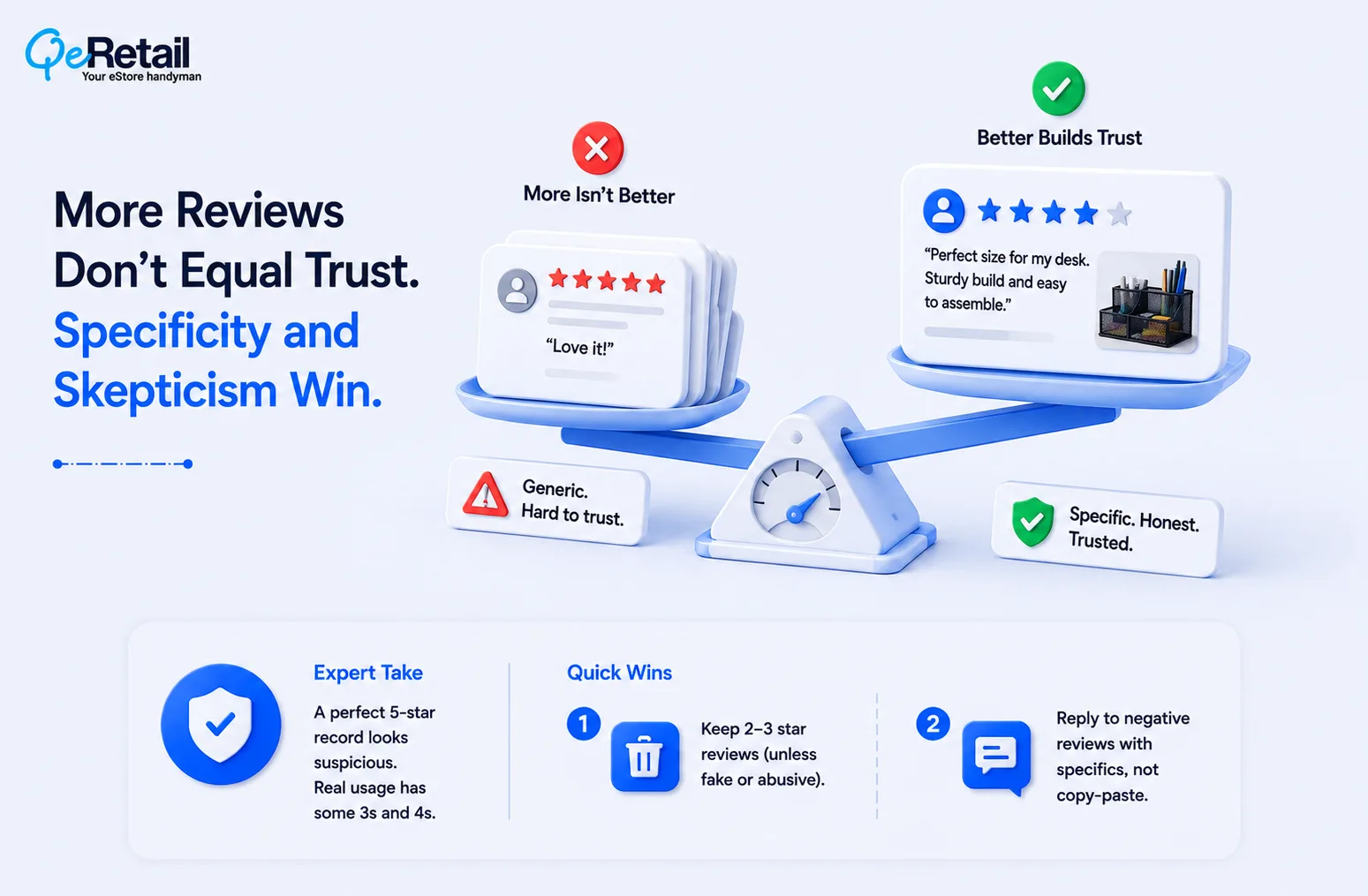
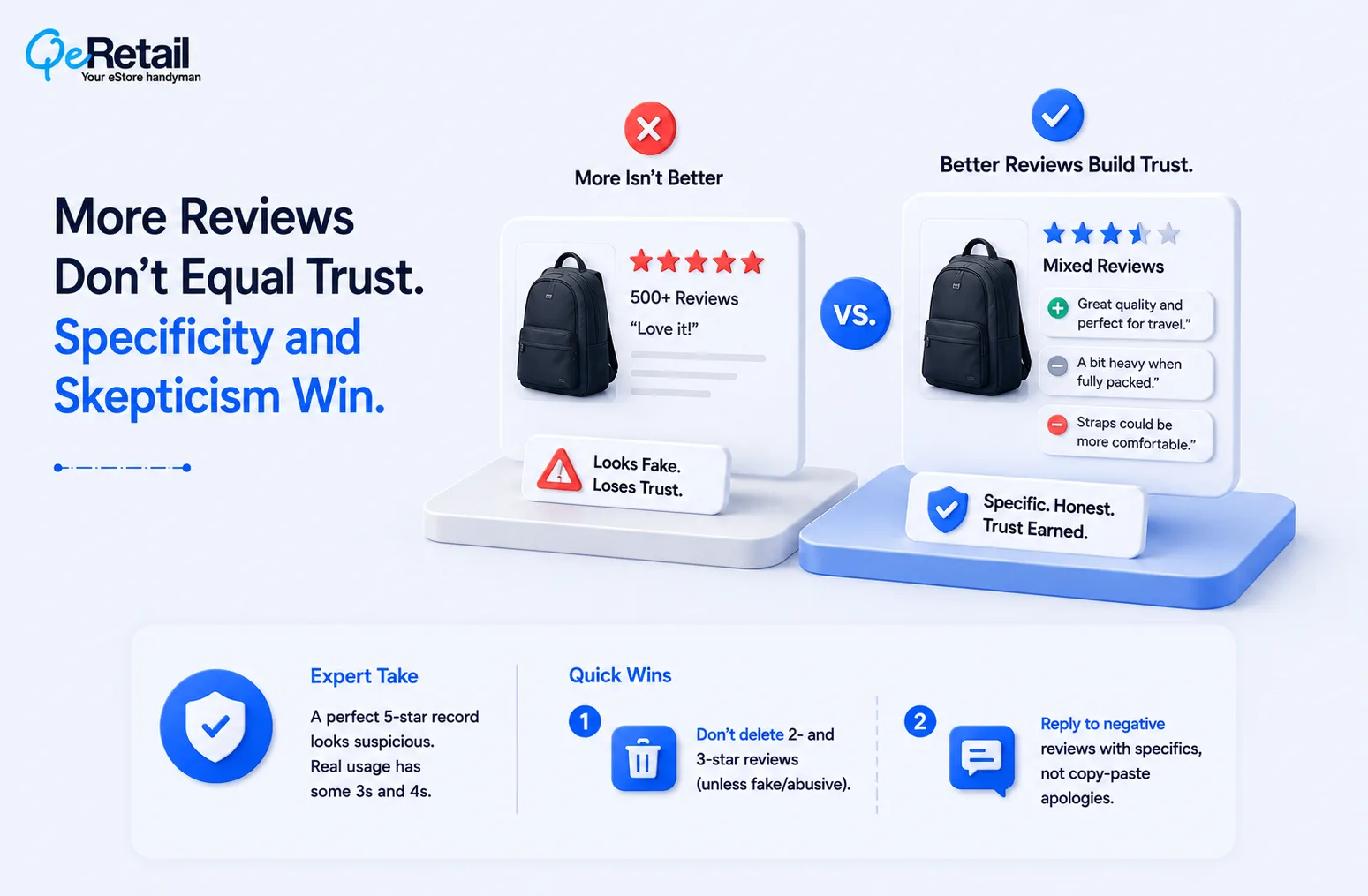
More reviews isn’t the same goal as better reviews. Independent analysis of major review platforms found over 23% of online reviews are fake, with only about 53% classified as genuine. A pile of generic five-star reviews doesn’t just fail to help. If it looks manufactured, it damages trust.
Specificity and Skepticism Beat Volume
Nobody comparing two similar products asks “is this good”; they ask “is this good for me,” and a hundred reviews that only say “love it” answer neither question.
Buyers actively hunt for the bad reviews first: shoppers are reported to be 514% more likely to focus on negative ratings than positive ones when judging credibility, and 76% trust a review set more when it’s mixed rather than all five stars
Hiding critical feedback doesn’t remove the doubt; it removes the one thing that could resolve it.
Expert Take:
If your rating distribution is 98% five-star, that’s not a trust signal; it’s a red flag. Real usage produces some 3s and 4s from people the product wasn’t right for. A perfect record is what makes shoppers, and anything else trying to verify your product, suspicious.
Quick Wins:
- Stop deleting 2- and 3-star reviews that aren’t abusive or fake
- Respond publicly to negative reviews with specifics, not a copy-paste apology
The Review Evidence Framework: What Reviews Actually Prove
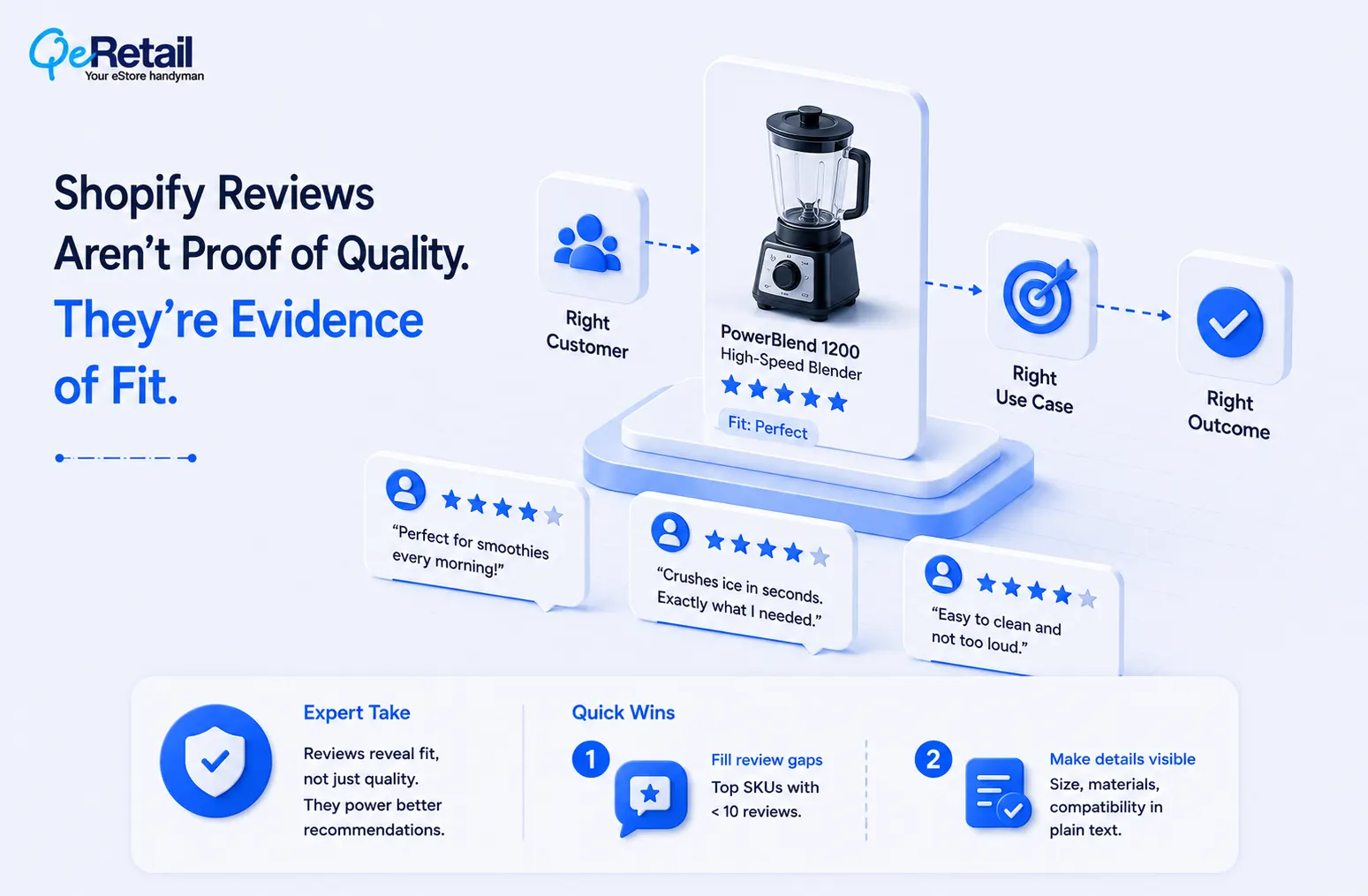
Reviews aren’t valuable because they’re positive. They’re valuable because they contain evidence about fit, and fit is the thing no product photo can prove on its own. A genuinely useful review does one of a few jobs:
1. Product experience – did it do what it claims, in the buyer’s words
2. Use-case evidence – who it worked for, and who it didn’t
3. Quality signals – did it match the listing’s expectation
4. Objection handling – the specific problem a buyer hit
5. Real-world context – how it performs outside the studio photo

What Shopify Stores Should Do Differently With Reviews
Fixing this isn’t about a new app; it’s about what you ask for and what you do with the answer. The right system changes with your size.
The Growth Starter ($100K–$200K): Ask Better Questions
You don’t have volume to be picky, but you control what you ask for. “How was your purchase?” gets a one-word answer. Ask what they were solving, what surprised them, who they’d recommend it to.
- Rewrite your review request with three product-specific questions.
- Time it to the use point: send it after the customer has used the product, not the day it shipped.
- Incentivize detail, not stars: a discount for a photo or specific answer, never a rating.
What Can Shopify Store Owners Do?
Swap your generic review request for three product-specific questions this week.
The Scaling Operator ($200K–$400K): Build a Review-to-Content Loop
You have enough volume to mine. The constraint is that nobody’s reading what customers already wrote.
- Tag review themes monthly into use case, objection, and quality-mismatch buckets.
- Route repeated objections into your product copy and FAQs.
- Feature your most specific reviews in MOFU retargeting content, not the generic five-star ones.
What Can Shopify Store Owners Do?
Pull 90 days of reviews into a spreadsheet, tag the themes, and fix the product page hitting the same objection three times.
The Enterprise-Ready Brand ($400K+): Operationalize Review Intelligence
At this size, review intelligence can’t live in one person’s spreadsheet anymore. The constraint shifts from finding the signal to routing it to the teams that can act on it.
- Pipe tagged review themes into merchandising, so recurring objections shape assortment and bundling decisions.
- Feed objection data into CRO testing instead of guessing at what to test on product pages next.
- Loop review language back to support and product teams, so fixes happen upstream instead of repeating in every ticket.
What Can Shopify Store Owners Do?
Assign an owner for review intelligence, even part-time, and give merchandising, CRO, and support a shared feed of tagged themes instead of three separate review inboxes.
Track this across every tier, by SKU, not just storewide: collection rate, recency, percentage with real detail, rating distribution, and review-assisted conversion against your customer acquisition cost. None of these numbers mean much on their own. Together, they show whether your reviews produce evidence or just noise.
Stop Collecting Reviews. Start Building Evidence.
Most Shopify stores still treat reviews as decoration under the buy button. If your strategy stops at “get more of them,” you didn’t build an evidence layer; you just collected applause.
The opportunity isn’t simply to collect more reviews. It’s to make the reviews you already collect more useful for answering the questions a shortlist-stage shopper actually has: does this fit, does this work, who is this for. That gets stronger every month you keep asking better questions.
If you want to know whether your reviews are producing useful evidence, start with your top 10 SKUs: check them for specificity, recency, rating distribution, and recurring objections. Book a free consultation, and we’ll run that audit with you.
Frequently Asked Questions
Do AI Shopping Assistants Actually Read Product Reviews Before Recommending Something?
How Many Reviews Does A Shopify Store Actually Need Before Reviews Start Helping Conversion?
Should I Hide Or Delete Negative Reviews On My Shopify Store?
How Do I Know If Fake Reviews Are Hurting My Credibility?
Can A Small Shopify Team Realistically Build A Review-To-Product-Data System?
Table of Contents