You built the audience by creating a funnel and even got some conversions.
Revenue is coming in. But between discovery and checkout, warm shoppers are quietly dropping off.
Most stores rely on a welcome series and an abandoned cart flow, and nothing in between. That gap is expensive. At the $100K–$500K mark, MOFU is your biggest lever for growth. These shoppers already know you.
They just need trust, clarity, and a reason to buy now. More traffic won’t fix that. A smarter mid-funnel strategy will. McKinsey reports 76% of consumers get frustrated when brands fail to personalize their experience, and 76% are more likely to repurchase from brands that do.
So, you need to fix your MOFU, and this piece helps you with it.
This Guide Covers:
- The reason why the middle of the funnel is important
- The three questions every MOFU shopper is silently asking
- The three email sequences that convert
- A practical rollout you can start this week
Key Action Points:
- Stop relying on discounts as your only mid-funnel move.
- Build sequences around education, proof, and objection handling in that order.
- Fix product page trust signals before pushing more email traffic to them.
- Match your retargeting creative to the email message your shopper last received.
- Segment your list by intent before you build flows, not after.
Why MOFU Matters?
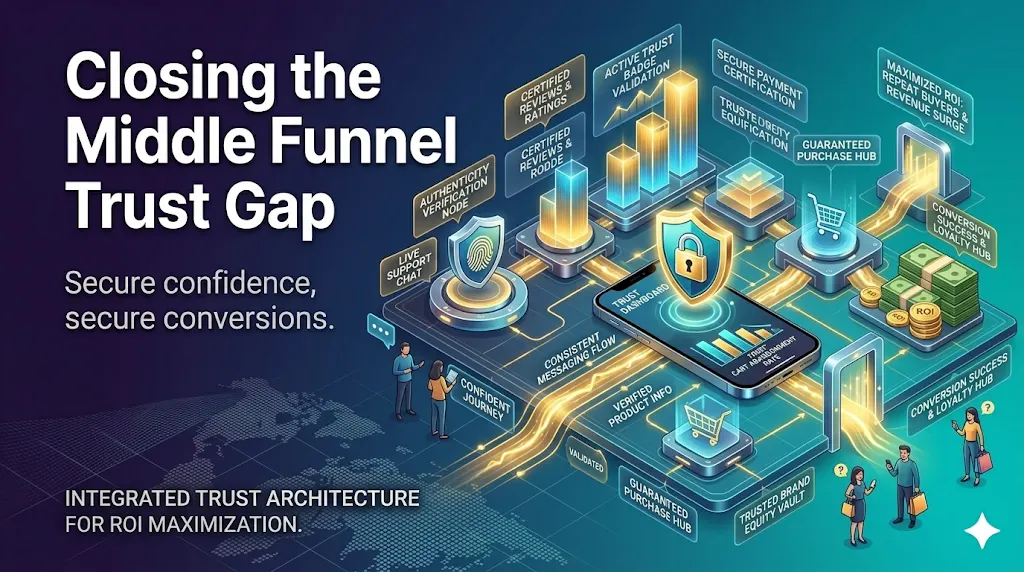
The middle of the funnel is where interest becomes buying intent. Shoppers already know who you are. What they need now is confidence. For Shopify stores, that means answering three questions every shopper is silently asking:
- Is this product right for me?
- Can I trust this brand?
- Why should I buy now instead of later?
If your store doesn’t answer those clearly, more traffic won’t solve the problem. MOFU strategy does.
Expert Take: A well-built MOFU email sequence generates 25 to 30% of total store revenue without incremental ad spend. Most stores at the $100K–$500K tier are sitting on that revenue right now. They just haven’t built the system to capture it.
3 Email Sequences That Move Shoppers Closer to Purchase
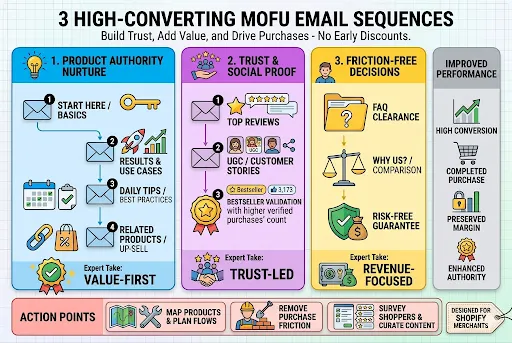
1. Educational Nurture Flow
This sequence helps subscribers understand the product, its use cases, and its value, especially useful for skincare, wellness, apparel, and any category where shoppers need context before buying. A simple four-email flow:
- Product basics or getting started
- Use cases and real results
- Tips, routines, or best practices
- Cross-sell or related category introduction
Education removes hesitation. When shoppers understand how a product fits into their lives, conversion becomes easier.
Expert Take: Email campaigns that go straight to a discount offer are not MOFU. They are BOFU content sent to an MOFU audience. That mismatch trains your list to wait for discounts, compresses margin, and erodes brand authority over time.
Action Points:
- Map your top three products and list the most common pre-purchase questions for each
- Build a four-email educational flow starting with your bestseller
- Replace any early discount trigger in your welcome series with a value-first email
2. Social Proof Drip
This sequence is for shoppers who are interested but not yet convinced, browsers who revisit categories or open emails without taking the next step. A strong three-email version:
- Best customer reviews
- UGC or customer story highlights
- Bestseller validation with review volume or shopper favorites
Social proof shortens the trust gap. Instead of repeating brand claims, you let your customers do the convincing.
Expert Take: Review-led emails consistently outperform promotional emails in click-through and conversion for stores in the $100K–$500K range. Shoppers at this stage are not looking for a reason to buy. They are looking for permission. Social proof gives them that.
Action Points:
- Pull your top 10 reviews and identify the ones that address purchase hesitation directly
- Build a three-email proof sequence triggered after a shopper browses a product twice without buying
- Add UGC or photo reviews to at least two emails in this flow
3. Objection Handler Flow
Some shoppers are close to buying but have one unresolved concern: shipping, sizing, ingredients, returns, or product fit. This flow should cover:
- Common FAQs
- Comparison or why-us messaging
- Guarantee, risk-reversal, or reassurance
The goal isn’t to rush them with discounts. It’s to remove the friction blocking the purchase.
Expert Take: Most stores jump to a discount the moment a shopper stalls. That’s a margin problem disguised as a conversion strategy. Objection handling through email done right closes the same shopper without giving away revenue.
Action Points:
- Survey your existing customers on what almost stopped them from buying
- Build a two to three-email objection flow triggered after 5 to 7 days of inactivity post-browse
- Create a dedicated FAQ or guarantee page to link from within these emails
What to Add Beyond Email?
Email performs better when the rest of the MOFU experience supports it. A strong sequence loses momentum the moment it clicks through to a weak product page. 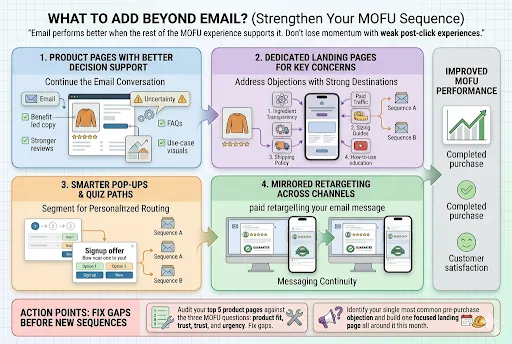
1. Product Pages With Better Decision Support
If your emails educate and reassure, your product pages need to continue that same conversation. Add benefit-led copy, stronger review placement, FAQs, comparison charts, and use-case visuals. A shopper shouldn’t click through from an objection-handling email only to find a page that creates new uncertainty.
Action Point: Audit your top 5 product pages against the three MOFU questions: product fit, trust, and urgency. Fix the gaps before building new sequences.
2. Dedicated Landing Pages for Key Buyer Concerns
Some objections deserve their own page: ingredient transparency, sizing guides, shipping policy, or how-to-use education. These pages give your MOFU emails a stronger destination than a generic product page and also support paid traffic, retargeting, and organic visitors at the same time.
Action Point: Identify your single most common pre-purchase objection and build one focused landing page around it this month.
3. Smarter Pop-ups and Quiz Paths
Not every MOFU visitor should get the same signup offer. A simple quiz, guided finder, or segmented pop-up lets you collect intent signals early and route shoppers into the right sequence from the start.
4. Retargeting That Mirrors Your Email Message
Paid retargeting should echo your MOFU flows, not ignore them. If your email sequence is leading with reviews, your ad creative should reinforce that proof. If you’re handling objections, your ads should highlight returns, shipping, or guarantees. Consistency across channels helps shoppers move forward faster.
Where to Start?
Don’t overbuild this from day one. A practical rollout:
- Build the educational nurture flow
- Strengthen reviews and FAQs on top product pages
- Launch the social proof drip
- Create one objection-focused landing page
- Add the objection handler flow
This gives you both email coverage and stronger on-site conversion support without overwhelming your team.
The Real MOFU Takeaway
The stores winning in 2026 aren’t just sending more emails. They’re building a connected mid-funnel system. Email sequences drive the conversation forward, but on-site proof, better pages, and audience-aware journeys are what convert that conversation.
If your current setup stops at welcome emails and abandoned cart, your funnel is leaking in the middle. Fix that, and you often don’t need more traffic first. You need a better path from interest to purchase.
Not sure where your funnel is leaking?
We audit Shopify stores at the $100K–$500K tier and identify exactly where MOFU is costing you revenue.
Book a free consultation and get a clear picture of what to fix first.
Table of Contents