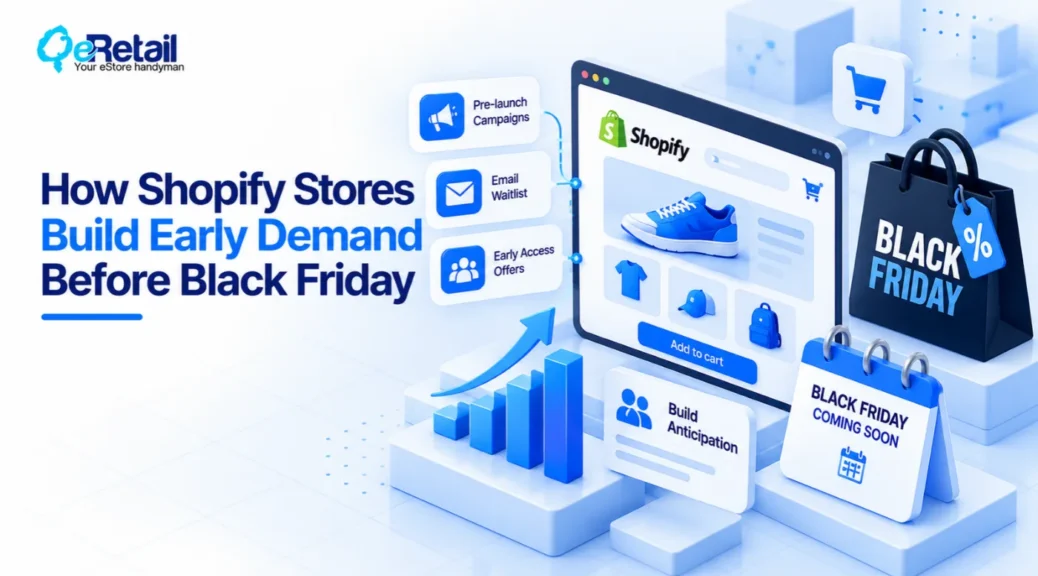
Almost half of the holiday shoppers plan to start their shopping before the end of October, and yet many Shopify stores save their first many full offers for Black Friday.
By then, early planners have already picked brands, built carts, compared prices, and spent part of their budget with competitors.
And you cannot close this gap by offering bigger discounts. You need to offer a reason for shoppers to buy early before the BFC EFCM season starts.
Offering early access can help you retain existing customers while attracting new customers who are already planning to shop before the sale season.
This guide shows how you can build it without training your audience to ignore full-price offers. It also covers
- The role of pre-BFCM early access
- The offers that create urgency without margin damage
- A three-part launch framework
- Revenue-tiered rollout plans
Key Action Points:
- Build one early-access offer for returning customers before public BFCM messaging begins.
- Segment your list by intent, margin, and repeat-purchase potential.
- Set a clear access deadline that ends before your public promotion starts.
- Use a private landing page to measure early demand separately from BFCM traffic.
- Protect margin with bundles, thresholds, and limited perks before deeper discounts.

What is Pre-BFCM Early Access?
Early access to your products with a different subject line before the Black Friday sale offers a private buying window for potential customers.
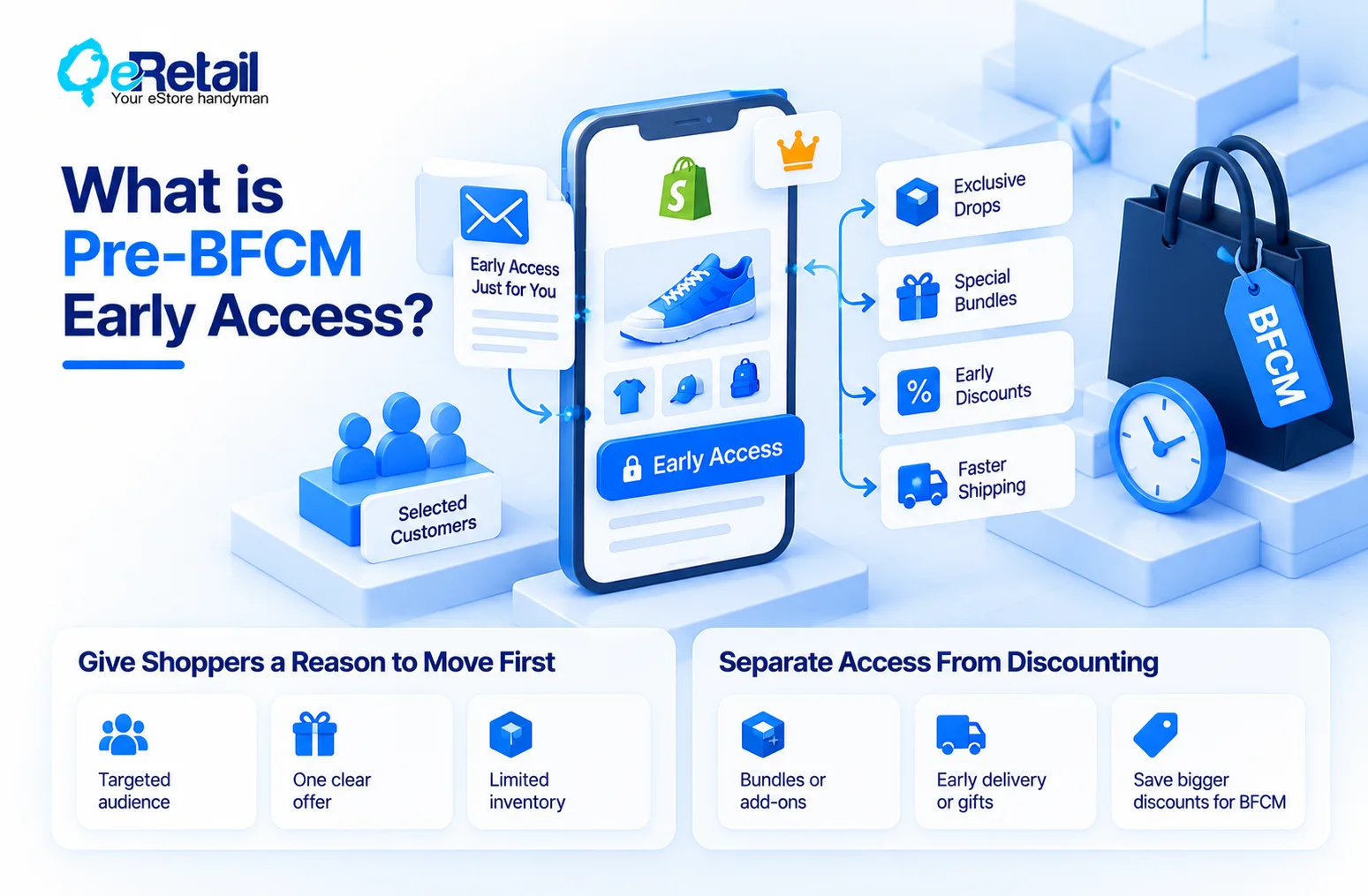
The value of the offer can be anything from exclusive product drops to customization options, a specific bundle, a gift, a specific discount, faster shipping, or a price cut before the sale begins. Here, the goal is to offer better association and proximity to your brand.
Give Shoppers a Reason to Move First
For Shopify stores, early access works when the offer answers a real shopper question: why buy from you now instead of comparing ten tabs on Black Friday?
A limited bundle for past buyers, a gift above a cart threshold, or first access to a seasonal product or collection gives your audience a concrete answer. Keep the offer narrow. Your public BFCM promotion can be broad. Your early-access offer should feel earned.
Expert Take:
A vague “VIP sale” is not exclusivity. If every subscriber receives the same code, shoppers read it as an early discount, not a relationship benefit. Make access conditional on a behavior, a customer segment, or a limited inventory pool.
Quick Wins:
- Name the access group clearly, such as returning customers or loyalty members.
- Offer one primary reason to buy early, not five competing incentives.
- Reserve selected inventory or a limited bundle for the access window.
Separate Access From Discounting
Your best early-access offer may not reduce the product price at all. A high-margin add-on, early delivery confidence, complimentary gift wrapping, or a product pairing can protect contribution margin while still creating a deadline. This matters when shoppers are price-aware. They want value, not necessarily a storewide percentage-off sign.
Expert Take:
Discounting before BFCM can make your later offer look less special. Use pre-BFCM to sell certainty, access, and curation. Save your broadest price message for the moment shoppers expect it.
Quick Wins:
- Audit gross margin before choosing the incentive.
- Test a gift or bundle against a percentage discount.
- State the access end time in every campaign message.
Why Most Shopify Stores Lose Early Shoppers
The common mistake is calendar-first planning. Teams decide the launch date, create one sitewide code, and wait for traffic to arrive. But the early shopper is already moving. A 2025 survey found that 66% of respondents said discounted prices motivate earlier shopping, while availability also pushes shoppers to act. That is intent you can capture before your acquisition costs climb.
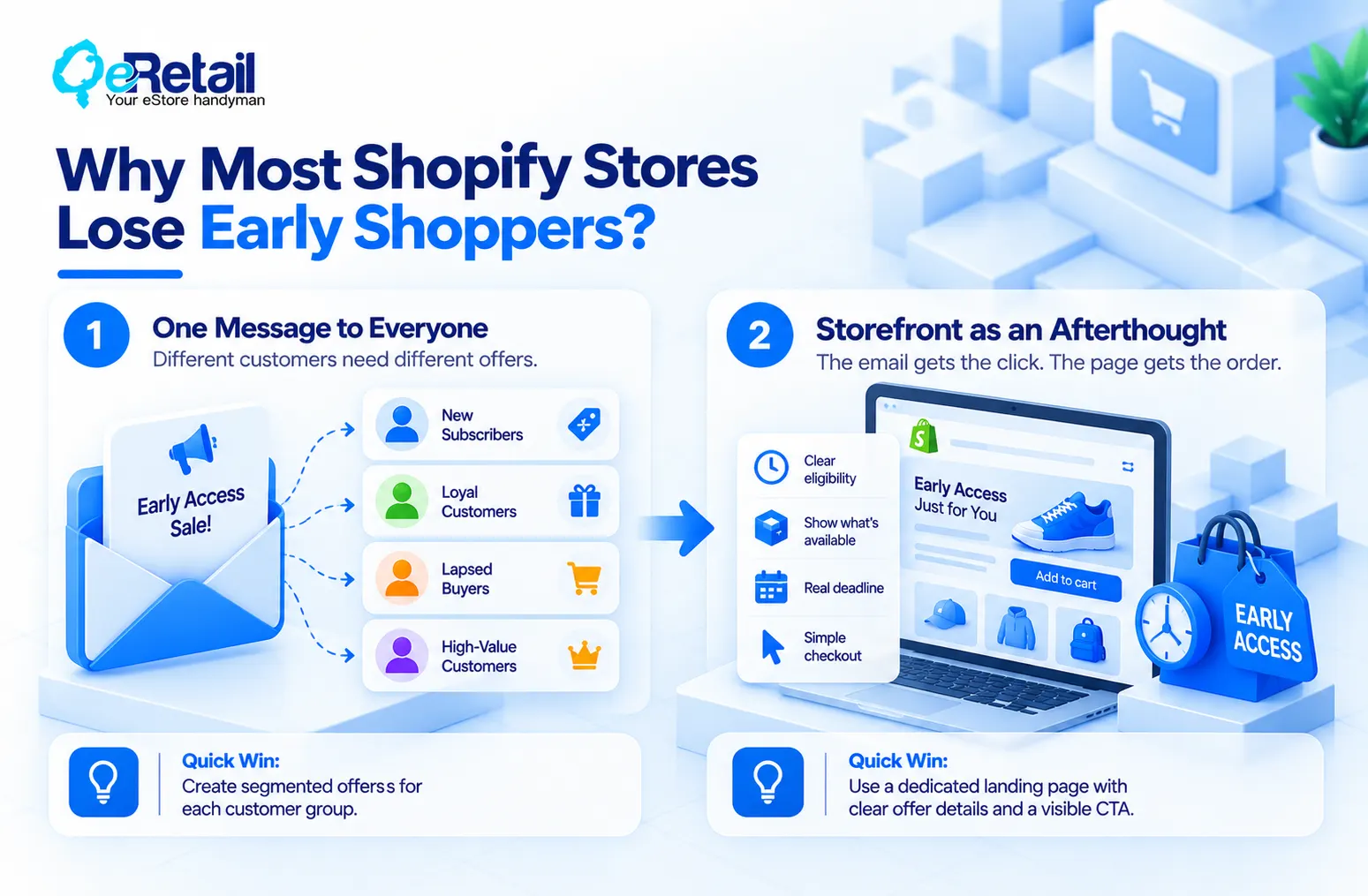
Sending One Message to the Entire List
New subscribers, loyal customers, lapsed buyers, and high-value customers do not need the same invitation. A first-time shopper may need a tightly scoped entry offer. A repeat buyer may respond to a replenishment bundle. A high-AOV buyer may value limited inventory or early access to a premium set. One blast erases those differences and makes a private window feel public.
Expert Take:
Segmentation is not a reporting exercise you do after BFCM. It is the offer architecture. If the offer is not different by customer value or intent, you are paying to send a generic promotion faster.
Quick Wins:
- Create a past-purchaser segment and a non-purchaser segment.
- Exclude recent full-price buyers from blunt discount messages.
- Build one tailored product collection for each priority segment.
Treating the Storefront as an Afterthought
The email earns the click. The landing page earns the order. Send early-access traffic to a clean Shopify collection or private landing page, not your standard homepage. The page should show who qualifies, what is available, when access ends, and what happens next. Remove competing banners and make the add-to-cart path obvious.
For more conversion work before the traffic spike, pair this campaign with Shopify checkout optimization. A strong early-access offer cannot rescue a checkout that adds friction when the shopper is ready.
Expert Take:
Countdown timers do not create trust. A credible deadline does. Tie urgency to a real inventory, fulfillment, or access constraint, then let the page explain it plainly.
Quick Wins:
- Create a dedicated URL and tag every campaign link.
- Put the deadline and primary CTA above the fold.
- Check mobile checkout, shipping visibility, and discount logic before launch.
The Three-Part Early-Access Framework
This is a sequence, not a single send. Start with qualification, create a short private conversion window, then use what you learn to sharpen your public BFCM campaign.
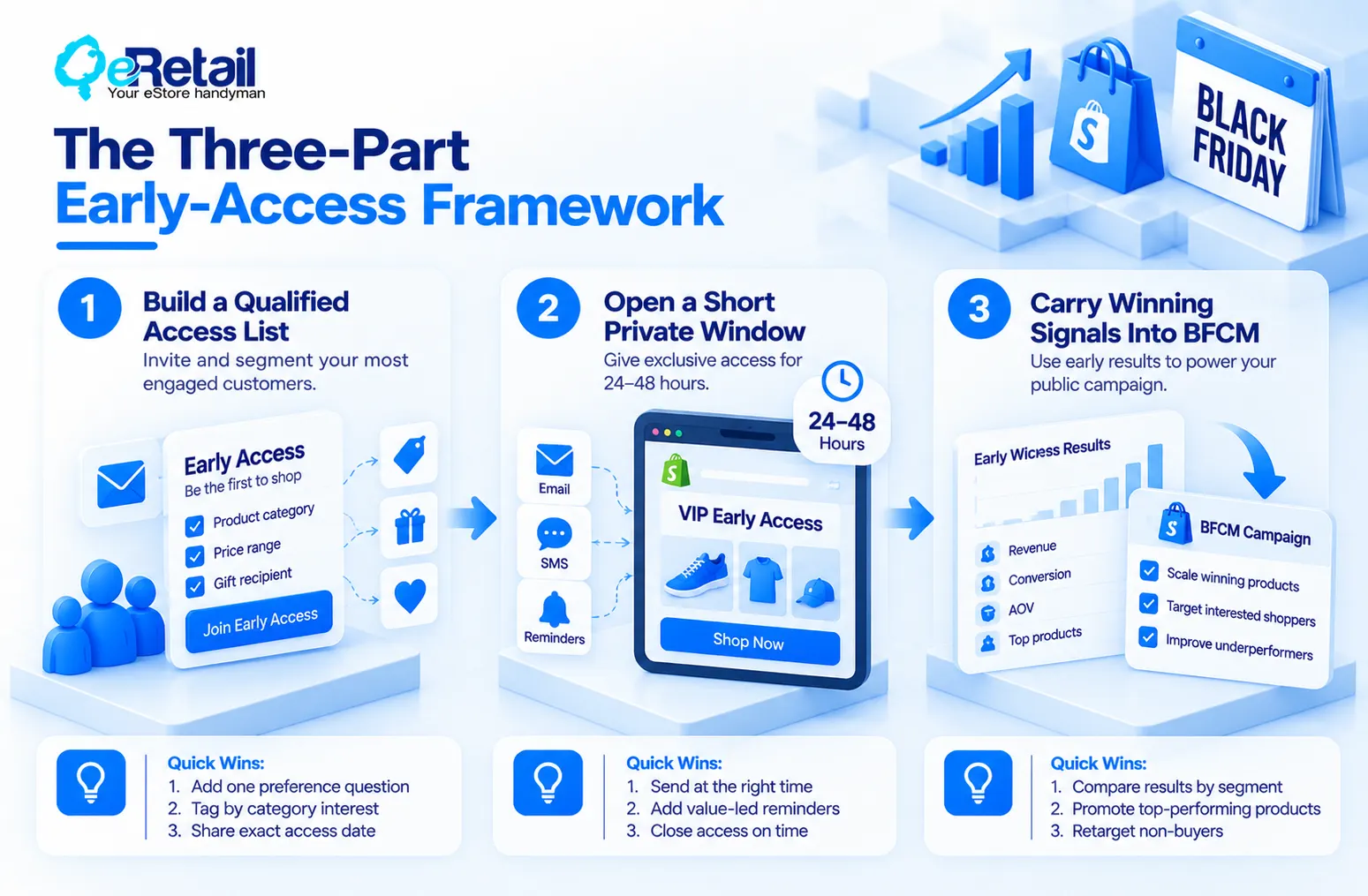
Part 1: Build a Qualified Access List
Start 14 to 21 days before your public BFCM launch. Invite your most engaged email and SMS subscribers to opt in, or automatically qualify loyalty members and recent purchasers. Use the opt-in page to learn what they want: a category, price band, gift recipient, or restock alert. That input gives you better merchandising choices than a generic sale countdown.
Expert Take:
The opt-in is not just list growth. It is a buying signal. A shopper who chooses a category has told you what to feature, what to retarget, and what inventory deserves attention.
Quick Wins:
- Launch an opt-in form with one preference question.
- Tag subscribers by category interest.
- Set expectations for the exact early-access date and channel.
Part 2: Open a Short Private Window
Open access for 24 to 48 hours. Give customers a private link or logged-in collection, then make the benefit immediately visible. Use email for the announcement, SMS or a reminder channel for the final hours, and on-site messaging for returning visitors. Avoid extending the window without a real reason. The deadline only works when you honor it.
Expert Take:
A longer access period is not automatically safer. If the offer is available for a week, it becomes another promotion shoppers plan to revisit later. Short windows force a decision while attention is close.
Quick Wins:
- Send the launch message when your audience is active.
- Schedule one value-led reminder and one final-hours reminder.
- Close or change the private offer exactly when promised.
Part 3: Carry Winning Signals Into BFCM
Measure revenue per recipient, conversion rate, average order value, attachment rate, and unsubscribe rate by segment. The early window shows which products and messages deserve paid support during BFCM. If a bundle converts but a discount code does not, put the bundle at the center of your public campaign. If a category draws clicks but no carts, fix the product page before scaling traffic.
This is also where a TOFU, MOFU, and BOFU Shopify funnel matters. Early access identifies warm buyers. Your BFCM retargeting should meet them with the next most relevant message, not restart the conversation from zero.
Expert Take:
Pre-BFCM is a paid-media briefing disguised as a retention campaign. Treat the results as evidence, or you will repeat the same untested creative and product bets at a higher cost during Cyber Week.
Quick Wins:
- Compare results by segment and incentive type.
- Promote the highest-margin converting collection during BFCM.
- Retarget non-buyers with the category they viewed.

Revenue-Tier Rollout Plans for Your Pre-BFCM Campaigns
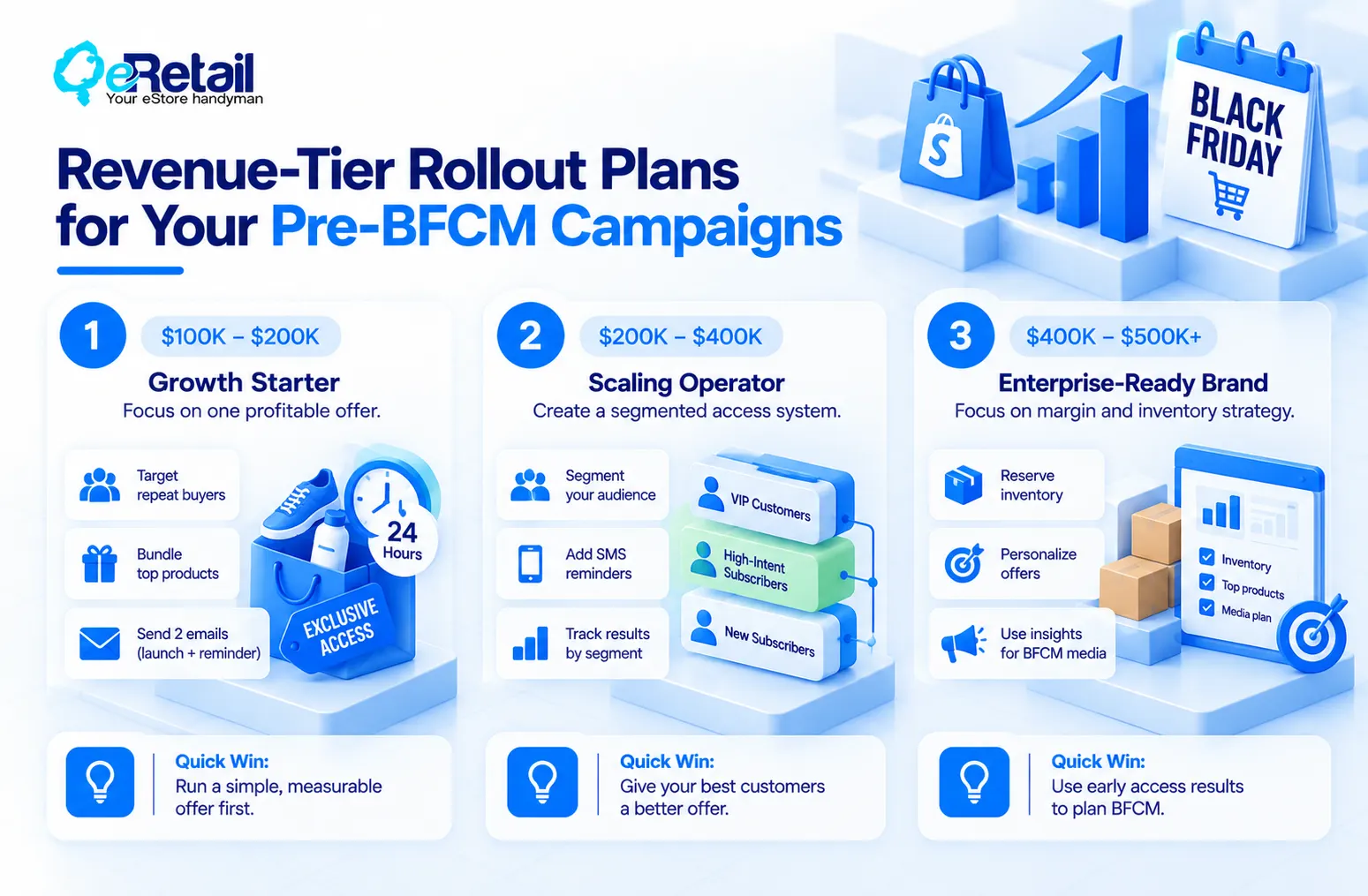
The Growth Starter (100K–200K): Focus on One Profitable Offer!
Keep the build small. One customer segment, one bundle or threshold gift, one private collection, and a 24-hour window is enough to learn.
- Choose repeat buyers: Invite customers with a completed order in the last 12 months.
- Bundle proven products: Pair your top seller with a high-margin add-on.
- Send two emails: Launch access, then send a final-hours reminder.
What can Shopify store owners do?
Ship a clean, measurable offer before adding complex automation. A simple campaign you can assess beats a large campaign you cannot explain.
The Scaling Operator (200K–400K): Create a Segmented Access System!
At this tier, split your list by purchase history and product interest. Create separate collection paths for repeat customers, high-intent subscribers, and new leads.
- Build segment offers: Match incentives to expected customer value.
- Add SMS reminders: Use them for opted-in, high-intent shoppers near the deadline.
- Track cohort results: Compare revenue, AOV, and unsubscribe rate by group.
What can Shopify store owners do?
Do not reward every shopper the same way. Your best customers should see a better reason to buy now than an unqualified lead.
The Enterprise-Ready Brand (400K–500K+): Focus on Margin and Inventory Strategy!
Use early access to direct demand toward inventory you can fulfill profitably. Coordinate merchandising, retention, and paid media around the same prioritized categories.
- Reserve inventory: Protect enough stock for the access group without starving public BFCM demand.
- Personalize assortments: Show category-specific bundles to past buyers.
- Feed media planning: Use early conversion data to set BFCM creative and budget priorities.
What can Shopify store owners do?
Make early access a forecast input, not a side campaign. The result should change your BFCM inventory and media decisions.
Stop Waiting for Black Friday. Start Capturing Intent.
Black Friday is still important. But treating it as the first day shoppers can buy from you is expensive thinking. Some buyers are already planning, comparing, and protecting their budgets before the noise peaks.
Early access gives you a smaller, cleaner window to learn what moves your audience. It can create revenue before the promotion rush, protect margin through smarter incentives, and give your BFCM plan a better starting point. If you send the same offer early to everyone, you did not create early access; you just moved your sale forward.
Need a partner who can turn that intent into a stronger Shopify campaign? Book a free consultation, and we will identify the segments, offer structure, and conversion fixes worth prioritizing before BFCM.
Frequently Asked Questions
When should a Shopify store launch pre-BFCM early access?
Should early-access shoppers receive a bigger discount than Black Friday shoppers?
How many messages should an early-access campaign include?
Can a small Shopify team run an early-access campaign?
What should we measure after the early-access window?
Table of Contents