AI platforms are becoming the new shopping destination for shoppers.
In fact, Gartner predicts mobile app usage will drop 25% by 2027 as shoppers hand everyday tasks to AI assistants.
The problem is that most Shopify store owners focus on mobile app development rather than ensuring a mobile-first experience. Focusing on the storefront is also crucial because it’s the first point of interaction for any shopper.
Especially when shoppers are planning to spend 55% of their retail budgets online, they will land on your storefront and not an app. But does this mean you don’t need an app? Well, not exactly! Each option has its advantages and disadvantages.
This guide shows where each option pays off, where the risk sits, and where a $100K to $500K store should put its next dollar.
Key Action Points:
- Fix mobile filters, stock badges, and delivery dates before you price an app.
- Clean your product data so AI agents can read and recommend your catalog.
- Track returning-customer revenue every month before you sign with an app builder.
- Stop running pop-ups that interrupt the mobile buying path.
- Build an app only after your storefront converts the traffic it already gets.

How are Shopify Mobile Apps Different From a Mobile-First Store?
A mobile app is not a smaller copy of your website. It’s a separate product your customers have to find in the App Store or Google Play, download, and choose to keep on their phone. Most Shopify brands build one with an app builder such as Tapcart or Shopney, which means no coding but a monthly fee.
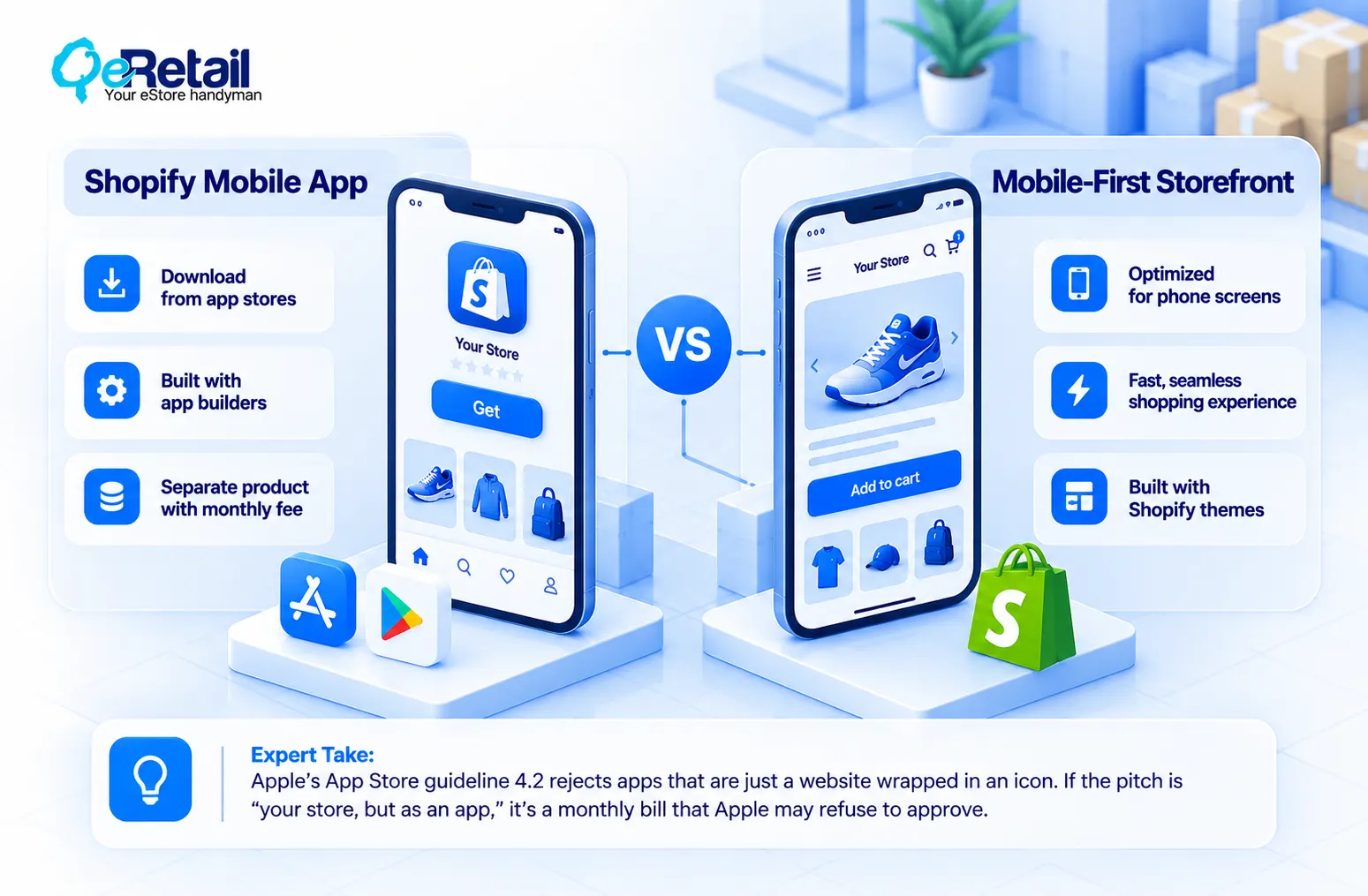
A mobile-first store is your regular Shopify website, designed for phone screens before desktop ones. Picture pages that load fast, an “Add to cart” button that stays on screen while shoppers scroll, filters that are easy to tap, and a checkout with very few steps.
Shopify’s free Horizon themes give you a modern starting point, built from blocks you can move around in the theme editor without writing code.
That makes the split easy to see. An app serves people who already chose your brand, while your mobile website serves everyone else, including every new shopper your ads bring in.
Expert Take:
Apple’s App Store guideline 4.2 rejects apps that are just a website wrapped in an icon. If the pitch you hear is “your store, but as an app,” that isn’t a plan. It’s a monthly bill that Apple may refuse to approve.
Why Does Your Mobile Store Carry More Weight in 2026?
Where people discover brands has changed. Most apps didn’t change with it.
Where are New Shoppers Finding Your Brand?
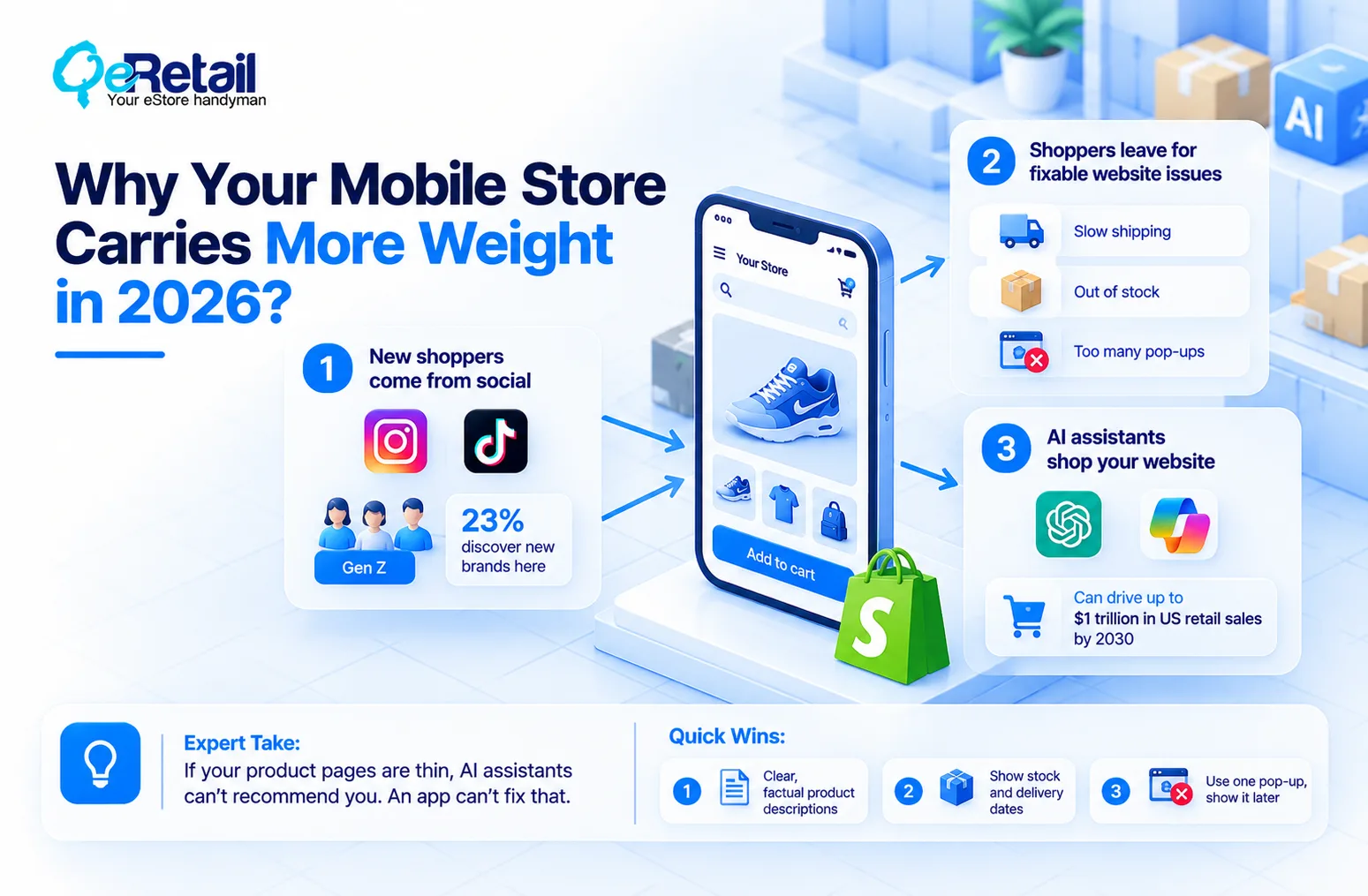
McKinsey’s State of the Consumer 2026 found 23% of Gen Z shoppers discovered a new brand on social media, compared with just 7% of baby boomers. When those younger shoppers tap a post, your product page opens inside Instagram or TikTok, not inside an app. Older buyers tend to arrive through Google or AI tools like ChatGPT, yet they land on that very same page.
What this means is simple. Your mobile product page is the front door for every channel you pay for.
What Makes Phone Shoppers Leave Without Buying?
Deloitte’s 2025 Holiday Retail Survey also asked shoppers what bothers them most online. The top answers were slow or delayed shipping (37%) and items being out of stock (36%), and about a quarter said pop-ups made shopping less enjoyable. Despite growing up online, Gen Z reported more frustration with online shopping than older generations.
Every one of these can be fixed on your website, from showing delivery dates to cutting back pop-ups. But none of them needs an app. If shoppers also drop off at the final payment step, our Shopify checkout optimization guide walks you through it.
Why are AI Assistants Now Shopping Your Website?
AI shopping assistants, often called AI agents, are tools like ChatGPT that can search, compare, and even buy products for a shopper. McKinsey projects these agents could drive up to $1 trillion in US retail sales by 2030. They pull your product details, policies, and stock levels straight from your website. And they don’t open apps.
This is where Shopify is already moving. Its Agentic Storefronts feature can share your product catalog with AI assistants such as ChatGPT and Microsoft Copilot. Our Shopify agentic commerce guide explains how to set it up.
Expert Take:
If your product pages are thin, an AI assistant can’t tell what you sell, who it’s for, or when it will arrive. So it recommends a store whose pages answer those questions. An app can’t fix that, because the assistant never opens it.
Quick Wins:
- Rewrite product descriptions in plain, factual words: what the product is, who it’s for, and its size, material, and care details.
- Show stock levels and delivery dates on every product page, so shoppers and AI tools never have to guess.
- One pop-up is enough. Show it only after someone has browsed for a while, never the moment they land.

Which Shopify Stores Should Build Mobile Apps?
Apps do work, but only for the right kind of store. More than 75% of Gen Z and millennials say a good digital experience matters in loyalty programs, and 51% of shoppers will share their data for a more personal experience.
That mix helps one type of store most: brands selling things customers run out of, like coffee, supplements, or skincare. For them, an app can send a reorder reminder at the right moment and let customers buy again in one tap. Those reminders reach customers directly, without paying Meta or Google each time.
Expert Take:
An app nobody opens every week isn’t a loyalty program. It’s a cost with a renewal date. Downloads only prove people were curious, while repeat opens prove the app is useful.
Where Should Your Store Invest at Each Revenue Level?
Your yearly sales change the answer. Here’s what makes sense at each of three stages.
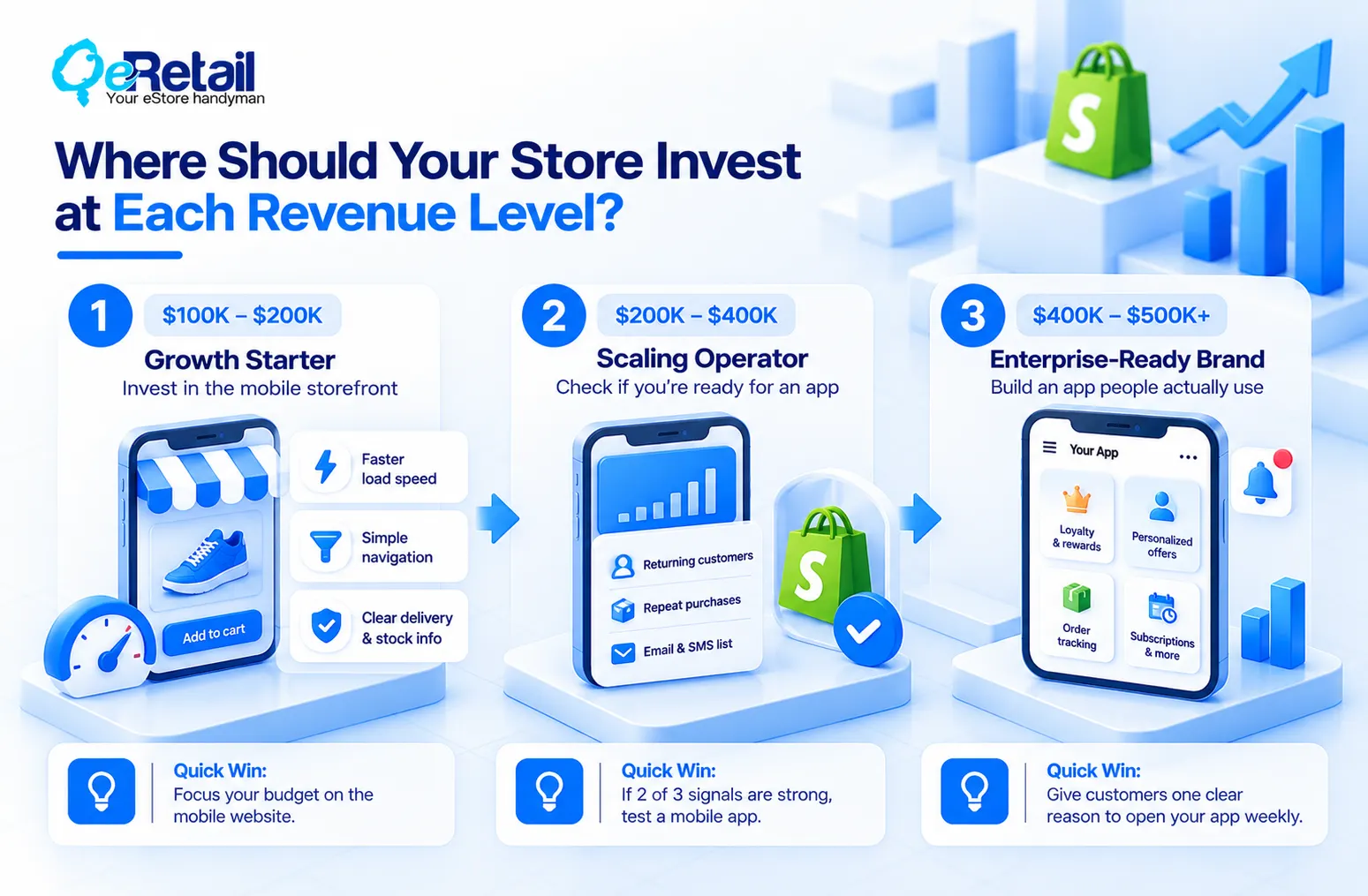
The Growth Starter ($100K to $200K): Why Does the Mobile Store Come First?
At this stage, every dollar spent on an app is a dollar taken from the pages that turn first-time visitors into buyers. You also don’t have enough repeat customers yet to make app notifications worth sending.
- Speed: Shrink large product images and remove add-ons from the Shopify App Store that you no longer use, since each one can slow your pages.
- Navigation: Add filters people actually use, like size, price, and what the product is for.
- Trust: Put a clear “arrives by” date and an “in stock” label near the Add to cart button.
What can Shopify store owners do?
Put your whole mobile budget into the website, and revisit the app question once yearly sales pass $250K.
The Scaling Operator ($200K to $400K): What Signals Show Your Store is Ready for Mobile Apps?
By now, your mobile store should already turn visitors into buyers. The next job is checking whether you have enough loyal customers to justify an app.
- Returning revenue: Each month, track how much of your revenue comes from people who have bought before.
- Product fit: Check whether customers reorder on a regular schedule, such as every 30 or 60 days.
- Owned list: Grow an email and SMS list of people who open your messages regularly, because they are the ones who would use app notifications. A strong list also lowers your customer acquisition cost, which is what you spend to win each new buyer.
What can Shopify store owners do?
If two of these three signals look strong, test an app builder on a short contract. If not, keep improving the website.
The Enterprise-Ready Brand ($400K to $500K+): What Makes Mobile Apps Worth Opening Every Week?
Here, an app can finally pay off, as long as it does more than sell. The IBM and NRF study released in January 2026 found one in three consumers want super apps, meaning apps that combine shopping with other useful services.
- Loyalty: Put points, member tiers, and early access to new products inside the app.
- Personalization: Use each customer’s purchase history to time reorder reminders.
- Utility: Add order tracking, sizing help, or subscription management.
What can Shopify store owners do?
Build the app around one clear reason to come back every week, and keep your website ready for AI shoppers at the same time.
Why Does Fixing Your Website Beat Building a Second Store?
If your mobile pages still hide stock levels, bury the filters, and fire three pop-ups, an app won’t fix any of that. Instead of a new sales channel, you’d just be giving the same problems a second home.
Get the website right, and every channel gets stronger. Social clicks turn into sales, AI assistants start recommending you, and your eventual app launches to buyers who already trust you.
Shoppers who use search, social media, and AI tools together plan to spend $2,893 this season, versus $1,175 for those who use none of them.
All of those shoppers walk in through your website. This Black Friday and Cyber Monday, how well it treats them decides how much you sell.
Frequently Asked Questions
Do Shopify Stores Really Need Mobile Apps?
Which Sells Better, Mobile Apps or Mobile Websites?
Will AI Assistants Replace Shopping Apps?
How Long Does a Mobile-First Rebuild Take?
Table of Contents