In 2025, 80% of loyalty program members told Deloitte they get more value from a brand because of its program. Read that again. Those customers feel known. They feel known because the brand sorted them and treated them differently.
You probably send one newsletter, one discount code, and one set of flows to everyone. Your first-time buyer and your fifth-time buyer get the same email.
That is not laziness. It is a belief that segmentation needs an analyst, a warehouse, and a six-figure stack. It doesn’t. Shopify already tracks order count, total spend, last order date, and email status on every customer. You just haven’t filtered it.
This guide gives you five segments to build today, the message for each, and the mistake that wrecks it.
Key Action Points:
- Build the Champions segment first, before you touch anything else
- Send a second-order message to every first-time buyer inside 30 days
- Separate slipping regulars from one-and-done buyers, because they need different offers
- Stop sending your best customers the same discount you send strangers
- Check each segment’s count monthly and delete any you never message

What is Customer Segmentation Without a Data Team?
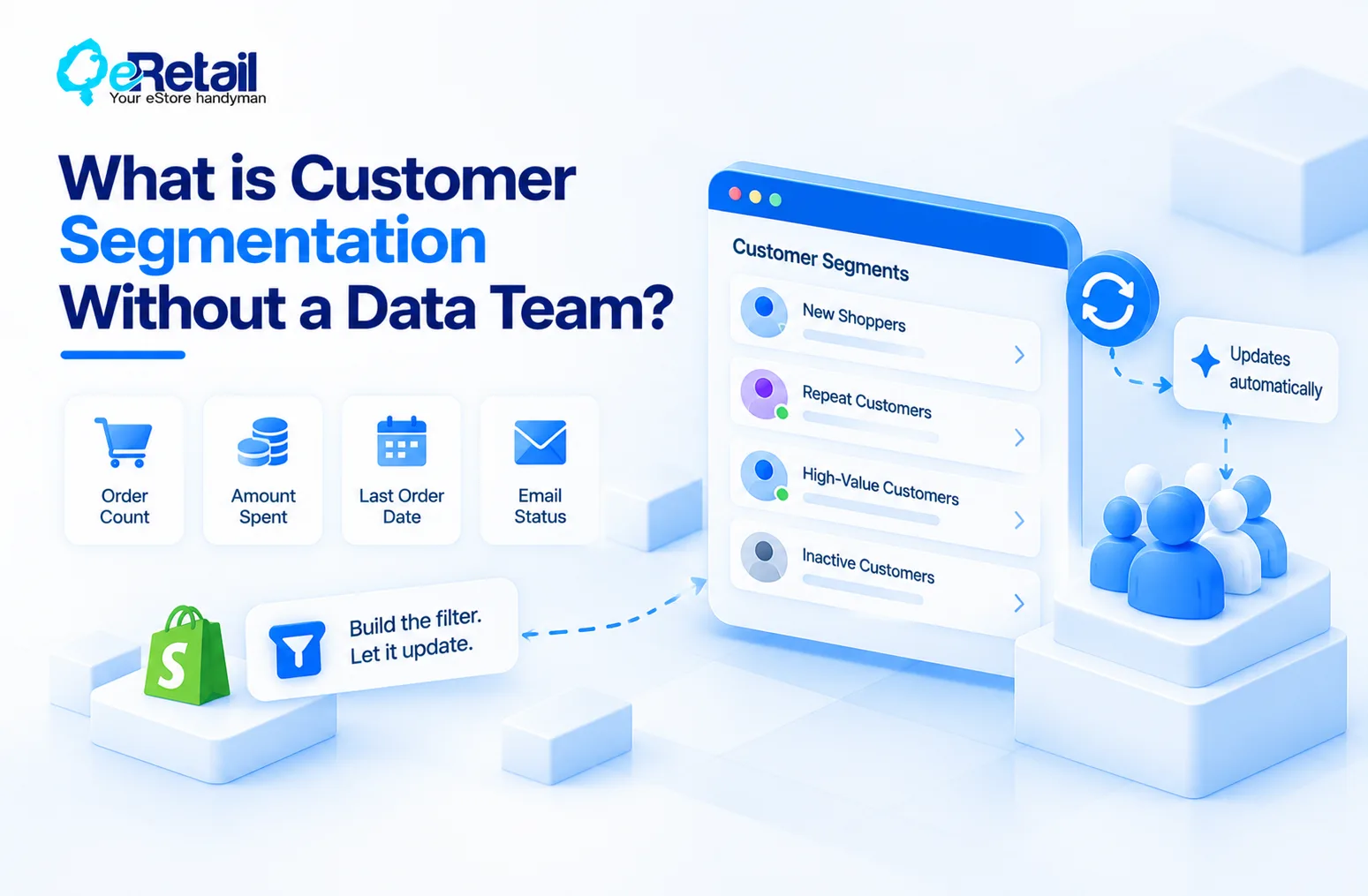
It isn’t a data science project. It’s a saved filter. Shopify’s customer segments let you group people by rules like order count, amount spent, last order date, and email subscription status. No export. No spreadsheet. No SQL. You build the filter once, and the segment updates itself as customers move in and out.
The real work is not technical. It is deciding what each group should hear. That is why five simple segments beat fifty clever ones. You can only write so many messages before the list rots.
More segments do not mean more revenue. Past five or six, most stores at this size stop sending to them. An unused segment is a dashboard, not a strategy.
The 5-Segment Framework You Can Build Today
Each segment below has a filter you can recreate in your Shopify admin, a job, and a trap. Filter names can shift between admin updates, so check the segment editor for the exact wording.
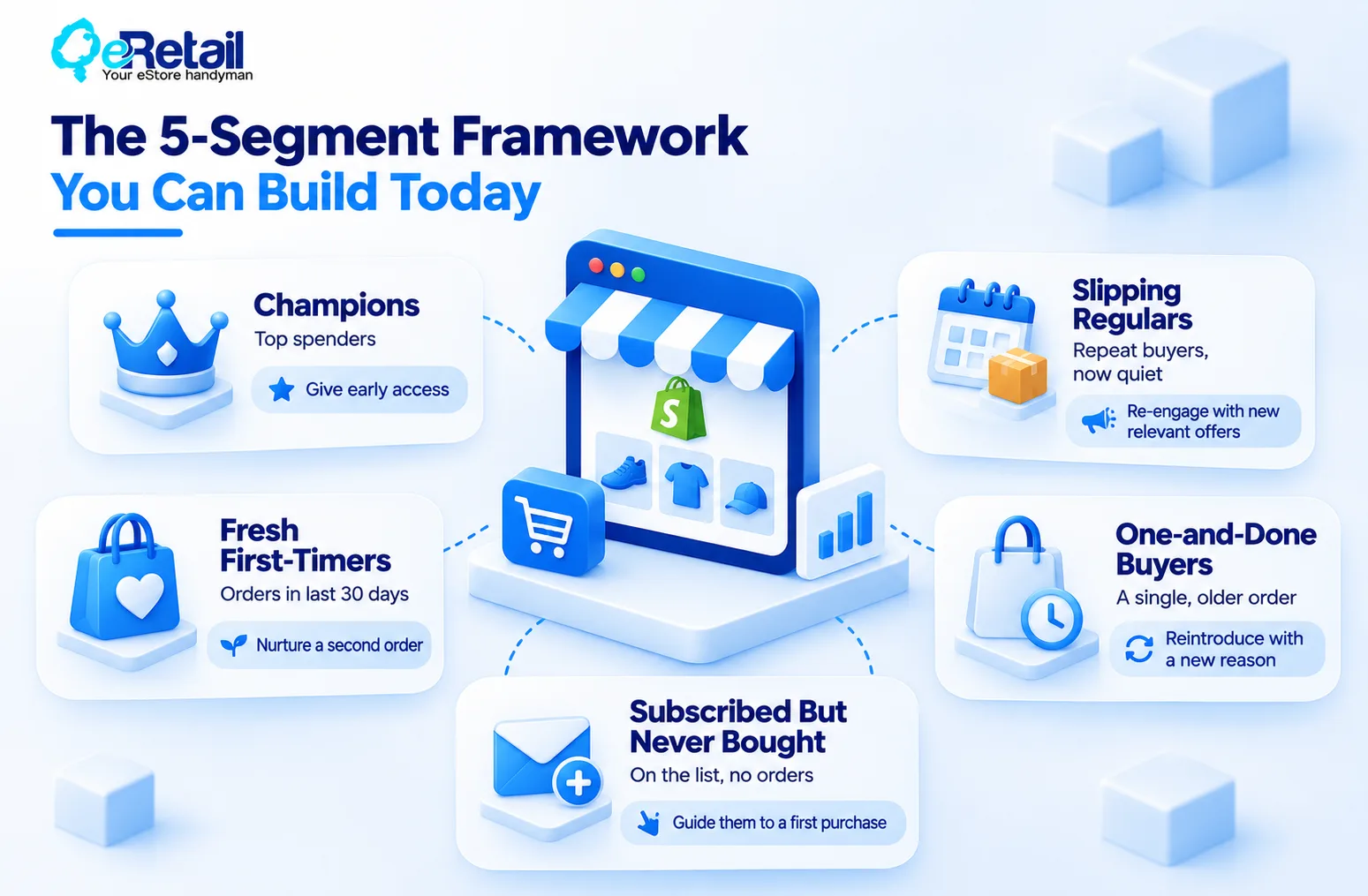
1. Champions: Your Top Spenders
These are customers with several orders and high lifetime spend. Try a filter like number_of_orders >= 3 AND amount_spent >= 300, then set the spend number so the group is roughly your top 10% of buyers.
They are small in number and large in revenue. Treat them like it. Give them early access, a note from the founder, and first look at launches. Skip the blanket 15% off. They were going to buy anyway.
Expert Take:
Discounting your best customers is not a loyalty move. It trains your most reliable buyers to wait for a code. Reward them with access and status, not margin.
Quick Wins:
- Save the Champions segment and note its size
- Send a launch preview to this group 48 hours before everyone else
- Exclude them from site-wide discount emails
2. Fresh First-Timers: Orders in the Last 30 Days
Try number_of_orders = 1 AND last_order_date >= -30d. These people just trusted you with a card number. The window to earn order two is short.
34% of consumers said they would switch from a preferred brand to one that makes them feel special, according to Accenture’s 2025 Consumer Pulse research. A first-timer has no preferred brand yet. You are competing for that slot right now.
Send a how-to-use message, a care guide, or a pairing suggestion tied to what they bought. Not a coupon on day two. Value first, offer later.
Expert Take:
Most stores treat the post-purchase email as a receipt. It is your cheapest acquisition channel. Our guide on reducing Shopify customer acquisition cost shows why the second order is where payback actually happens.
Quick Wins:
- Build a three-email sequence for this segment only
- Recommend a specific second product based on the first
- Move buyers out of this segment automatically after 30 days
3. Slipping Regulars: Repeat Buyers Gone Quiet
Try number_of_orders >= 2 AND last_order_date < -120d. Adjust the number of days to match your normal reorder cycle. A candle store and a mattress store should not share a window.
These customers already proved they like you. Something changed. Your message is a nudge, not a rescue.
Ask what they’d like to see. Show what’s new since their last order. Offer a small, time-boxed incentive only if the nudge alone fails.
Expert Take:
“We miss you” is the weakest subject line in eCommerce. Nobody misses a brand. They respond to something relevant they haven’t seen yet.
Quick Wins:
- Set the quiet window to roughly 1.5 times your average reorder gap
- Lead with new products, not a discount
- Test the incentive only on those who ignore the first message
4. One-and-Done Buyers: A Single Order, Long Ago
Try number_of_orders = 1 AND last_order_date < -180d. Different from the slipping group, and this matters. They never formed a habit.
Do not treat them like lapsed loyalists. Reintroduce the brand. Show a bestseller they didn’t buy, a review from someone like them, or a bundle. Think of it as a second first impression.
Cap your effort here. Two or three tries, then suppress them from regular sends. Your sender reputation matters more than a stale list.
Expert Take:
This is where most win-back flows go to die. Stores keep emailing cold buyers for years, and open rates drag down inbox placement for the customers who do care. Suppression is a revenue tactic.
Quick Wins:
- Run a three-touch reintroduction, then stop
- Move non-responders to a suppression list
5. Subscribed But Never Bought
Try email_subscription_status = ‘SUBSCRIBED’ AND number_of_orders = 0. These people raised a hand and then did nothing. That is not rejection. It is hesitation.
76% of shoppers felt overwhelmed by too many product choices, per Accenture’s 2025 holiday research. Your subscriber may be one of them. Narrow the choice for them. Send one bestseller, one review, one clear reason to try it.
Your welcome discount is not a strategy for this group. If a 10% code didn’t convert them in week one, a second code in week six will not either. The blocker is trust or clarity, not price.
Quick Wins:
- Send your top three reviewed products, not your full catalog
- Answer the biggest objection: shipping, sizing, returns, or quality
- Retire anyone who stays silent after four emails

How Each Revenue Tier Should Start
You don’t need all five this week. Pick by stage.
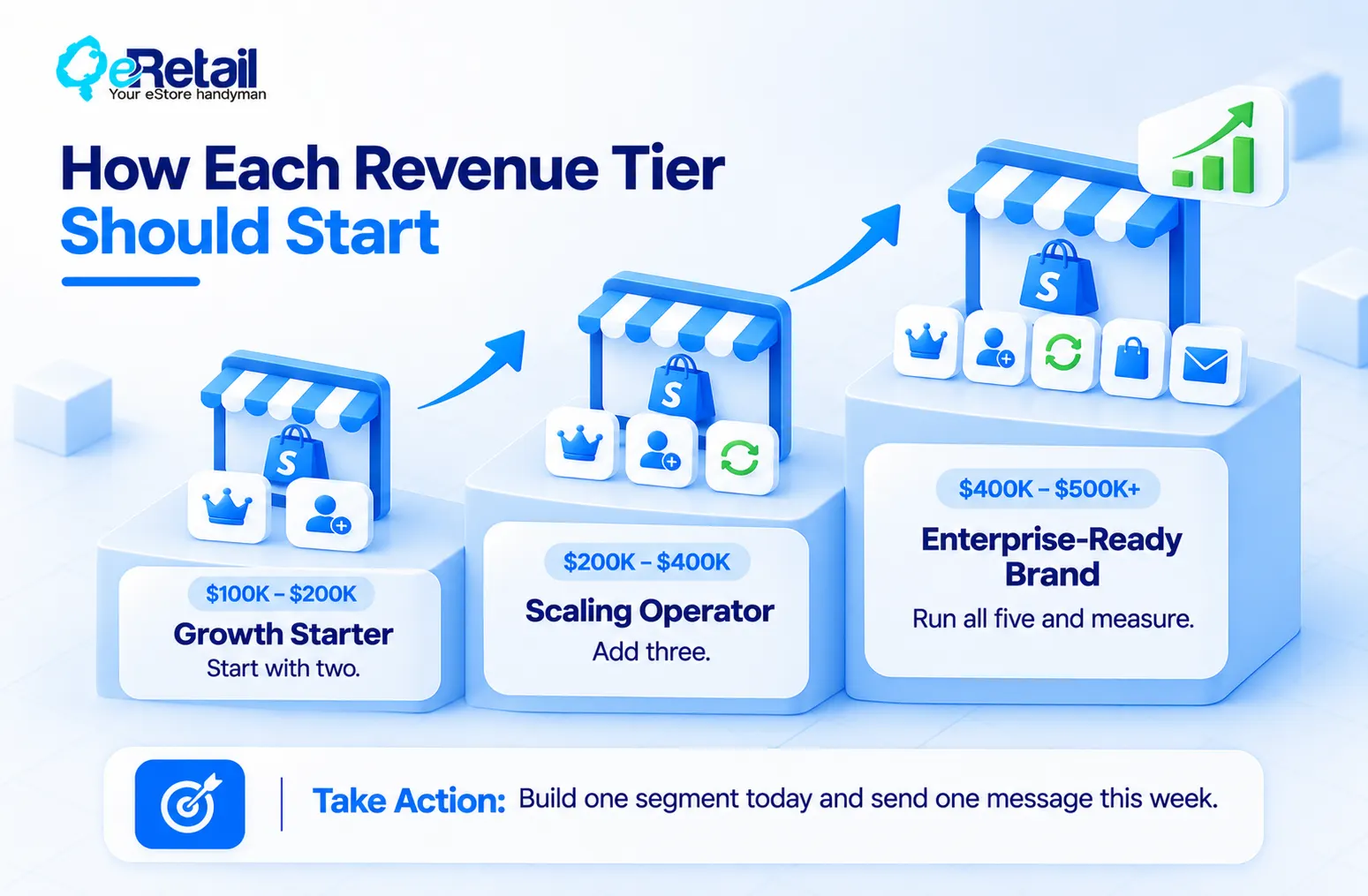
- The Growth Starter (100K- 200K): Start With Two. Build Champions and Fresh First-Timers. Your list is small, and the second order is your biggest lever.
- The Scaling Operator (400K-200K): Add Three. Layer in Slipping Regulars and One-and-Done Buyers. At this size, retention starts to pay for acquisition.
- The Enterprise-Ready Brand (400K-500K+): Run All Five and Measure. Compare revenue per recipient by segment. Review how each fits your wider TOFU, MOFU, and BOFU funnel.
What can Shopify store owners do?
Build one segment today and send it one message this week. A live, imperfect segment teaches you more than a perfect plan.
Final Thoughts
Most stores think they’re doing segmentation because they have a “VIP” tag nobody uses. You didn’t segment; you just labeled.
Real segmentation changes what a customer sees. The champion gets access. The first-timer gets help. The slipping regular gets news. The cold buyer gets a clean exit.
Do that for a quarter, and your list stops being one big audience and starts behaving like five smaller ones, each with a reason to open the next email. Not sure which of your segments is leaking the most revenue?
Work with a team that audits it with you. Book a free consultation, and we will map your five segments and the first message for each.
Frequently Asked Questions
Can I Do Customer Segmentation in Shopify Without Any Apps?
How Many Customer Segments Should a Small Store Have?
Do Customers Actually Want Personalized Messages?
Will Segmenting Reduce My Email Volume?
How Long Does It Take to Set Up These Five Segments?
Table of Contents