Every Shopify store owner spends time improving product pages, optimizing checkout, and lowering acquisition costs.
Yet many first-time shoppers still leave without buying because they hesitate at one simple question:
“What happens if I need to return this?”
For growing Shopify brands, return policies are often treated as legal documentation rather than part of the buying experience. They are buried inside the footer, written in complex language, or filled with conditions that create uncertainty instead of confidence.
The result is subtle but expensive. Customers postpone purchases, compare competitors, or abandon their carts altogether, not because they dislike the product, but because they are unsure about the risk of buying.
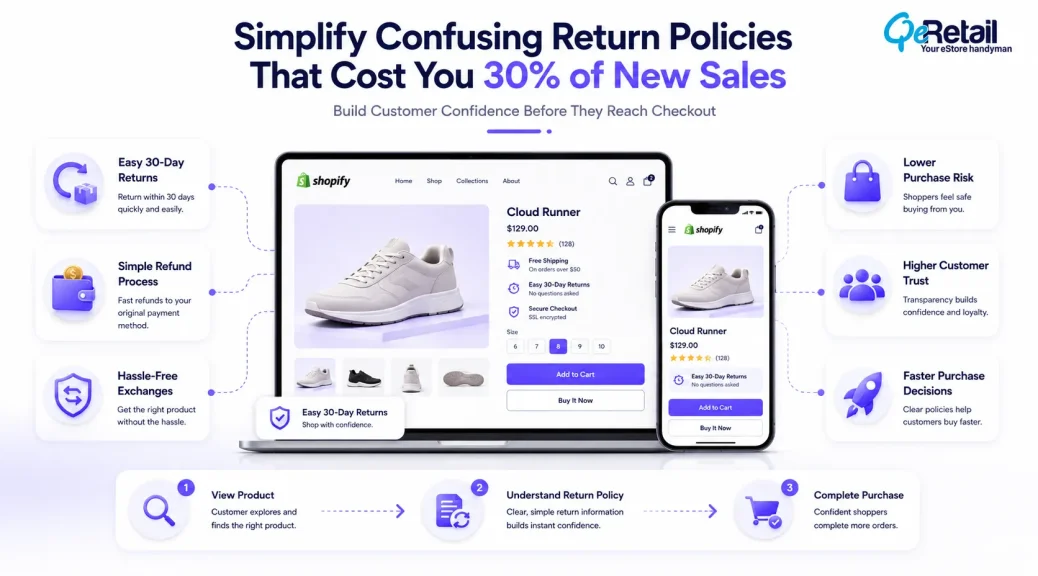
A return policy should reduce buying anxiety, not create it. When customers can immediately understand how returns work, they make purchasing decisions faster and with greater confidence.
As per Baymard Institute’s cart abandonment research, 10% of online shoppers leave because the return policy wasn’t satisfactory.

Key Action Points Summary
Before improving your return experience, focus on these practical actions that immediately improve purchase confidence.
- Replace legal language with customer-friendly explanations
- Display return highlights on product pages
- Clearly define return eligibility and timelines
- Explain refund processing before checkout
- Make return costs visible early
- Use visuals instead of large text blocks
- Keep return messaging consistent across devices
- Regularly test customer understanding
Quick Wins: Improve Purchase Confidence Before Rewriting Your Entire Policy
Most Shopify stores don’t need to rebuild their entire returns process overnight. Small improvements made today often remove enough uncertainty to recover lost conversions almost immediately.
1. Move your return policy link closer to the Add to Cart button.
Customers often look for return information while deciding whether to purchase, not after they have added a product to the cart. If they cannot find it quickly, many leave the page to search elsewhere or postpone the purchase entirely. Making return information visible at the decision point reduces unnecessary friction and keeps customers focused on completing the order.
2. Replace legal terminology with plain English.
Many return policies are written from a legal perspective instead of a customer perspective. Complex language increases cognitive effort and creates unnecessary uncertainty.
Rewriting the policy using simple, conversational language helps shoppers understand exactly what happens if they need to return a product, making your business appear more transparent and trustworthy.
3. Add a simple “Free Returns Within 30 Days” trust badge.
Visual reassurance often works faster than paragraphs of policy text. A small trust badge placed near pricing or the Add to Cart section immediately communicates purchase protection without forcing customers to leave the product page.
It reduces hesitation while reinforcing confidence during one of the most important decision-making moments.
4. Answer the three questions every shopper has.
Can I return it?
How long do I have?
Who pays for shipping?
If these answers are immediately visible, purchase hesitation drops significantly.
Why Do Return Policies Influence First-Time Purchase Decisions?
Many Shopify merchants assume customers only read return policies after something goes wrong.
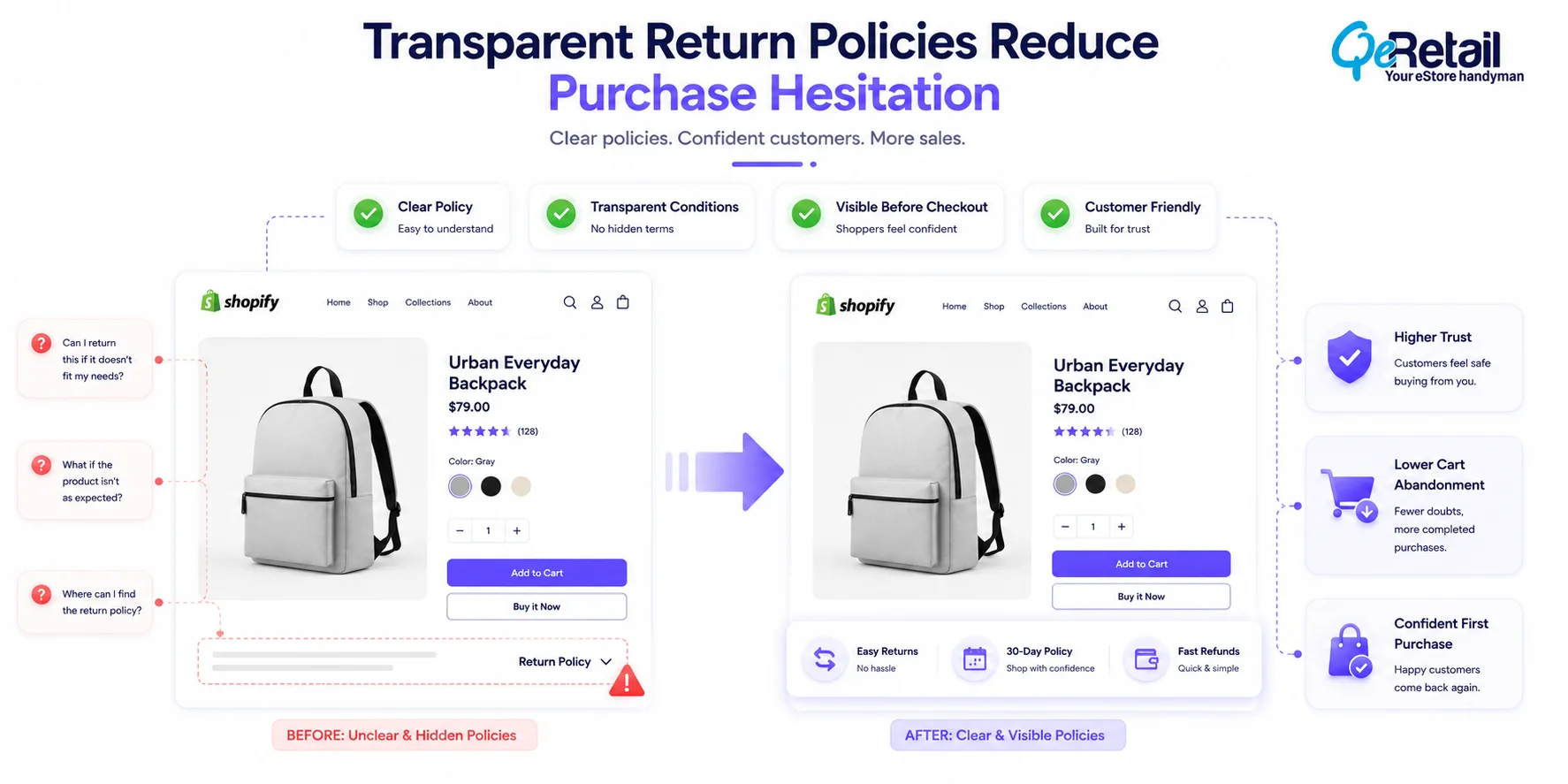
Customer behavior suggests otherwise.
New shoppers frequently review return information before purchasing because they are evaluating overall purchase risk. Unlike repeat buyers who already trust your business, first-time visitors have very little experience with your fulfillment process, customer service, or refund reliability.
Your return policy becomes part of your trust architecture.
When customers quickly understand what happens if the product doesn’t meet expectations, they feel safer completing the purchase. When the policy feels vague or complicated, uncertainty begins replacing purchase intent.
5 Ways to Simplify Your Shopify Return Policy
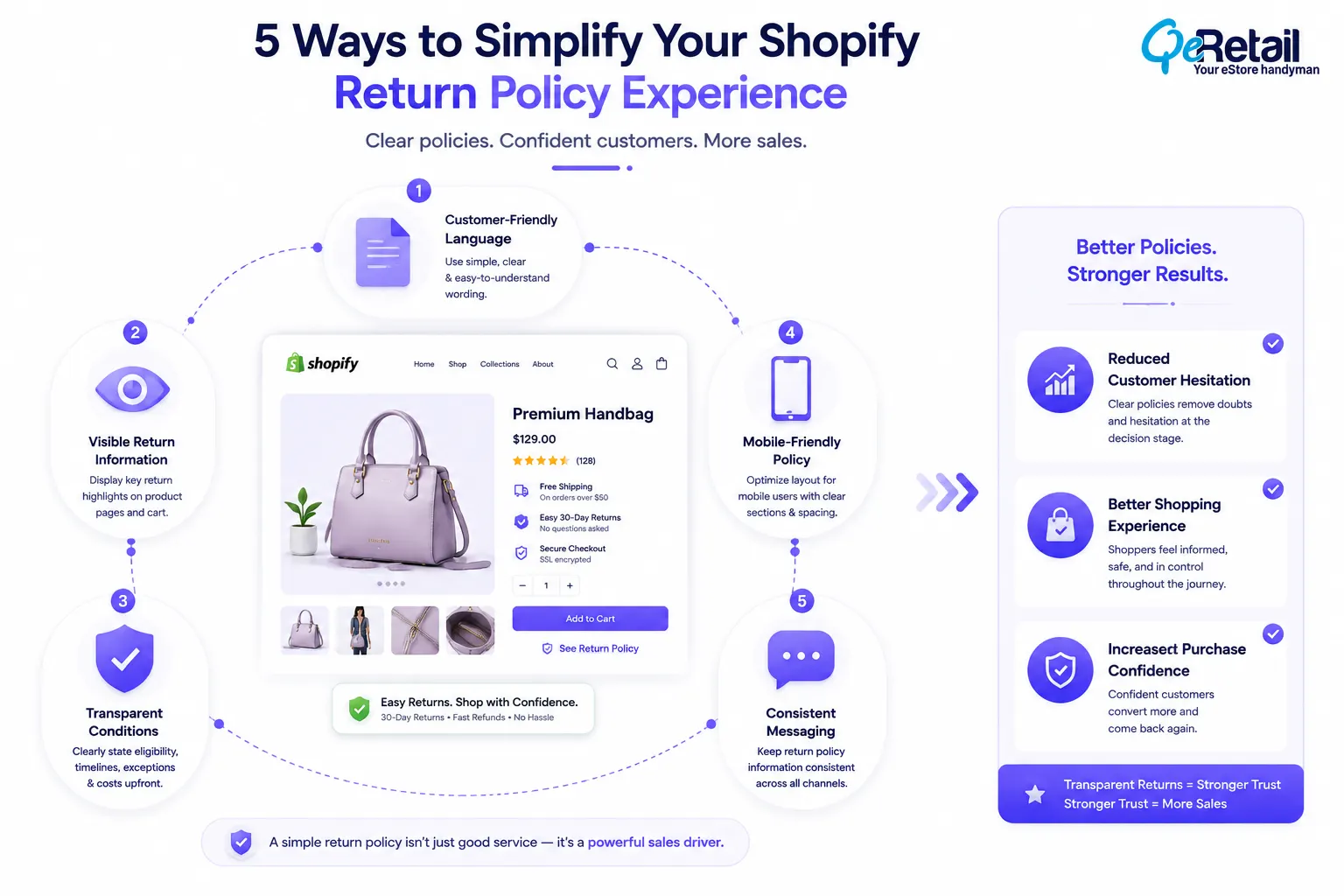
1. Replace Legal Language with Customer Language
Many Shopify return policies are written to protect the business legally, but they often overlook the customer experience. Long paragraphs filled with legal terminology can make straightforward policies appear complicated. Customers are rarely looking for legal precision, they simply want clear answers before making a purchase.
What should Shopify stores improve?
- Rewrite policies using customer-friendly language.
- Break long paragraphs into smaller sections.
- Replace technical terminology with plain English.
- Use practical examples wherever appropriate.
Quick Wins:
Review the first five paragraphs of your existing return policy today. If any sentence feels like it belongs in a legal agreement rather than a customer guide, simplify it. Improving readability alone can reduce customer uncertainty before checkout.
2. Surface Return Information Before Customers Need It
Many stores hide their return policy inside the website footer, assuming customers will find it if necessary. In reality, shoppers often want reassurance while comparing products or evaluating whether they trust your business.
During our internal UX reviews of multiple Shopify storefronts, we observed that nearly 7 out of 10 stores displayed return information only inside the footer or a separate policy page. Stores that surfaced return messaging directly on product pages generally created a smoother purchase journey and reduced pre-purchase hesitation.
What should Shopify stores improve?
- Add return highlights on product pages.
- Display return information near pricing.
- Mention refund timelines inside the cart.
- Reinforce return guarantees before checkout.
Quick Wins:
Instead of asking customers to read an entire policy page, add one simple reassurance statement below every Add to Cart button, such as “Easy Returns Within 30 Days.” This small UX improvement immediately increases policy visibility.
3. Remove Hidden Conditions
Customers generally accept reasonable return limitations when they are communicated honestly. Problems begin when important restrictions are buried inside lengthy paragraphs or revealed only after purchase.
What should Shopify stores improve?
- Clearly list non-returnable products.
- Explain product condition requirements.
- Display restocking fees early.
- Separate exceptions into dedicated sections.
Quick Wins:
Read your policy from the perspective of a first-time customer. If you discover important exceptions only after scrolling extensively, move those conditions closer to the beginning of the page where shoppers can easily notice them.
4. Optimize Return Policies for Mobile Users
A growing percentage of Shopify shoppers read return information directly from their smartphones. Unfortunately, many return pages remain difficult to navigate because of large text blocks, inconsistent formatting, and excessive scrolling.
What should Shopify stores improve?
- Improve spacing and typography.
- Use collapsible content sections.
- Simplify long paragraphs.
- Test readability across different screen sizes.
Quick Wins:
Open your return policy on both Android and iPhone devices. If customers need to zoom, scroll excessively, or search through dense paragraphs to find key information, reorganize the layout into shorter sections with clear headings.
5. Keep Return Messaging Consistent Across Every Customer Touchpoint
Return information should remain consistent wherever customers encounter it.
Product pages, FAQs, checkout pages, confirmation emails, live chat, and customer support documentation should all communicate the same policy. Conflicting information creates unnecessary confusion and can quickly reduce customer confidence.
What should Shopify stores improve?
- Standardize return messaging.
- Update FAQ content.
- Review automated email templates.
- Align customer support responses.
Quick Wins:
Search your website for every mention of “returns,” “refunds,” and “exchanges.” Compare each version carefully and update anything that no longer matches your official return policy.
How QeRetail Helps Shopify Stores Build Return Experiences That Increase Sales
Return policies influence far more than post-purchase operations. They shape customer confidence throughout the buying journey.
QeRetail helps Shopify brands evaluate how return communication interacts with conversion behavior, mobile experience, trust signals, and overall customer experience.
Rather than simply rewriting policy pages, we analyze how return information appears across product pages, checkout, support journeys, and post-purchase communication. This allows businesses to reduce uncertainty before customers hesitate.
Our Shopify specialists focus on improving:
- Return policy usability
- Trust-building UX improvements
- Mobile readability
- Customer journey consistency
- Conversion-focused policy placement
- Checkout confidence optimization

Conclusion
For first-time visitors, return policy is one of the strongest indicators of how confidently a business stands behind its products.
When return information is simple, transparent, and consistently presented throughout the buying journey, customers spend less time questioning risk and more time completing purchases. Small improvements in clarity often influence conversion rates more than many expensive marketing initiatives.
QeRetail helps Shopify businesses transform operational content into customer confidence. By combining Shopify expertise, UX optimization, and conversion-focused design, we help brands simplify complex customer journeys while improving long-term revenue performance.
If your Shopify return policy is creating uncertainty instead of confidence, contact us to discover how strategic UX improvements can strengthen both trust and conversions.
Frequently Asked Questions
How Does A Return Policy Affect Shopify Conversion Rates?
Where Should Return Policy Information Appear On A Shopify Store?
Should Every Shopify Store Offer Free Returns?
How Often Should A Shopify Return Policy Be Reviewed?
How Can I Tell If My Return Policy Is Confusing Customers?
Table of Contents