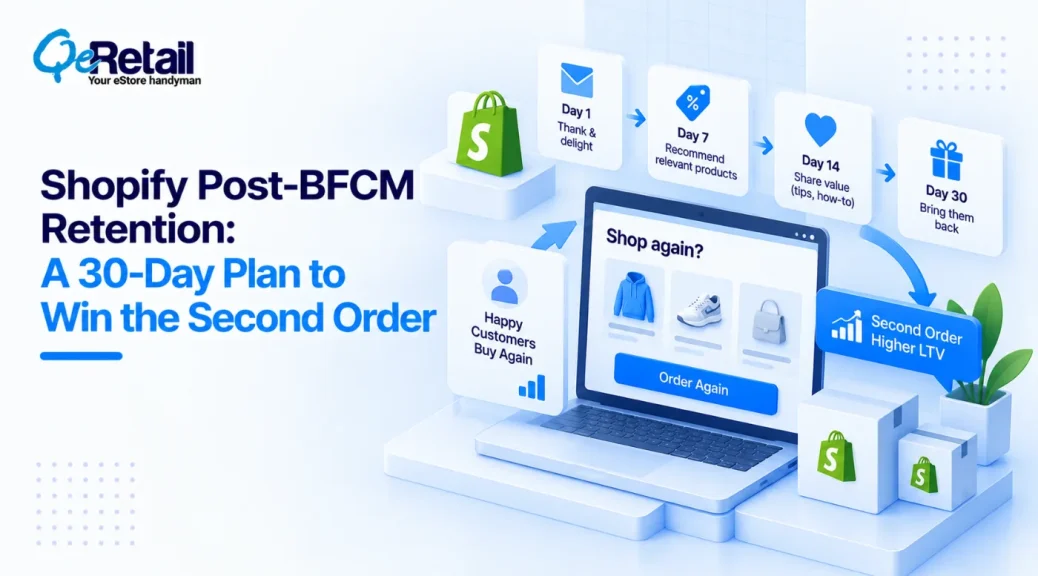
Black Friday and Cyber Monday (BFCM) can bring a sudden wave of first-time buyers, higher order volumes, and customers who may have discovered your brand primarily because of a discount.
The harder part begins after the sale ends.
Once promotional banners disappear and order volumes return to normal, Shopify stores have an opportunity to determine whether those customers become repeat buyers or simply remain one-time transactions.
The first 30 days after BFCM are particularly important because the store still has fresh purchase data, recent customer interactions, product preferences, and post-purchase signals to work with.
Shopify merchants generated a record $14.6 billion in BFCM sales in 2025, while more than 81 million customers purchased from Shopify-powered businesses worldwide. That creates a substantial pool of customers for merchants to engage after the event.
But retention does not mean sending another discount to everyone who purchased during BFCM.
It means understanding who bought, what they bought, how they experienced the order, and what should happen next based on those signals.

Key Action Points Summary
- Separate first-time BFCM buyers from existing repeat customers
- Segment customers according to products, order value, purchase intent, and engagement
- Trigger post-purchase communication based on the actual customer journey
- Use product-specific education to increase satisfaction and future purchase potential
- Identify customers who are ready for a second purchase rather than discounting everyone
- Use customer and order data to build more relevant retention campaigns
- Monitor returns, support requests, reviews, and fulfillment issues before pushing another offer
- Create different retention paths for high-value, repeat, and discount-driven customers
- Measure second-purchase behaviour instead of judging retention only through campaign clicks
- Use Shopify automation, customer data, APIs, and integrations where manual retention workflows become difficult to manage
The 30-Day Shopify Retention Plan After BFCM
The first month after BFCM should gradually shift from transaction-focused communication toward customer-specific engagement.
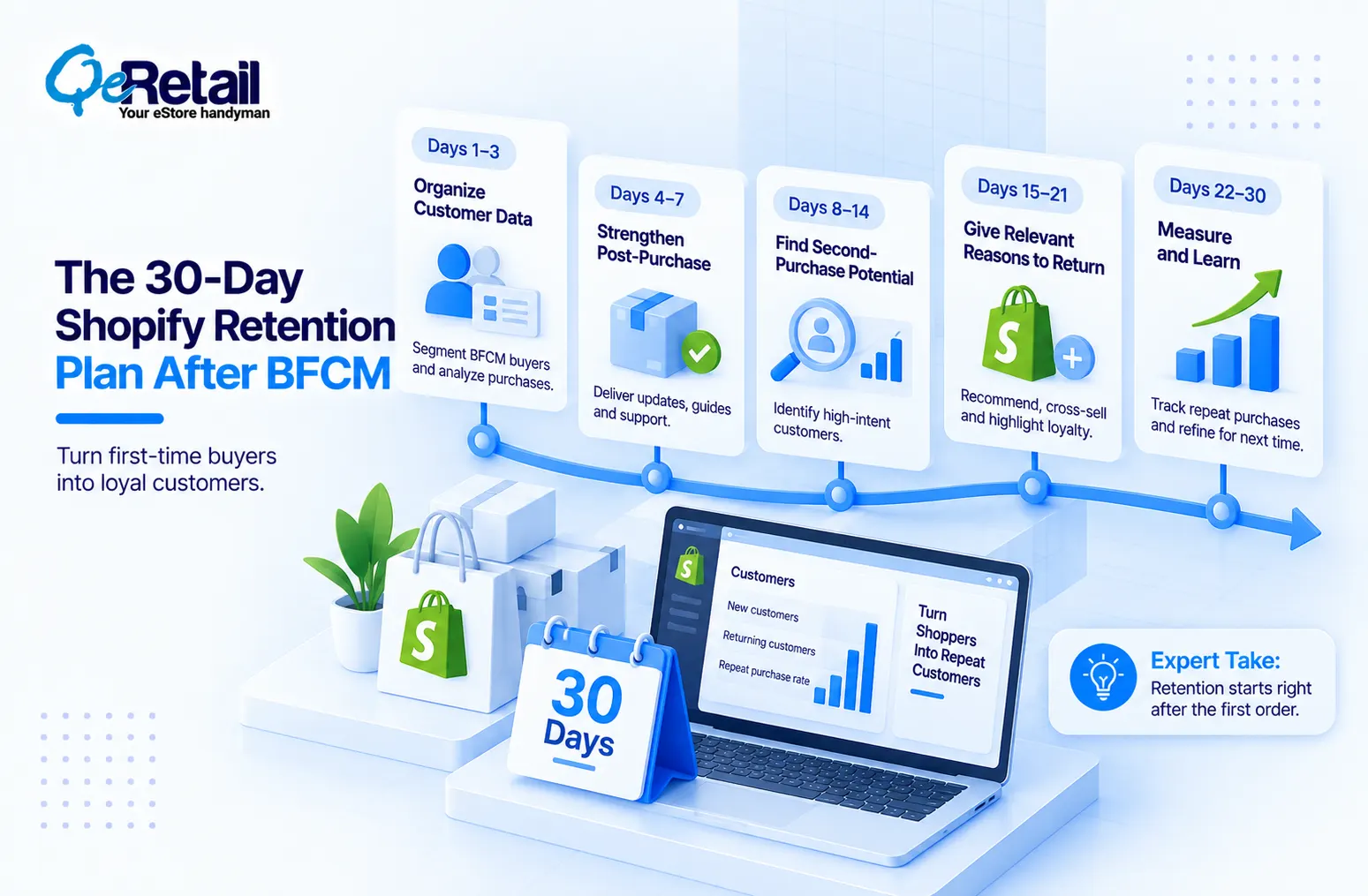
Instead of running another broad promotion immediately, Shopify stores can use the information generated during BFCM to determine what each customer should experience next.
Days 1–3: Organize Your BFCM Customer Data
The first step is understanding who actually purchased during the event.
Separate new customers from existing customers and identify the products, order values, discounts, markets, and channels associated with those purchases.
Shopify customer profiles and analytics can provide useful foundations for comparing new versus returning customers, repeat purchase rates, customer lifetime value, retention cohorts, and purchase frequency.
What Should Shopify Stores Do To Improve?
- Create a segment for first-time BFCM customers
- Separate new customers from returning customers
- Record products and categories purchased
- Compare order value and discount levels
- Identify customers with multiple BFCM orders
Quick Win:
Create a BFCM customer segment containing first-time buyers only. Add purchase date, order value, product category, discount usage, and subscription status so future campaigns can use actual purchase context.
Days 4–7: Make The Post-Purchase Experience Part Of Retention
Retention can start before a customer is ready to buy again.
Customers who receive clear delivery information, useful product guidance, and timely support have more opportunities to develop confidence in the brand after the initial transaction.
This stage should therefore focus on helping customers get value from what they already purchased rather than immediately asking them to purchase again.
What Should Shopify Stores Do To Improve?
- end useful product-specific information after purchase
- Communicate fulfillment and delivery updates clearly
- Provide setup, usage, or care instructions where relevant
- Make returns and support information easy to access
- Monitor customer-service issues before triggering promotional messages
Quick Win:
Build post-purchase content around the products customers actually bought. For example, customers purchasing skincare, electronics, apparel, or fitness products can receive different education rather than one generic thank-you email.
Days 8–14: Identify Customers With Second-Purchase Potential
By the second week, Shopify stores should begin distinguishing customers who show genuine interest from those who purchased only because of the BFCM promotion.
Look at product type, engagement, browsing behaviour, previous customer history, and the likely replenishment or purchase cycle.
A customer who purchased a consumable product may have a natural second-purchase opportunity, while someone buying a durable product may need education or complementary products first.
What Should Shopify Stores Do To Improve?
- Identify products with natural repeat-purchase cycles
- Create complementary-product segments
- Compare engagement after the first purchase
- Separate high-value customers from discount-only buyers
- Avoid sending the same offer to every BFCM customer
Quick Win:
Take your top five BFCM products and map one logical next purchase for each. Use the map to create product-specific retention segments rather than relying on one broad customer list.
Days 15–21: Introduce Relevant Reasons To Return
At this stage, the communication should move beyond explaining the first purchase.
Customers who have received their products and engaged with the brand can now be introduced to complementary products, new collections, loyalty benefits, educational content, or other relevant reasons to return.
The important distinction is relevance.
What Should Shopify Stores Do To Improve?
- Recommend products based on previous purchases
- Introduce complementary products where appropriate
- Highlight loyalty or membership benefits
- Personalize campaigns according to customer behaviour
- Reserve stronger incentives for customers who actually need them
Quick Win:
Build a simple product relationship matrix showing which products naturally complement each BFCM bestseller. Use it to power targeted recommendations instead of promoting the entire catalog.
Days 22–30: Measure The Second-Purchase Opportunity
The final week should focus on measurement rather than automatically launching another campaign.
Shopify stores should determine which BFCM customers returned, which segments engaged, which products generated additional interest, and where customers stopped progressing through the journey.
This creates a feedback loop that can improve future retention campaigns and next year’s BFCM acquisition strategy.
What Should Shopify Stores Do To Improve?
- Track customers making a second purchase
- Compare repeat purchase rates across segments
- Measure revenue from BFCM-acquired customers
- Identify products associated with stronger retention
- Feed retention insights into future campaigns
Quick Win:
Create a BFCM retention cohort and compare first-time buyers who made a second purchase within 30 days against those who did not. Then compare their original products, order values, discounts, and engagement patterns.
What Shopify Stores Should Measure After BFCM?
Revenue from the BFCM weekend can look impressive without showing whether the acquired customers will contribute additional value.
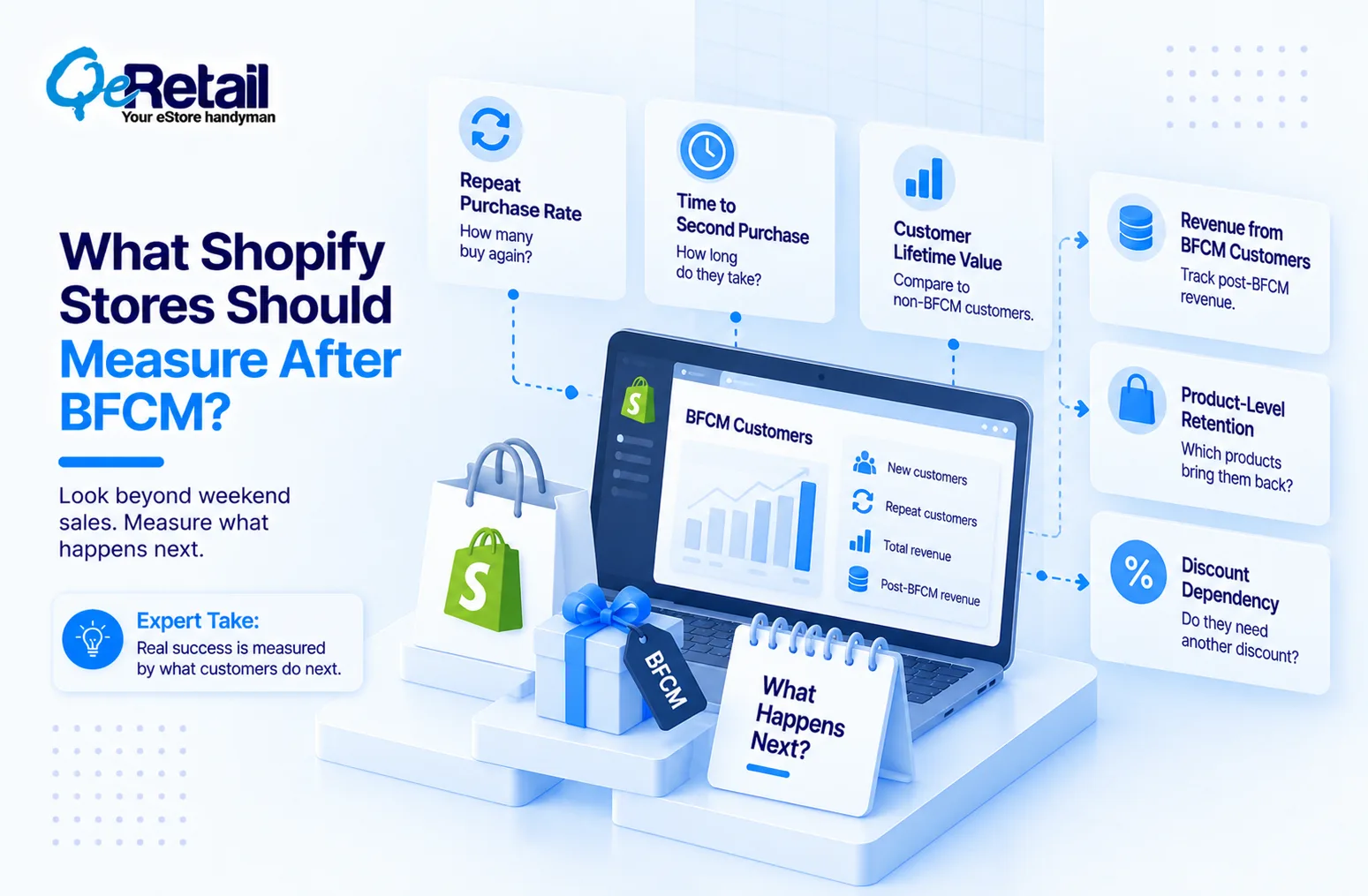
A stronger retention review looks beyond total sales and examines what happens after the original transaction.
Repeat Purchase Rate
Measure how many BFCM customers placed another order during the following 30 days.
Time To Second Purchase
Track how long customers take to return. This can help identify natural purchase windows for different product categories.
Customer Lifetime Value
Compare the longer-term value of BFCM-acquired customers against customers acquired during ordinary trading periods.
Revenue From BFCM-Acquired Customers
Separate revenue generated during BFCM from revenue generated by those same customers afterward.
Product-Level Retention
Determine which products or categories are associated with stronger repeat-purchase behaviour.
Discount Dependency
Compare second purchases made with and without additional discounts. This helps identify whether customers are returning because of brand value or because another promotion is required.
How QeRetail Helps Shopify Stores Build Post-BFCM Retention Systems
QeRetail helps Shopify businesses connect customer data, storefront experiences, integrations, and automation into more structured retention workflows.
- Shopify Customer Data and Segmentation: We help businesses structure customer and order data so retention campaigns can be based on meaningful purchase behaviour rather than broad customer lists.
- Custom Shopify Automation: We can implement custom workflows and business rules when standard automation cannot adequately support the required customer journey.
- CRM, Email and Marketing Integrations: We integrate Shopify with CRM, email, SMS, loyalty, analytics, and other marketing platforms to create more connected retention workflows.
- Personalized Shopify Experiences: We can develop product recommendations, customer-specific storefront experiences, and other personalization features based on available customer and product data.
- Shopify API and Third-Party Integrations: Our team can connect Shopify with external systems when customer information needs to move between multiple business platforms.
- Retention Analytics and Optimization: We help Shopify stores create reporting structures that reveal repeat purchases, customer cohorts, product performance, and other post-BFCM retention signals.

Conclusion
BFCM creates an unusual concentration of customer activity, but the value of that activity should not be measured only by the revenue generated during the sale. The customers acquired during this period give Shopify stores new behavioural and transactional data that can inform what happens next.
A successful 30-day plan therefore moves away from treating every BFCM buyer as another promotional audience.
QeRetail helps Shopify businesses turn these retention requirements into practical digital solutions through custom Shopify development, automation, integrations, personalization, and analytics.
Contact us to explore how your Shopify store can turn post-BFCM customer activity into a stronger retention strategy.
Frequently Asked Questions
What Should Shopify Stores Do Immediately After BFCM?
How Long Should A Post-BFCM Retention Campaign Last?
Should Shopify Stores Offer Another Discount After BFCM?
How Can Shopify Stores Identify BFCM Customers Who Are Most Likely To Return?
Can Custom Shopify Development Improve Post-BFCM Retention?
Table of Contents