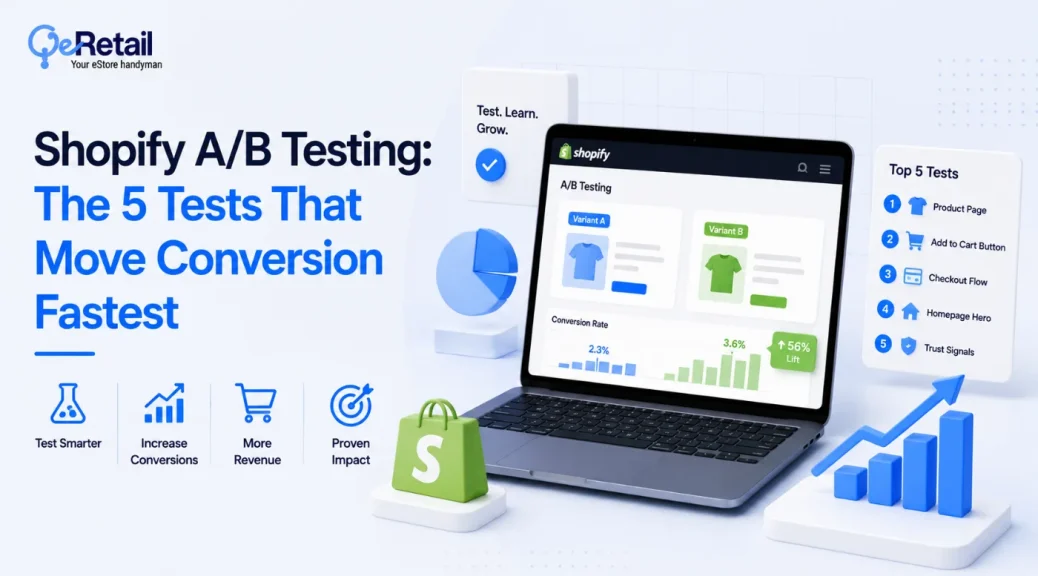
Your Shopify store can have strong traffic, good products, and a well-designed storefront, yet still leave conversion opportunities unexplored.
The challenge is knowing which change is actually worth testing.
A different button colour, headline, product image, cart layout, or checkout interaction may all look like reasonable experiments. But testing random elements can consume time without producing insights that meaningfully improve the business.
A better approach is to start with the parts of the shopping journey that influence important customer decisions and have enough traffic to produce useful evidence.
A/B testing gives Shopify stores a way to compare different experiences with real customers instead of relying entirely on assumptions. Shopify describes A/B testing as a method for testing variations against each other and using measurable outcomes to determine which performs better.

Key Action Points Summary
- Start with high-traffic pages that influence important purchasing decisions
- Identify the customer problem before deciding what to test
- Prioritize tests based on potential business impact and implementation effort
- Test product-page elements before moving into more complex experiences
- Evaluate cart and checkout interactions where appropriate
- Use one clear primary conversion metric for each experiment
- Avoid declaring winners from short-term or insufficient data
- Consider revenue and business value alongside conversion rate
- Segment results only when there is a strong business reason
- Turn successful experiments into permanent improvements and new hypotheses
Quick Wins: Find Your Best Shopify A/B Testing Opportunities
Before building an experiment, look at your existing store data. The most valuable test is often hidden inside a page or interaction that already receives significant customer attention.
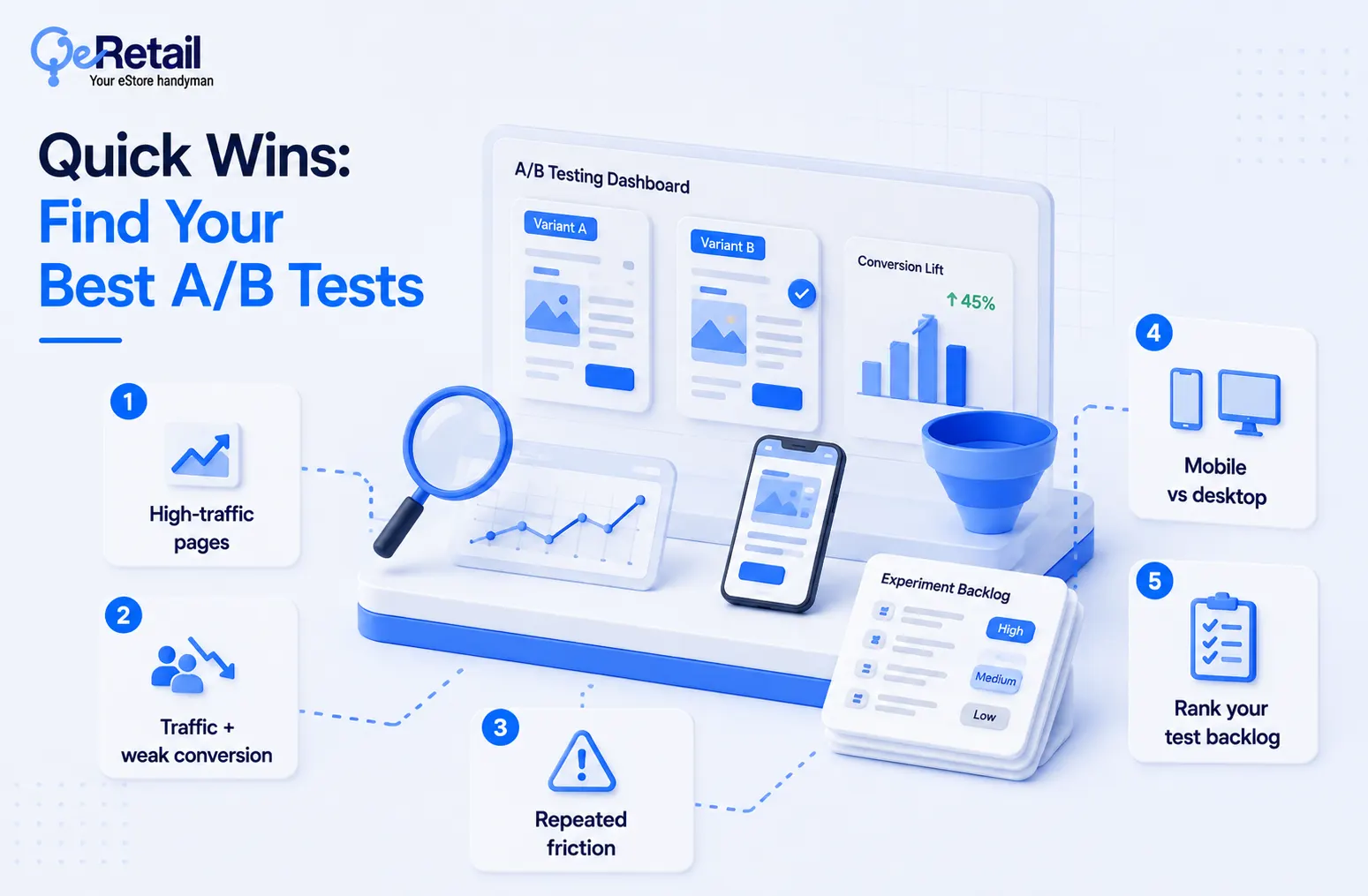
1. Identify Your Highest-Traffic Pages
Review your analytics and find the product pages, collection pages, cart, and other storefront areas receiving the most qualified traffic. These can provide a stronger starting point than low-volume pages.
2. Find Pages With Strong Traffic But Weak Conversion
Compare traffic with add-to-cart, checkout initiation, and purchase behaviour. A high-traffic page with a meaningful drop-off can be more valuable to test than a page with very little activity.
3. Look For Repeated Customer Friction
Review search behaviour, product interactions, cart exits, support questions, and session recordings where available. Repeated friction can provide stronger testing ideas than personal opinions about design.
4. Check Your Mobile Experience Separately
Compare mobile and desktop conversion behaviour. If mobile users interact with products differently or drop off earlier, the issue may be specific to responsive layouts, interactions, or performance.
5. Create A Short Testing Backlog
Write down five potential experiments and rank them by expected business impact, traffic availability, confidence in the hypothesis, and technical effort. This prevents your testing program from becoming a collection of disconnected ideas.
5 Shopify A/B Tests To Prioritize For Meaningful Conversion Improvements
A/B testing becomes more useful when experiments are selected according to where customer behaviour and business value intersect.
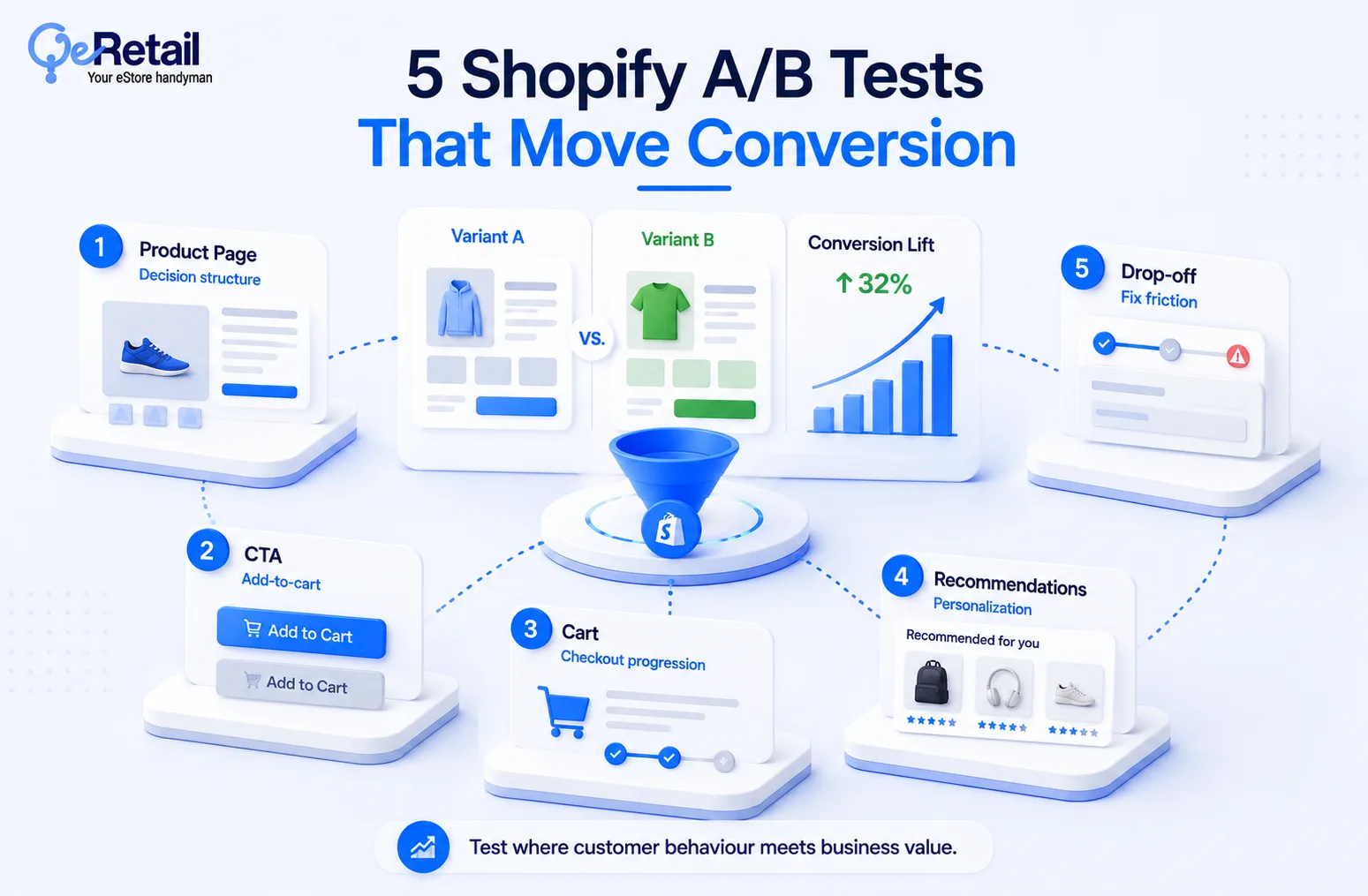
Instead of testing whatever element is easiest to change, Shopify stores should prioritize experiences that can influence product understanding, purchase intent, transaction completion, or revenue.
These five areas provide a practical starting point while leaving room for deeper technical experimentation as your store matures.
1. Test Your Product Page’s Purchase Decision Structure
The product page often has to answer several questions before a customer is willing to add an item to the cart.
What is the product? Why should I choose it? How much does it cost? Which variant do I need? When will it arrive? Can I return it?
If important information is buried beneath long descriptions, reviews, tabs, or secondary content, customers may need to work harder before taking action.
Product information is not a minor part of this decision process. Salsify’s Consumer Research found that 87% of consumers consider product content extremely or very important when deciding whether to purchase. This makes information hierarchy a meaningful area to investigate rather than simply a visual design preference.
Rather than testing isolated visual elements first, test how the purchase decision is structured.
What Should Shopify Stores Do To Improve?
- Test different product-information hierarchies
- Compare prominent versus lower-positioned purchase information
- Test alternative product-image and content arrangements
- Experiment with clearer variant-selection experiences
- Measure changes against add-to-cart and purchase behaviour
Quick Win:
Choose one high-traffic product page and identify the three pieces of information customers most need before purchasing. Create a variation that makes those elements easier to understand and test it against the current experience.
2. Test Your Primary Call-To-Action And Add-To-Cart Experience
A customer’s decision can be made but still fail to translate into action if the purchasing interaction is unclear, difficult to locate, or poorly adapted to the device being used.
The important question is not simply whether a button says “Add to Cart” or something different.
The experiment should examine whether the entire interaction makes the next action obvious and easy to complete.
What Should Shopify Stores Do To Improve?
- Test different primary CTA placements
- Compare sticky and non-sticky purchase controls where appropriate
- Test simplified variant-selection interactions
- Compare cart-drawer and direct-cart experiences where feasible
- Measure add-to-cart quality rather than clicks alone
Quick Win:
Review your product pages on mobile and desktop. Identify where the primary purchase action becomes difficult to see or use during scrolling, then create one focused variation addressing that specific issue.
3. Test Cart Experiences That Influence Checkout Progression
The cart is more than a place where customers review products.
It is a transition point between interest and transaction.
Customers may reconsider their purchase because of unexpected costs, unclear quantities, difficult editing, unnecessary promotional interactions, or distractions that appear after they have already decided to buy.
A useful cart experiment should therefore focus on whether the experience helps customers confidently move toward checkout.
What Should Shopify Stores Do To Improve?
- Test different cart information hierarchies
- Compare streamlined and more complex cart interactions
- Test visibility of shipping or delivery information
- Experiment with relevant cross-sell placement
- Measure checkout initiation and completed purchases
Quick Win:
Take one common purchase journey and document every interaction from add-to-cart to checkout. Identify the first interaction that does not directly help customers review or complete their purchase and consider it as a testing opportunity.
4. Test Personalization and Product Recommendations
Not every customer arrives with the same needs.
A first-time visitor may need product education, while a returning customer may already understand the category and need help choosing between a few specific products.
This creates an opportunity to test whether more relevant product recommendations or contextual experiences can influence purchasing behaviour.
What Should Shopify Stores Do To Improve?
- Test personalized versus generic recommendations
- Compare different recommendation placements
- Test recommendations based on product relationships
- Measure recommendation interactions against purchases
- Evaluate whether recommendations increase revenue without distracting customers
Quick Win:
Select a high-traffic product page and compare your current recommendation strategy with one alternative based on a clear relationship such as complementary products, frequently purchased products, or relevant category alternatives.
5. Test The Experience Where Customers Are Actually Dropping Off
The highest-value experiment is not always on the homepage or product page.
Sometimes the biggest opportunity exists in a specific step where customers consistently stop progressing.
That could be a collection page, product variant selector, cart, login requirement, shipping step, payment interaction, or mobile interface.
What Should Shopify Stores Do To Improve?
- Identify major drop-off points across the purchase journey
- Compare conversion behaviour between devices
- Test one major friction point at a time
- Connect behavioural data with experiment results
- Prioritize experiments according to potential revenue impact
Quick Win:
Choose one funnel stage with a noticeable drop-off and document what customers must do to continue. Create one hypothesis explaining why they may be leaving and build your next experiment around that specific issue.
How QeRetail Helps Shopify Stores Build A Better A/B Testing Strategy
QeRetail helps Shopify businesses turn experimentation from isolated design changes into a more structured approach to storefront optimization, customer behaviour analysis, and technical improvement.
1. Shopify Conversion Rate Optimization
We analyze customer journeys, page performance, product interactions, cart behaviour, and conversion funnels to identify opportunities where experimentation can produce meaningful business insights.
2. A/B Testing Strategy And Experiment Design
Our team can help define hypotheses, identify suitable test variables, establish primary metrics, structure variations, and determine which experiments deserve development resources first.
3. Custom Shopify Experiment Development
When a test requires functionality beyond standard theme settings, we can develop custom storefront components and controlled variations that allow businesses to test more meaningful experiences.
4. Shopify Analytics And Behaviour Tracking
We connect storefront behaviour with analytics and relevant business data to help identify where customers hesitate, abandon, interact, or convert.
5. Shopify API And Third-Party Integrations
We integrate Shopify with analytics, customer data, personalization, experimentation, search, and other platforms when the testing requirement extends beyond native capabilities.
6. Experimentation And Technical Optimization
A/B test results can reveal deeper technical opportunities involving navigation, performance, product discovery, cart interactions, personalization, or checkout experiences. We help turn those insights into scalable Shopify improvements.

Conclusion
A/B testing can become one of the most valuable tools in a Shopify store’s optimization strategy, but only when experimentation is connected to meaningful business questions.
The objective should not be to run as many tests as possible.
It should be to identify where customer behaviour and business performance suggest an opportunity, test a specific hypothesis, understand the result, and use that learning to make the next improvement more informed.
QeRetail helps businesses build that process through Shopify UX optimization, custom development, analytics integration, experimentation strategy, and conversion-focused digital solutions.
Contact us to identify which Shopify experience you should test first.
Frequently Asked Questions
What Should I A/B Test First On Shopify?
How Much Traffic Do I Need For A Shopify A/B Test?
How Long Should A Shopify A/B Test Run?
Should I Test One Element Or Multiple Elements At Once?
Can A/B Testing Improve Shopify Conversion Rates?
What If My Shopify Store Does Not Have Enough Traffic For A/B Testing?
Table of Contents