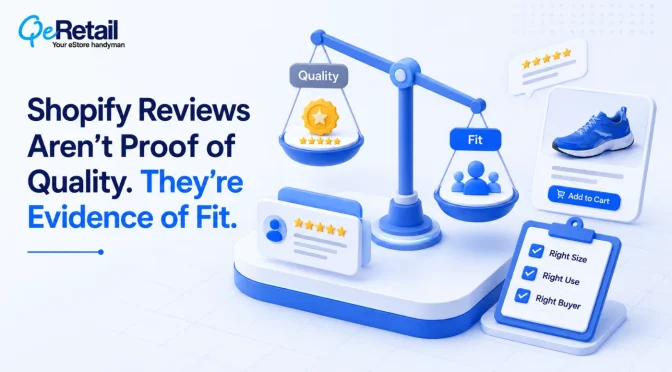
Customers rarely decide whether they trust a Shopify store from one element.
They form that judgment while checking the product, looking for reviews, evaluating shipping and returns, checking payment options, and deciding whether the store feels legitimate.
That means trust can weaken even when a store has a professional theme and a secure checkout.
A missing delivery estimate, outdated review, unclear return policy, inconsistent product information, or generic trust badge can create doubt at exactly the moment a customer is deciding whether to buy.
Shopify itself describes trust as foundational to commerce because customers need confidence that their data and transactions are safe.
For growing Shopify stores, building trust therefore should not always mean a complete redesign. Many important improvements can be made quickly by fixing the information and signals customers use to judge risk.

Key Action Points Summary
- Make essential product information easier to verify
- Show genuine customer feedback where purchase decisions happen
- Make shipping and return information visible before checkout
- Replace generic trust signals with relevant proof
- Check whether your store communicates security clearly
- Keep business information consistent across important pages
- Reduce uncertainty around availability, delivery, and payment
- Review trust signals on mobile as well as desktop
- Use customer behavior to identify where trust breaks down
- Connect trust improvements with actual conversion behavior
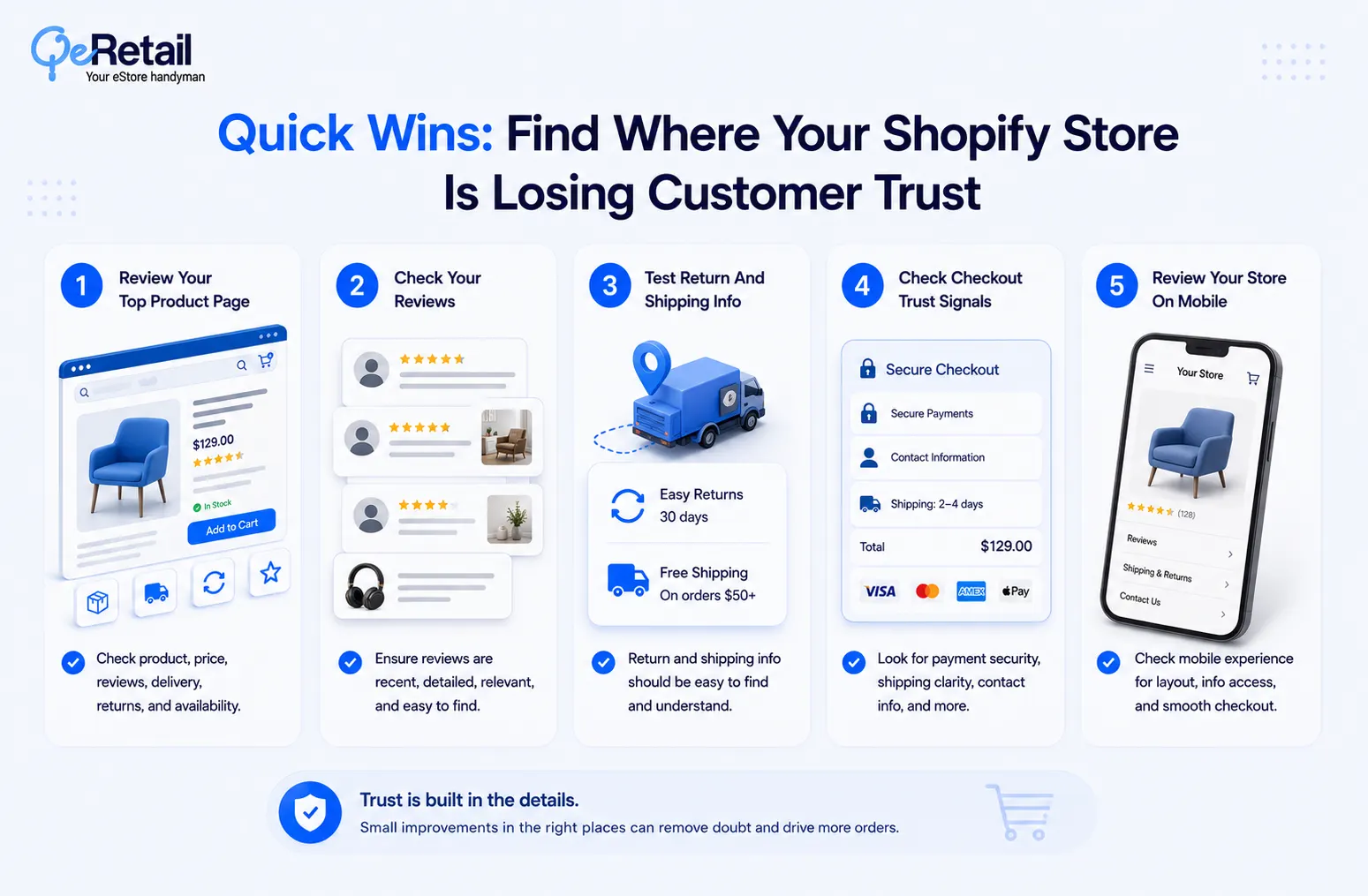
Quick Wins: Find Where Your Shopify Store Is Losing Customer Trust
You do not need to inspect every page to find trust problems. Start with the pages and interactions customers use when deciding whether your business, product, and purchase process are credible.
1. Review Your Highest-Traffic Product Page
Open one of your most visited product pages in an incognito window. Check whether a first-time customer can understand the product, price, reviews, delivery, returns, and availability without searching elsewhere.
2. Check Your Reviews
Look at your most important products and check whether reviews are recent, descriptive, relevant, and easy to find. Reviews with useful customer context can provide more reassurance than a collection of unexplained star ratings.
3. Test Your Return And Shipping Information
Try to find your return and shipping policies without using the site’s search function. If a customer has to visit the footer, open several pages, or leave the product page to answer a basic risk question, the information is too difficult to discover.
4. Check Your Checkout Trust Signals
Add a product to cart and move toward checkout. Look for clear payment information, security indicators, contact information, shipping expectations, and other details that reassure customers before they submit an order.
5. Review Your Store On Mobile
Open your store on a mobile device and inspect product pages, reviews, policies, contact information, and checkout. Trust can disappear when important information is hidden behind awkward menus, broken sections, or difficult interactions.
7 Ways To Build Trust On Your Shopify Store In Under An Hour
Building trust does not always require adding more badges, testimonials, or marketing messages.
The stronger approach is to identify the questions customers have before purchasing and make credible answers available at the right moments.
These seven strategies can help Shopify stores make meaningful trust improvements without starting a complete storefront redesign.
1. Put The Information Customers Need Before They Ask For It
Customers become uncertain when important purchase information is missing or difficult to find.
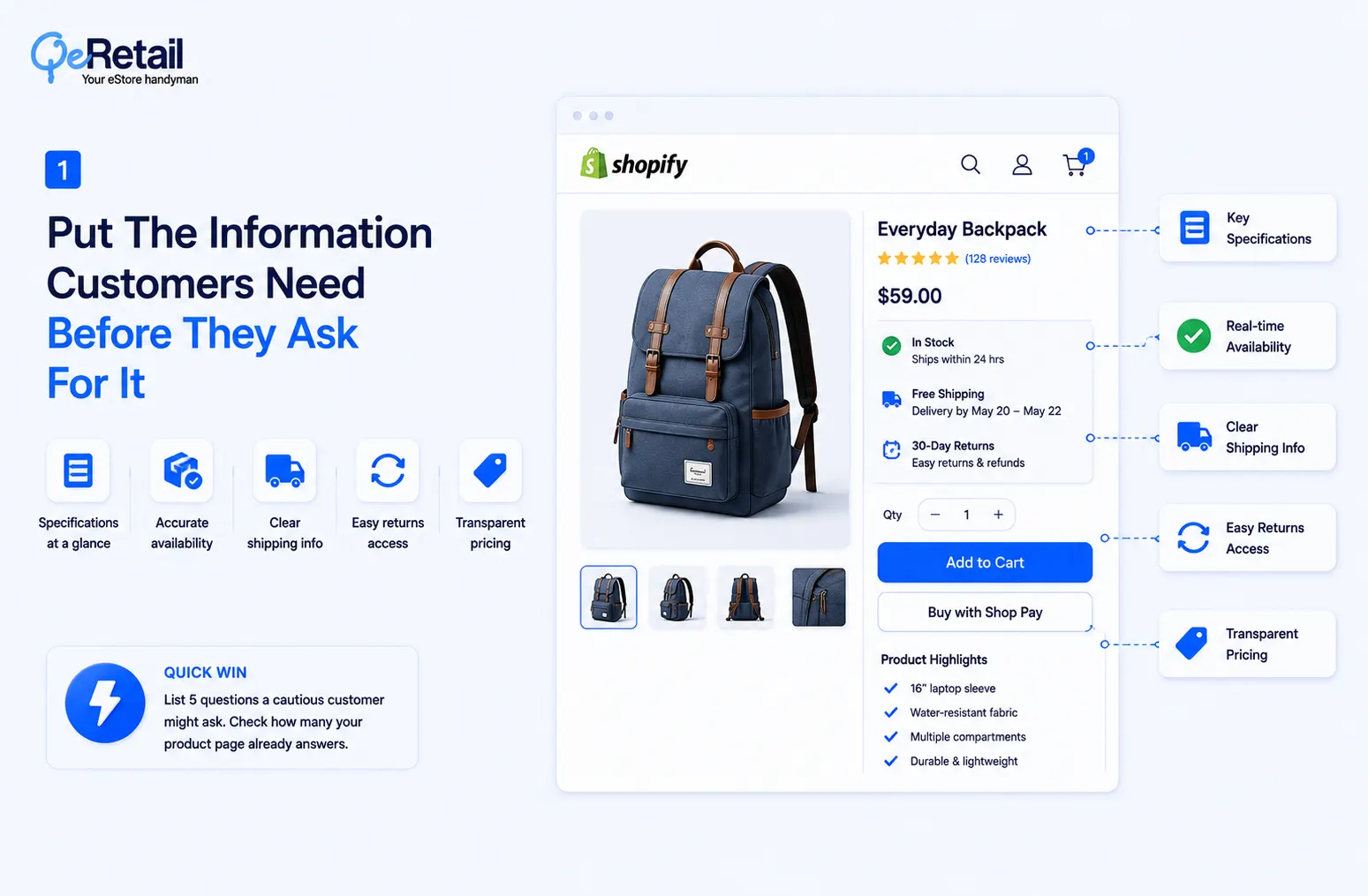
A product page may look attractive, but customers still need answers about size, specifications, materials, compatibility, availability, delivery, returns, and other purchase conditions.
Customer-trust research by Shopify found that product pages receive significant attention during purchase evaluation, with images, descriptions, sizing, inventory, shipping, taxes, and reviews among the important information shoppers look for.
What Should Shopify Stores Do To Improve?
- Add important specifications near the product information
- Show accurate availability
- Display relevant shipping information
- Link to return information from product pages
- Keep pricing and purchase conditions transparent
Quick Win:
Open your top product page and write down the five questions a cautious customer might ask before buying. Check how many can be answered without leaving the page.
2. Turn Customer Reviews Into Evidence, Not Decoration
A five-star rating can create a first impression, but detailed customer experiences can provide stronger evidence.
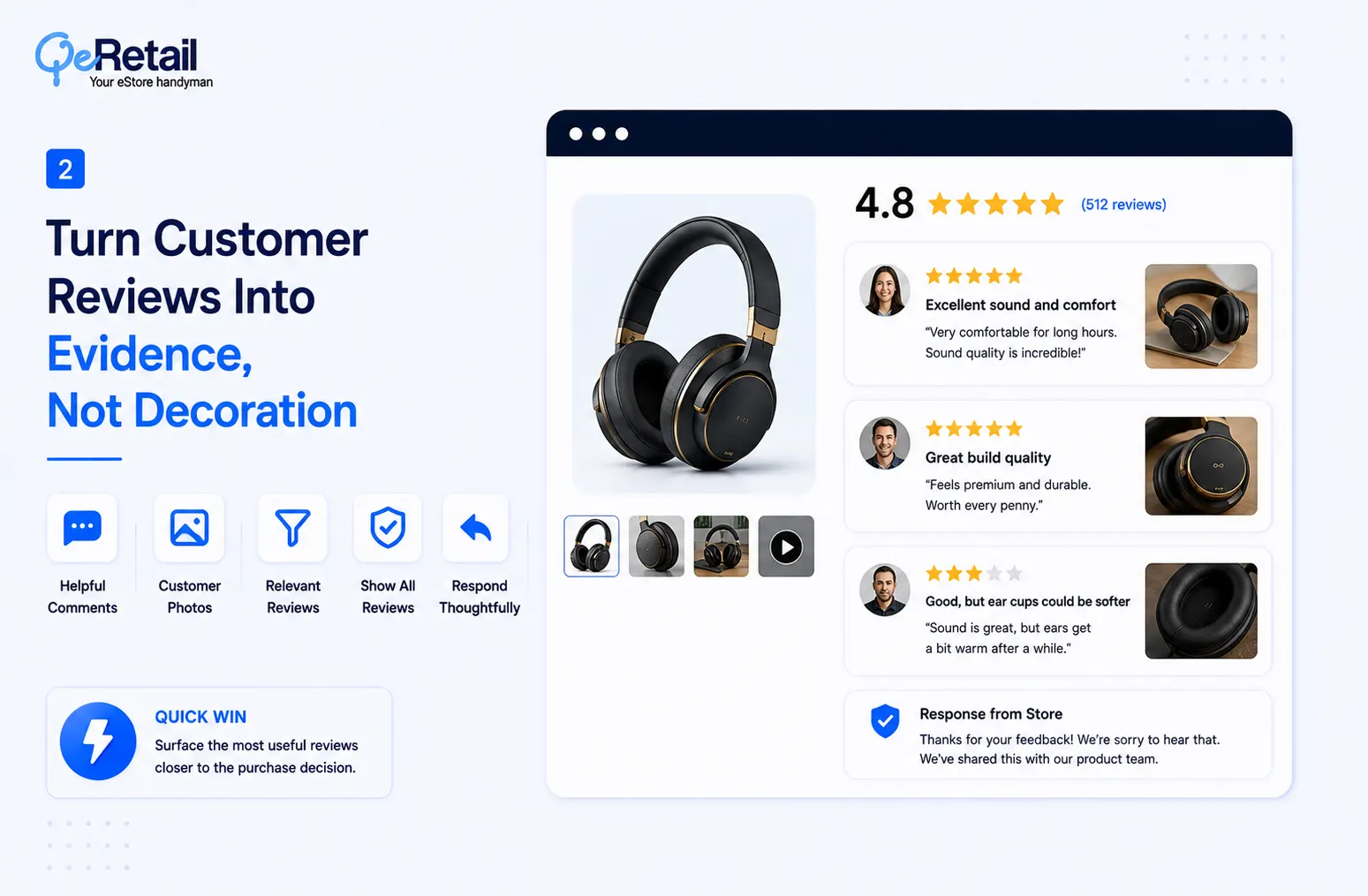
Customers want to know whether the product actually worked, whether the quality matched expectations, how the product looked in real use, and whether other buyers experienced similar outcomes.
What Should Shopify Stores Do To Improve?
- Highlight useful customer comments
- Include customer photos or videos where available
- Surface reviews relevant to specific product attributes
- Make negative reviews visible rather than hiding them
- Respond appropriately to customer concerns
Quick Win:
Choose your three highest-revenue products and identify the most useful customer review for each. Move those reviews closer to the purchase decision instead of leaving them buried below multiple sections.
3. Make Returns And Delivery Part Of The Product Experience
Customers are not only evaluating the product, but they are also evaluating what happens after they buy it.
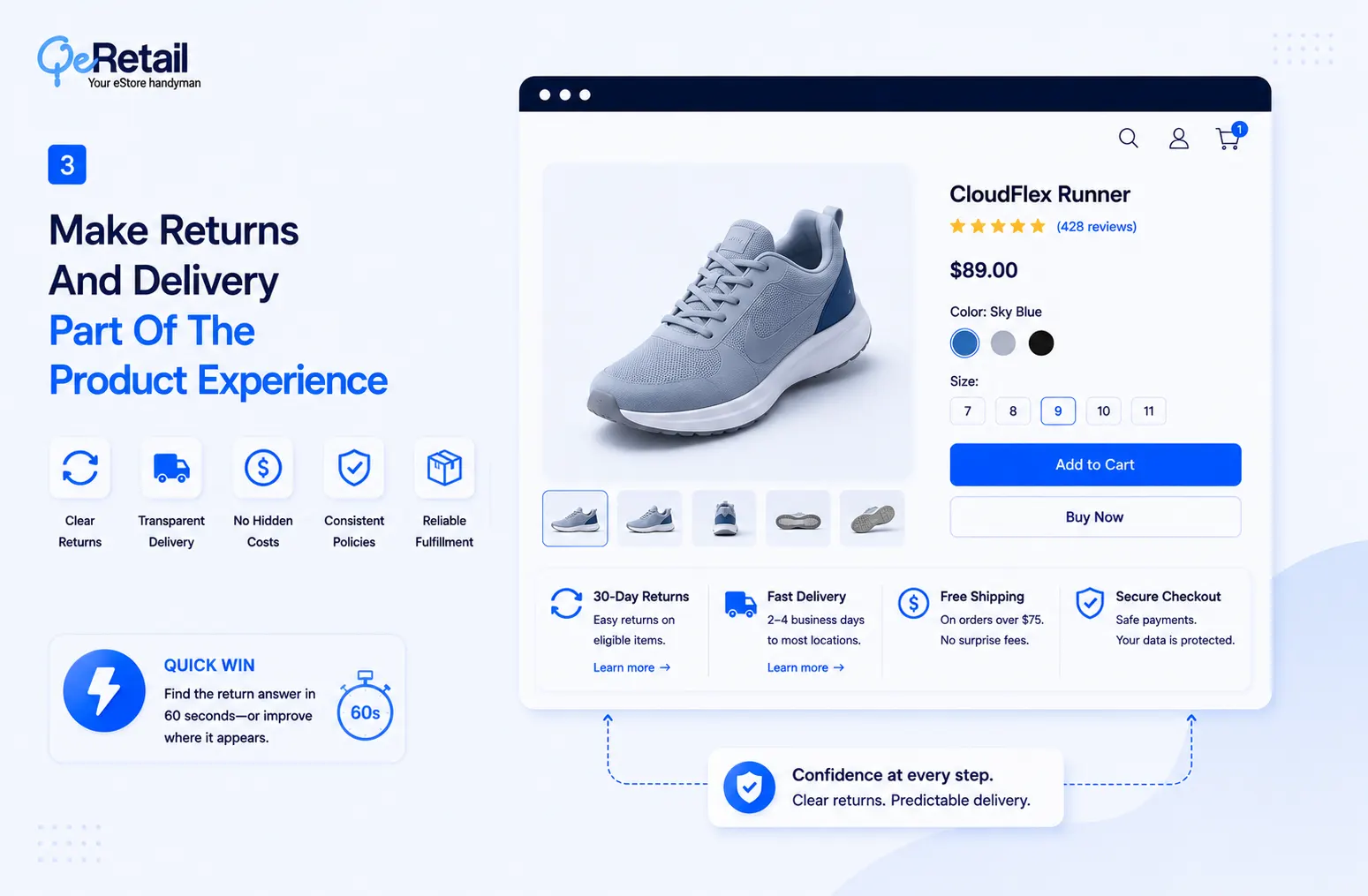
Unclear return conditions, vague delivery expectations, or unexpected shipping costs can create enough uncertainty to delay or stop a purchase.
Baymard’s 2026 research specifically recommends making return policies highly visible before checkout because uncertainty around returns can create purchase hesitation.
What Should Shopify Stores Do To Improve?
- Show return information near the buying action
- Explain return eligibility clearly
- Make shipping costs understandable
- Keep policy information consistent across the store
- Connect relevant fulfillment data where appropriate
Quick Win:
Visit one of your product pages and pretend you are a first-time customer who is unsure about returning the item. Give yourself 60 seconds to find the answer; if you cannot, improve the policy’s placement.
4. Replace Generic Trust Badges With Relevant Proof
Trust badges are easy to add and easy to ignore. A page filled with generic security icons can sometimes communicate less than a clear statement explaining how payment, returns, delivery, or customer information is actually handled.
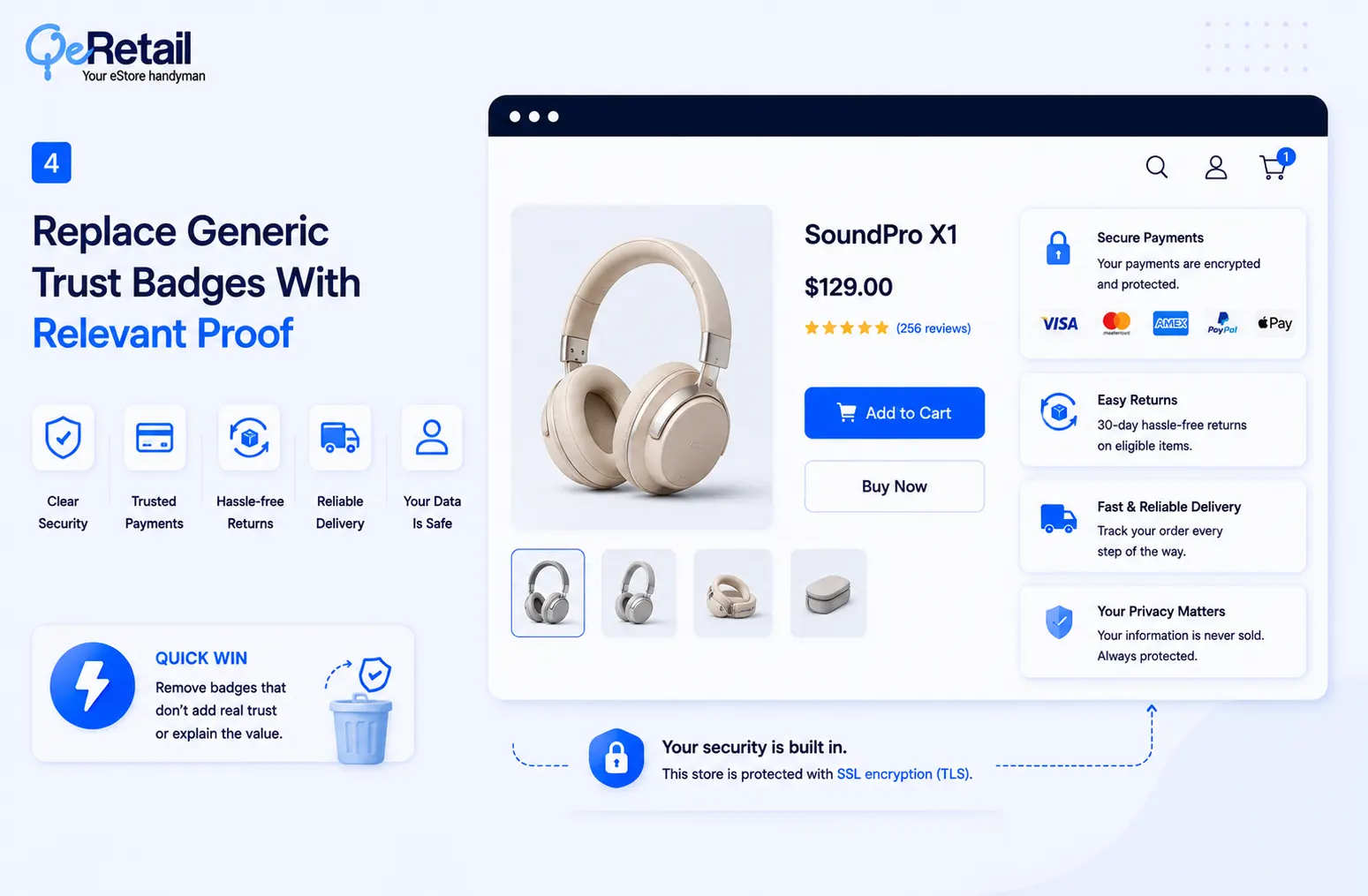
Shopify’s 2026 eCommerce Security Guidance notes that visible security signals can help customers feel more confident when deciding whether to enter sensitive information. Shopify also automatically provides TLS certificates for Shopify-hosted storefronts.
What Should Shopify Stores Do To Improve?
- Explain payment security clearly
- Use recognizable payment methods
- Avoid excessive or unexplained trust badges
- Place security information near sensitive actions
- Ensure security messaging matches the actual implementation
Quick Win:
Review every trust badge on your homepage and product pages. Remove any badge that does not communicate something meaningful to the customer or cannot be clearly explained.
5. Make Your Business Identity Easy To Verify
Customers do not only want to know whether the product is real. They also want to know whether the business behind the website is legitimate and reachable.
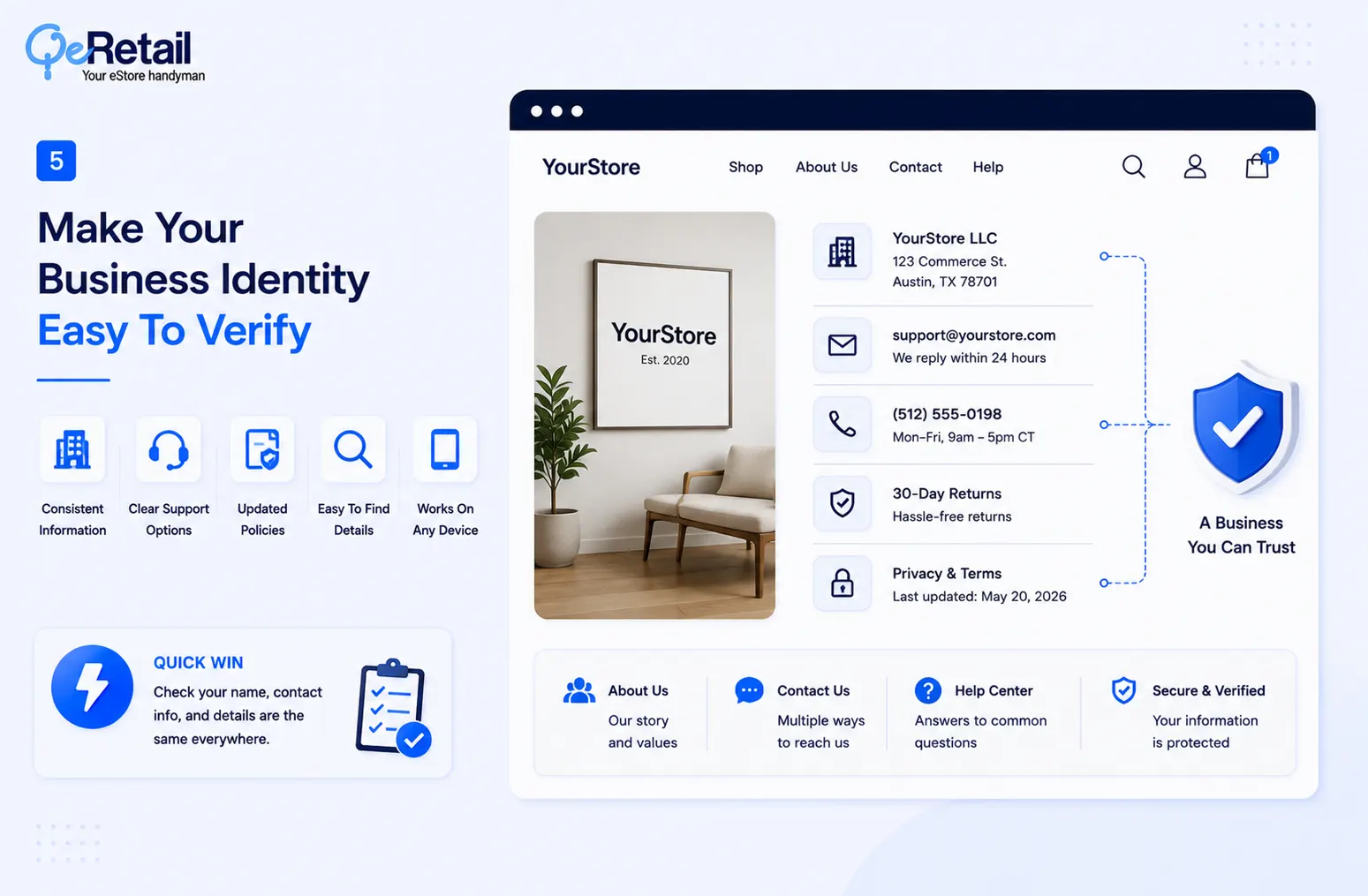
A store with limited company information, generic contact details, inconsistent business names, or missing support information can create unnecessary suspicion.
What Should Shopify Stores Do To Improve?
- Keep business information consistent
- Display customer-support options clearly
- Keep legal and policy pages updated
- Make important company details easy to find
- Ensure contact information works across devices
Quick Win:
Open your homepage, About page, Contact page, and footer side by side. Check whether your business name, contact information, and company details are consistent across all four locations.
6. Show Trust At The Moment Of Risk
Trust signals are more useful when they appear where customers actually experience uncertainty.
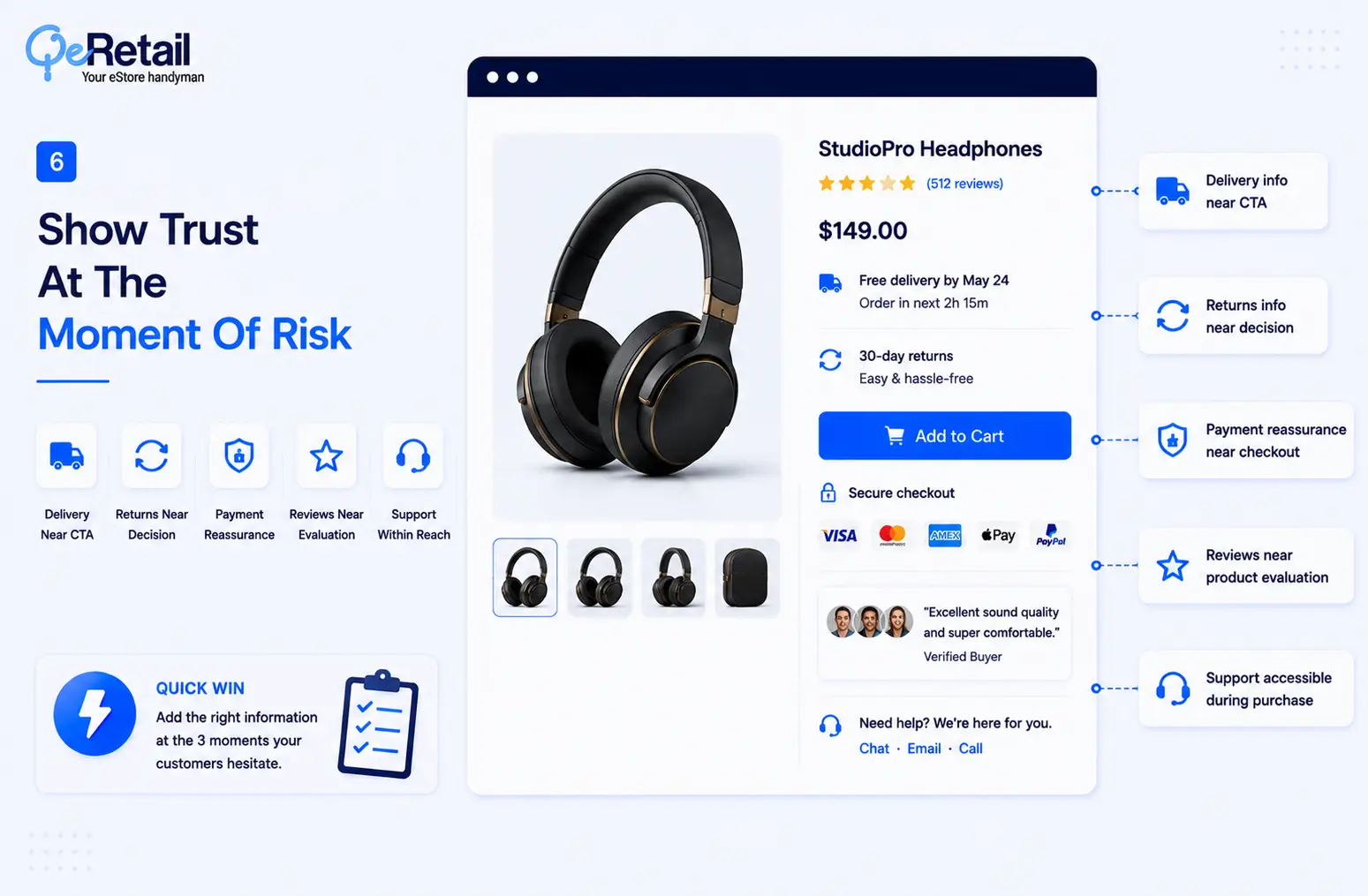
A security badge at the bottom of the homepage may have limited value when a customer is deciding whether to enter payment information.
Similarly, a return policy hidden in the footer is less useful when a customer is deciding whether to buy a product.
What Should Shopify Stores Do To Improve?
- Show delivery information near the purchase CTA
- Surface returns near product decisions
- Place payment reassurance near checkout
- Show reviews near product evaluation
- Keep support information accessible during purchase
Quick Win:
Choose one product page and identify three moments where a customer could hesitate. Add or reposition the relevant information directly around those decision points.
7. Use Store Data To Find Where Trust Is Breaking Down
Trust problems are not always visible through a manual website review.
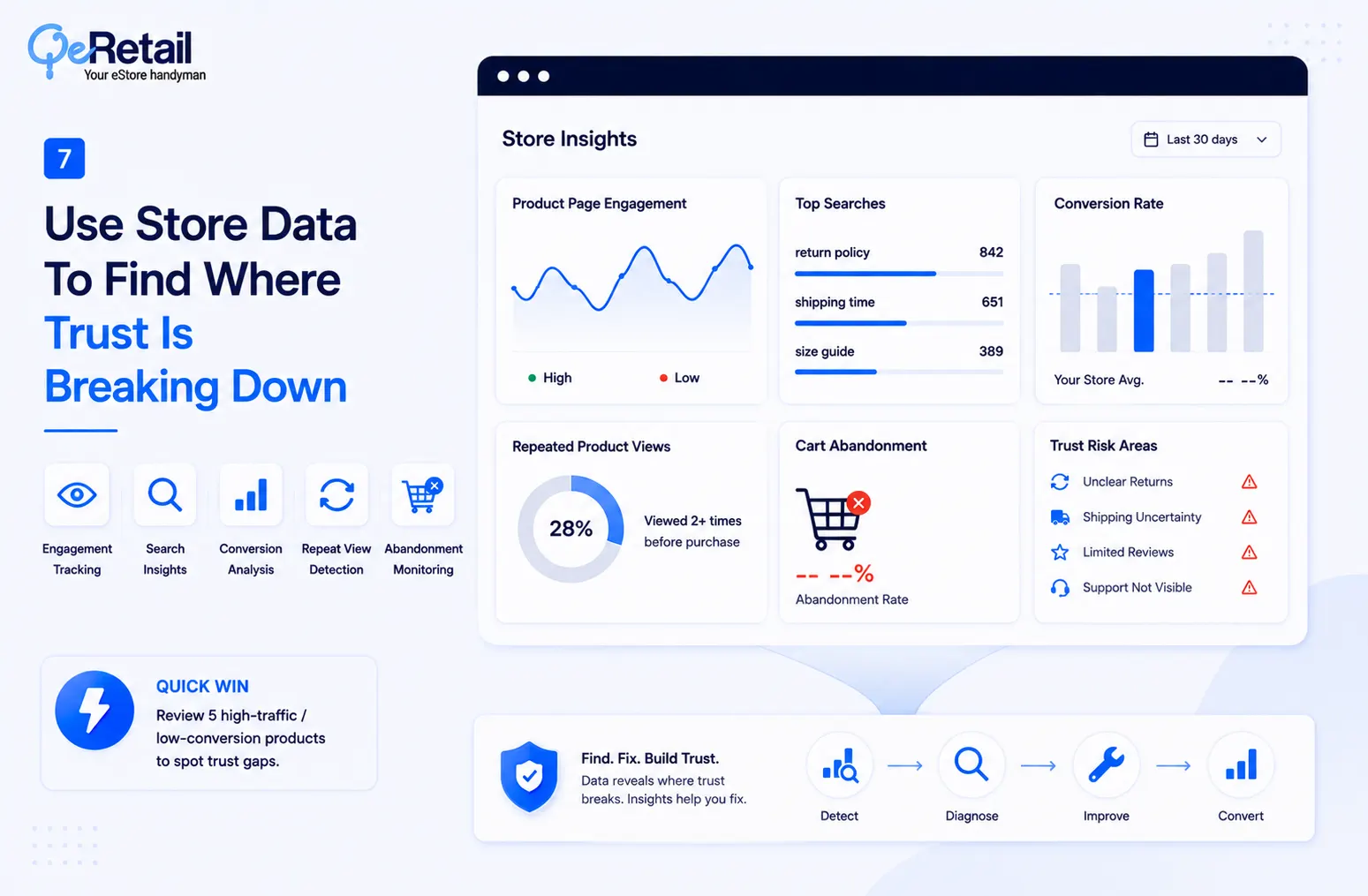
A store may look completely professional while customers repeatedly abandon a particular product, search for return information, revisit shipping pages, or leave during checkout.
Those behaviours can reveal where customers are experiencing uncertainty.
What Should Shopify Stores Do To Improve?
- Monitor product-page engagement
- Track searches for shipping and returns
- Compare conversion across products
- Identify repeated product views
- Monitor cart abandonment patterns
Quick Win:
Look at five products with strong traffic but weaker-than-expected conversion. Compare their reviews, product information, delivery details, returns, and customer-support questions to identify possible trust gaps.
How QeRetail Helps Build Trust Into Shopify Shopping Experiences
QeRetail helps Shopify businesses identify trust gaps across product pages, storefront UX, customer interactions, checkout, integrations, and technical implementation.
1. Shopify UX And Trust Optimization
We analyze the customer journey to identify where missing information, poor hierarchy, confusing interactions, or inconsistent experiences may be weakening purchase confidence.
2. Product Page Optimization
Our team helps structure product information, reviews, specifications, policies, availability, and purchasing elements so customers can evaluate products with greater confidence.
3. Custom Shopify Storefront Development
We build custom storefront components for reviews, product information, delivery messaging, trust signals, product discovery, and other experiences that require functionality beyond standard theme settings.
4. Shopify API And Third-Party Integrations
We connect Shopify with review platforms, inventory systems, shipping services, customer-data platforms, analytics tools, and other systems to keep important customer-facing information accurate and connected.
5. Conversion And Customer Behaviour Analysis
We help identify patterns in product engagement, cart activity, search behaviour, and checkout performance to understand where customers may be losing confidence.
6. Shopify Security And Technical Optimization
We review the technical implementation of storefront experiences, integrations, forms, third-party applications, and other components that can influence reliability and customer confidence.

Conclusion
Trust is often treated as a visual design problem. For a growing Shopify store, it is better understood as a customer experience system.
Product information, reviews, delivery promises, return policies, payment experiences, business identity, technical reliability, and customer behaviour all contribute to the decision customers make when they ask themselves one question: “Can I confidently buy from this store?”
The strongest trust improvements are therefore not necessarily the most visible ones. They are the changes that remove uncertainty before it becomes hesitation.
QeRetail helps Shopify businesses build these experiences through Shopify customization, UX optimization, technical integrations, customer-behaviour analysis, and conversion-focused digital solutions.
Contact us to identify where your Shopify store may be creating avoidable trust barriers.
Frequently Asked Questions
How Can I Build Trust On My Shopify Store Quickly?
Do Trust Badges Increase Shopify Store Trust?
How Important Are Reviews For Building eCommerce Trust?
Where Should I Display Trust Signals On My Shopify Store?
Can Custom Shopify Development Improve Customer Trust?
Table of Contents