A Shopify store can increase orders, grow revenue, and still become less profitable with every new sale.
The problem is not always pricing. In many growing stores, merchants measure profitability at the product level while the actual cost of selling happens at the order level.
A product may appear to have a healthy margin after accounting for its purchase cost. But once discounts, shipping, payment costs, fulfilment, returns, and other selling expenses are considered, the amount left from the sale can look very different.
This becomes more difficult as stores introduce free shipping thresholds, promotional discounts, multiple fulfilment methods, and return-friendly policies to improve customer experience and increase sales.
Shopify’s profit reporting shows that discounts and refunds can change reported profit margins, while its order-level profit reporting can also account for product costs, shipping costs, duties, and import taxes.
For growing Shopify businesses, the important question is therefore not only how much revenue each order generates, but how much of that revenue remains after the costs required to complete and support the sale.

Key Action Points Summary
- Measure contribution margin at the order level
- Include discounts and selling costs in margin calculations
- Set free shipping thresholds based on profitability
- Review which products absorb the most discounts
- Track return rates by SKU and product category
- Measure the cost of returned orders
- Separate revenue-driving products from margin-driving products
- Review high-volume products for hidden cost leakage
- Compare profitability before and after promotions
- Build regular margin reviews into store management
Quick Wins: Find Where Your Shopify Store Is Losing Margin
Before changing your pricing or reducing marketing spend, start with these simple checks.
Compare Product Margin With Actual Order Margin
Consider different aspects such as discounts, shipping, and other expenses for your top-selling products. Now, compare their product-level gross margin with the margin left after all the selling costs.
Review Your Recent Discounted Orders
Check how much margin was removed through discount codes, automatic discounts, bundles, and promotional offers.
Identify Products With High Return Rates
Compare the return rate of your major products with their contribution margin. A high-selling product with frequent returns may create less realized profit than expected.
Check Orders That Qualified For Free Shipping
Review orders that crossed your free shipping threshold. Compare the additional contribution generated by the extra products with the shipping cost absorbed by your business.
Compare Your Top Products By Revenue And Contribution
Rank your best-selling products by both revenue and contribution. Differences between the two lists can reveal products that generate strong sales but limited financial value.
Why More Shopify Sales Do Not Always Mean More Profit?
Increasing sales is usually treated as a positive sign of business growth.
More orders can mean stronger demand, higher revenue, better brand visibility, and greater customer acquisition opportunities.
But revenue growth does not automatically mean that every additional order is equally valuable.
The economics of an order change depending on how the customer purchases, which products are included, whether a discount is applied, how the order is shipped, and whether the customer later returns the product.
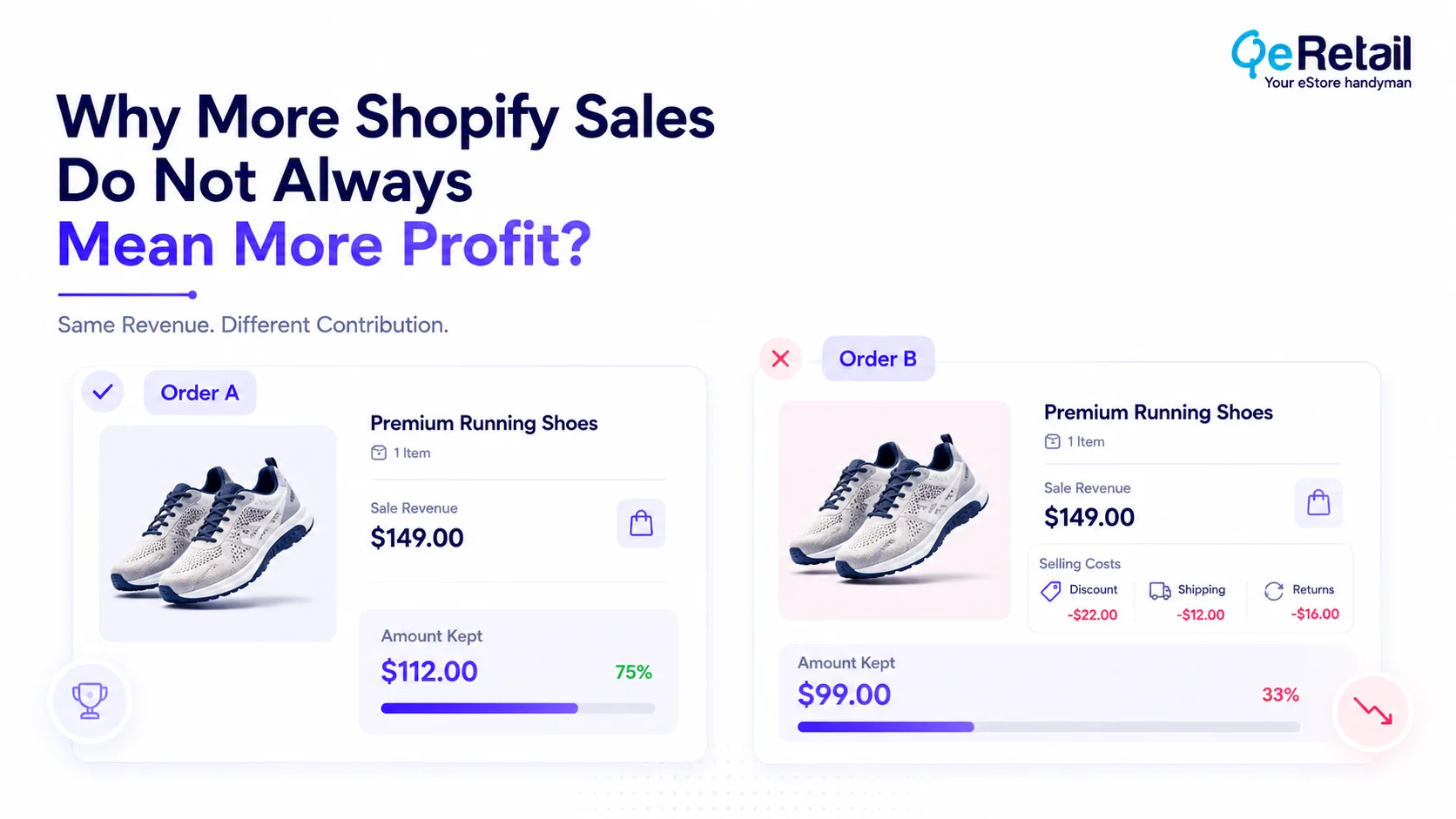
For example, two customers can purchase products worth the same amount while leaving very different margins for the business.
One order may be full price, inexpensive to ship, and never returned. Another may use a discount, qualify for free shipping, require more expensive fulfilment, and later generate a return.
Both orders increase revenue. But they do not create the same financial outcome.
For that reason, Shopify businesses should look beyond product margin and understand the contribution generated by each order after the costs directly associated with making and supporting that sale.
5 Hidden Margin Leaks That Can Make New Shopify Sales Less Profitable
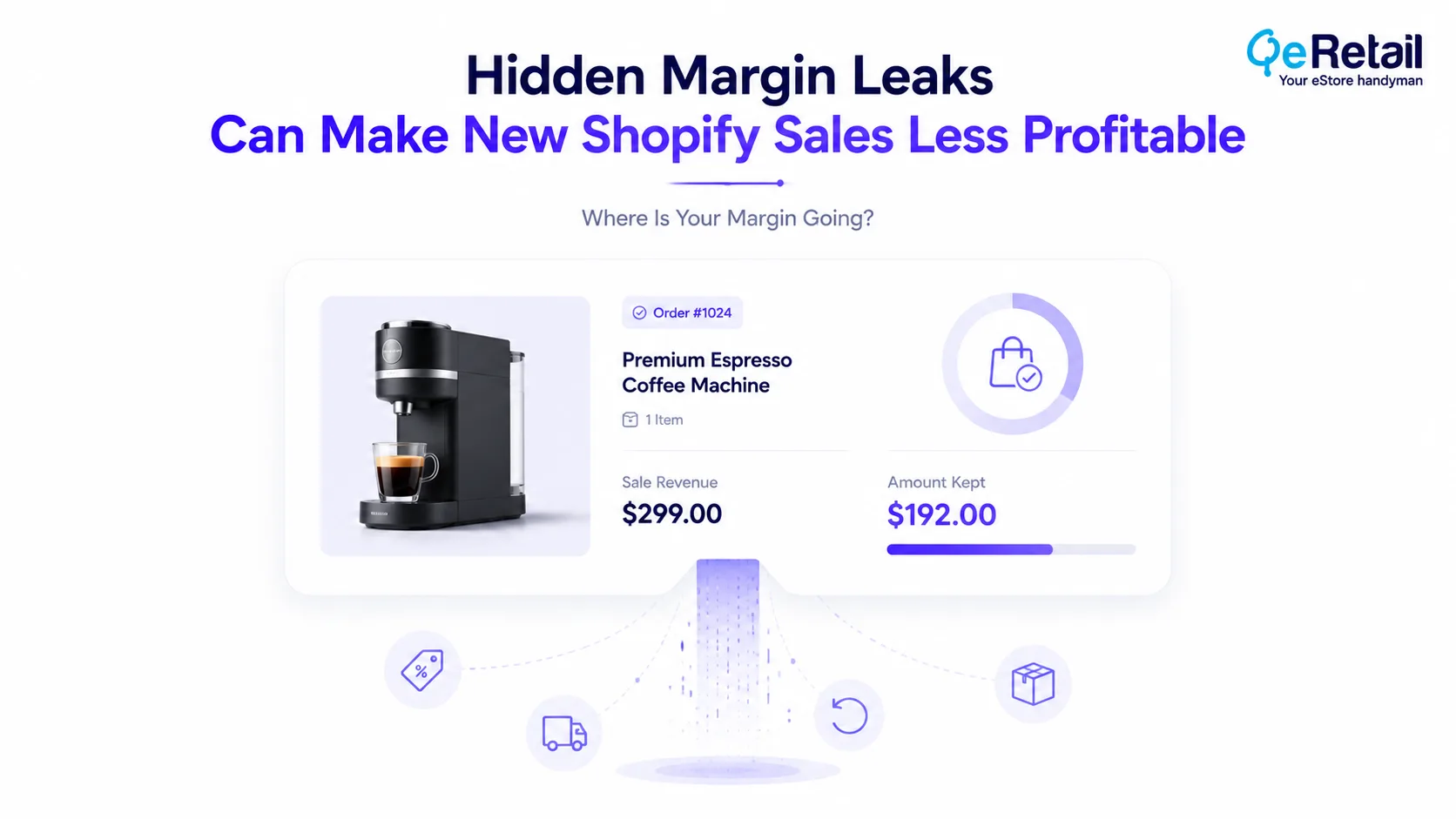
Most Shopify merchants monitor revenue and product margins closely. However, margin can gradually disappear through order-level costs, promotional decisions, shipping policies, returns, and product-level sales strategies that are rarely evaluated together.
1. Measuring Product Margin Instead of Actual Order Contribution
A common way to evaluate a product is to compare its selling price with its product cost. That provides a useful starting point, but it does not explain the complete economics of the sale.
During Shopify store audits, we frequently find that merchants evaluate product profitability without examining the complete cost structure of individual orders. Products that appear commercially strong at the SKU level can generate considerably lower contribution once discounts, shipping, fulfilment, and other order-level costs are considered.
What Should Shopify Stores Do To Improve?
- Track product costs accurately for major SKUs
- Include discounts and refunds in profitability reviews
- Account for variable order-level selling costs
- Compare product margin with actual order contribution
- Review contribution by SKU and order type
Quick Wins:
Review 20 recent orders and calculate what remains after product cost, discounts, shipping, fulfilment, and other directly attributable selling costs. Compare it with your reported product margin.
2. Free Shipping Thresholds That Increase AOV But Reduce Contribution
Free shipping can encourage customers to add more products to their orders. However, a higher average order value does not automatically produce a healthier margin.
The additional product may carry limited contribution while the business absorbs the shipping cost. Differences in product weight, destination, packaging, and fulfilment requirements can make a single threshold unsuitable for every order.
What Should Shopify Stores Do To Improve?
- Review thresholds against actual fulfilment costs
- Compare shipping costs across product categories
- Identify low-margin products used to reach thresholds
- Measure contribution alongside AOV
- Adjust shipping policies where product economics differ significantly
Quick Wins:
Review recent orders created to qualify for free shipping. Compare the additional contribution generated by those purchases with the shipping cost your store absorbed.
3. Discounts Reducing Margin Unevenly Across Products
A 15% discount does not have the same financial impact on every product. High-margin products may absorb it comfortably, while low-margin products can lose most of their contribution.
The problem becomes greater when discounts combine with free shipping, bundles, loyalty incentives, or other promotions. A campaign can therefore increase order volume while quietly reducing the value generated from each sale.
What Should Shopify Stores Do To Improve?
- Review discounts by SKU
- Identify products with limited discount tolerance
- Prioritize promotions around healthier-margin products
- Monitor discount stacking
- Define minimum contribution margins for promotions
Quick Wins:
Review your last promotional campaign and rank participating products by margin after discount. Separate low-margin products from future blanket promotions.
4. Returns Turning Profitable Orders Into Low-Margin Sales
A sale is not always financially complete when the customer receives the product.
Returns can introduce additional shipping, handling, inspection, restocking, refund, and inventory-related costs. A product with strong initial margin can therefore create significantly less realised contribution when return activity remains consistently high.
What Should Shopify Stores Do To Improve?
- Track return rates by SKU and category
- Record return processing costs
- Identify products with unusually high return frequency
- Analyze common return reasons
- Improve product information where expectations are unclear
- Compare initial and realised contribution
Quick Wins:
Compare sales volume and return rates for your five best-selling products. Investigate any product where strong revenue is accompanied by unusually high return activity.
5. Treating Best-Selling Products As Your Most Profitable Products
A high-volume product may depend heavily on discounts, generate expensive shipping orders, attract frequent returns, or require significant promotional spending. Another product may sell fewer units while creating substantially stronger contribution from every order.
Across the Shopify stores we have analysed, one recurring pattern is that the products generating the highest revenue are not always the products producing the strongest contribution. Reviewing revenue alongside discount dependency, fulfilment costs, and return behaviour often reveals a very different picture of product profitability.
What Should Shopify Stores Do To Improve?
- Rank products by contribution, not revenue alone
- Compare sales volume with discount dependency
- Review return rates alongside profitability
- Identify high-revenue, low-contribution products
- Identify lower-volume products with stronger margins
- Use profitability data when planning promotions
Quick Wins:
Create two lists of your top products: one ranked by revenue and another by contribution. Compare them to identify products driving sales without creating proportional financial value.
How QeRetail Helps Shopify Stores Improve Margin Visibility?
QeRetail helps Shopify businesses identify margin leakage across the storefront and order journey so that growth decisions can be made with better visibility into actual business performance.
Shopify Store Profitability Assessment
We review product costs, discounts, order economics, shipping considerations, and other factors that can influence the margin generated from individual sales.
Product & Order Contribution Analysis
Our team helps businesses compare product-level margins with order-level contribution to identify products and sales patterns that may appear profitable but generate limited financial value.
Promotion & Discount Review
We assess how discount structures affect different products and help businesses identify opportunities to build promotional strategies around healthier contribution margins.
Shipping & Fulfilment Optimization
We review how shipping policies, fulfilment costs, and free shipping thresholds influence order profitability and customer experience.
Returns & Margin Analysis
We help businesses identify products and customer journeys where return activity creates recurring financial leakage and opportunities for improvement.

Conclusion
Profitability is often treated as something businesses improve after a sale has already happened. In reality, much of the margin is decided before the customer places the order, through the products you promote, the discounts you offer, the shipping promises you make, and the buying journeys you create.
A healthier product mix, smarter promotional structure, and better understanding of order behaviour can allow the same traffic to generate more valuable revenue.
QeRetail helps Shopify businesses improve profitability visibility through practical analysis of product margins, order contribution, promotions, shipping, and customer journeys. By identifying hidden margin leakage, businesses can make better decisions about where to grow, what to promote, and which sales actually create value.
Contact us to identify where your Shopify store is losing margin and build a more profitable path for growth.
Frequently Asked Questions
How Can Shopify Stores Lose Margin Even When Sales Are Increasing?
What Is The Difference Between Product Margin And Order Contribution?
Can Free Shipping Reduce Shopify Profit Margins?
Do Discounts Affect Shopify Profit Margins?
Can Product Returns Affect Shopify Profitability?
Should Shopify Stores Focus On Revenue Or Profitability?
Table of Contents