Acquiring a new eCommerce customer now costs more than retention. That gap is why most store owners install a loyalty app the same week they read a stat like that.
Loyalty and referral programs get treated as apps you install, not investments you underwrite. Apps have monthly fees. Investments have payback math. However, merchants that skip the playbook math of customer acquisition vs retention end up losing on the incremental volume.
This piece gives you the exact equations, worked examples, and revenue-tier thresholds that tell you whether loyalty and referral are worth building for your store right now, or whether that money belongs somewhere else in your funnel.
Key Action Points:
- Calculate your baseline repeat purchase rate before installing any loyalty app
- Set a break-even order target: monthly app cost divided by contribution margin per repeat order
- Cap total reward liability at 5% of member revenue
- Price your referral reward below your blended paid CAC, never above it
- Track redeemer repeat rate against non-redeemers, not program signups
- Audit app pricing tiers against your 12-month order forecast before committing

What is Loyalty Break-Even Math?
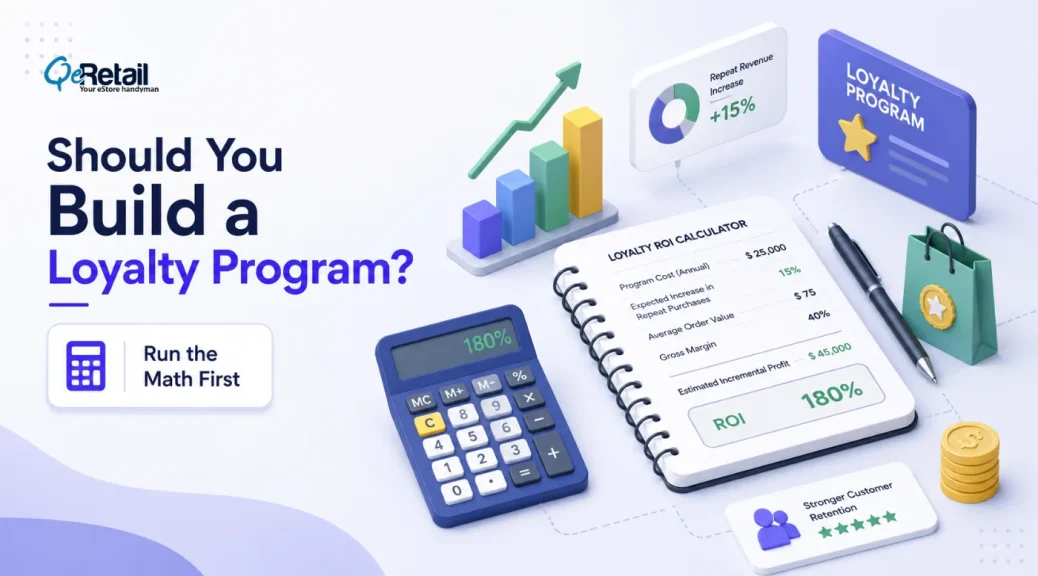
Loyalty break-even math is a simple test. It tells you how many incremental repeat orders your program must generate each month to cover its own cost before it earns you a single dollar of profit. A loyalty break-even math is the financial calculation merchants run to ensure loyalty programs generate “Net Incremental Revenue Lift”
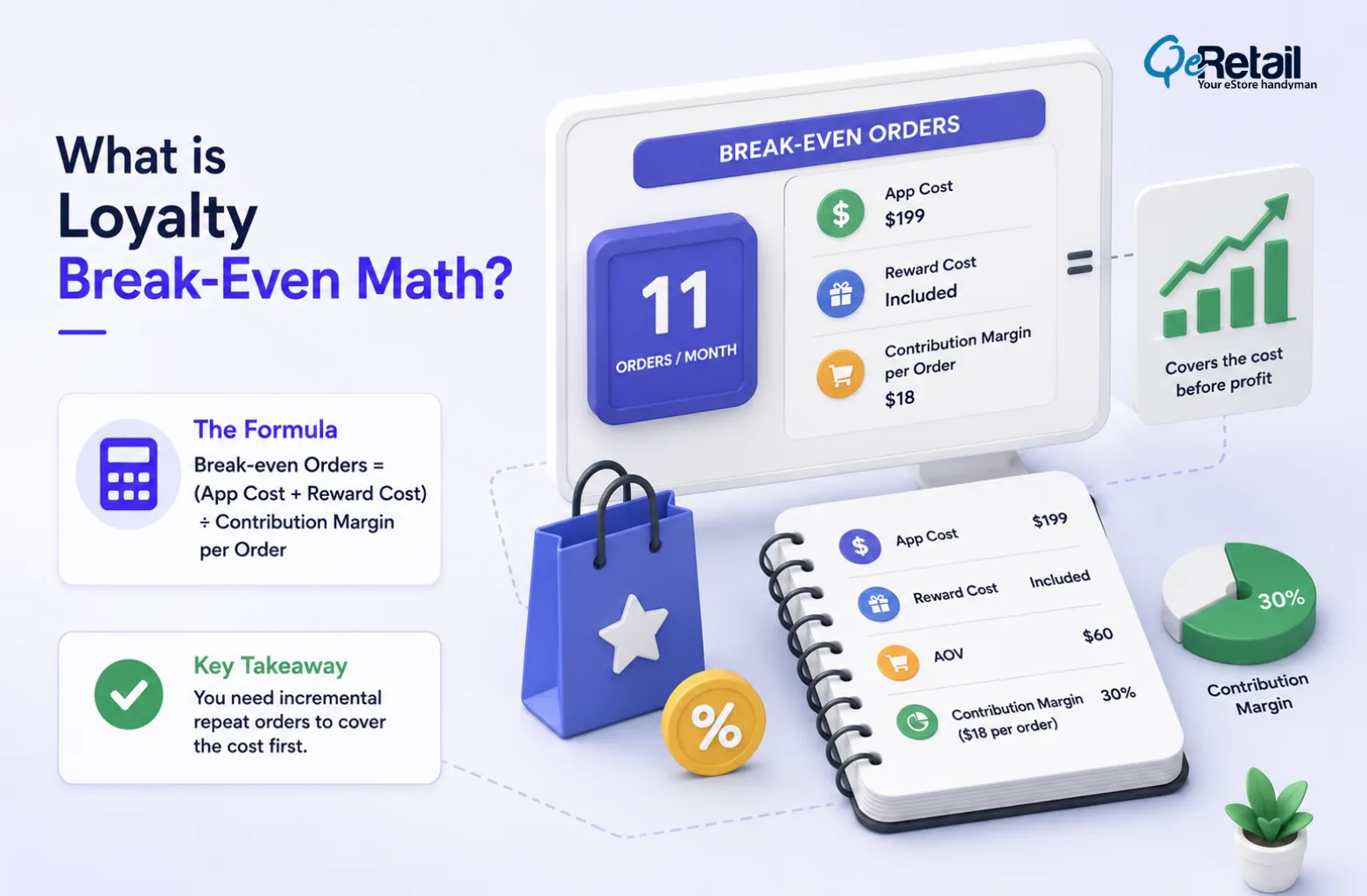
The formula: break-even orders = (app cost + reward cost) ÷ contribution margin per order.
Say your app costs $199 a month, your AOV is $60, and your contribution margin is 30%, which gives you $18 per order. Your program needs 11 incremental repeat orders every month just to pay for itself. That word “incremental” is where most loyalty ROI claims fall apart.
Why Do Most Shopify Stores Build Loyalty Backward?
A loyalty program is not a retention strategy. It is an amplifier for a retention baseline you already have. If your category buys once every three years, no points balance changes that. You would be paying app fees to decorate a purchase cycle you cannot compress.
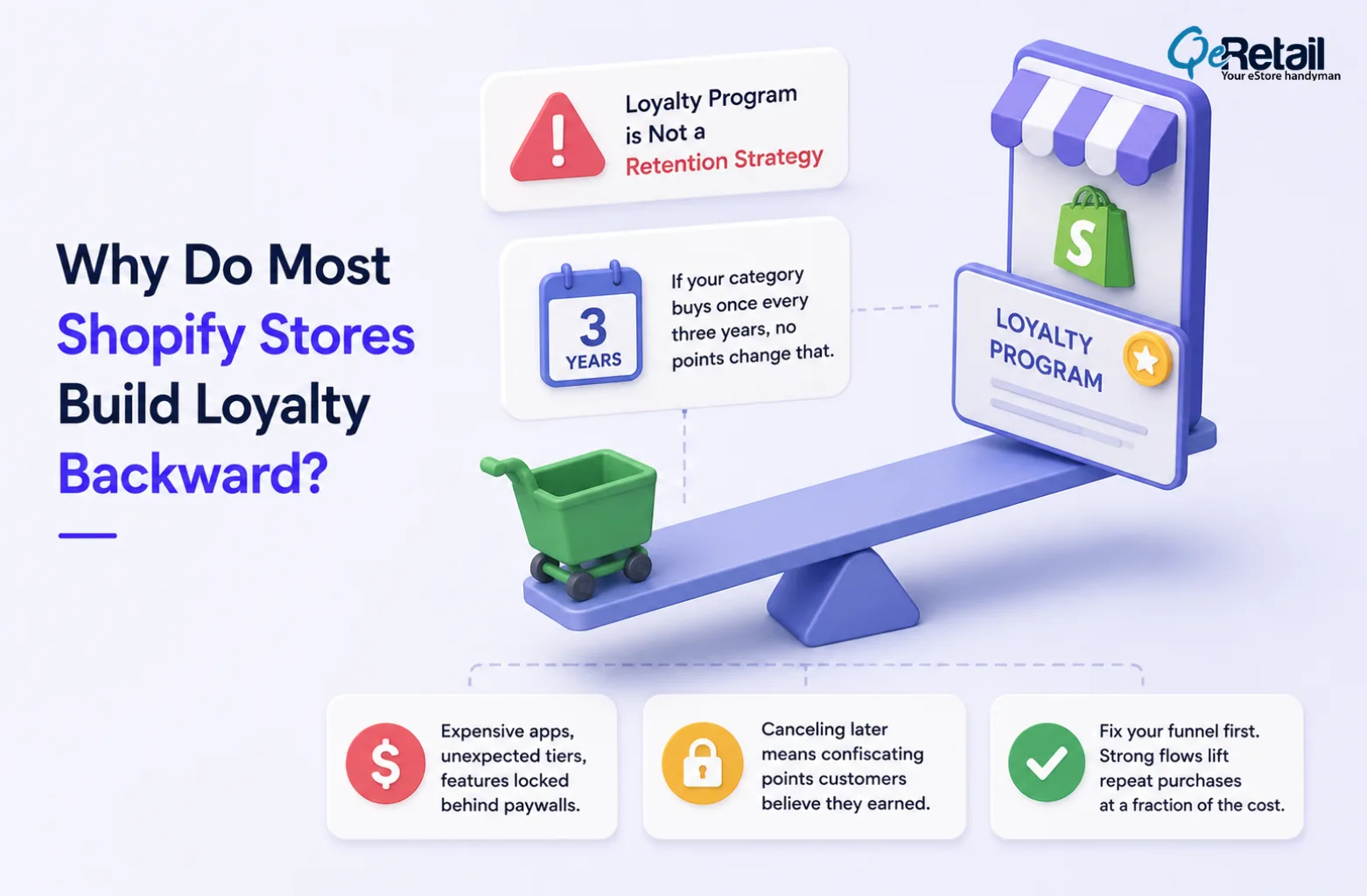
Apps priced by order volume that jump a full pricing tier right around 500 orders a month, features like analytics and email integration locked behind $199-plus plans, and the sinking realization that once a points program is live, killing it means confiscating value your customers believe they earned.
That last one deserves attention. Points are a liability on your books and a promise in your customer’s head. Launch casually, and you inherit both permanently.
So before you compare apps, answer one question: is your repeat rate low because customers lack an incentive, or because your funnel leaks before the second purchase ever becomes possible? If your post-purchase email flows are weak, fix those first. They cost a fraction of a loyalty stack and lift the same metric.

The 4-Variable Loyalty Equation
Four numbers decide whether loyalty pays: baseline repeat rate, realistic lift, reward cost, and app cost. Everything else is decoration.
Here is the full equation:
Annual program profit = (incremental repeat orders × contribution margin) − (annual app cost + annual reward redemptions)
Example: A $250K Store
Take a store doing $250K a year at a $60 AOV. That is roughly 4,150 orders from about 3,300 customers, with a 25% baseline repeat rate and 30% contribution margin.
A 4-point lift loses money at this size on a $199 plan. The same store on a $49 plan with the same lift nets roughly $290 positive, which is barely worth the operational attention. The program becomes genuinely profitable in two scenarios: the lift exceeds 6 points, or the store’s order volume grows enough that fixed app cost shrinks as a percentage of incremental profit.
What to Build at Your Revenue Tier?
The right answer changes with store size. Fixed app costs punish small stores and disappear for larger ones.
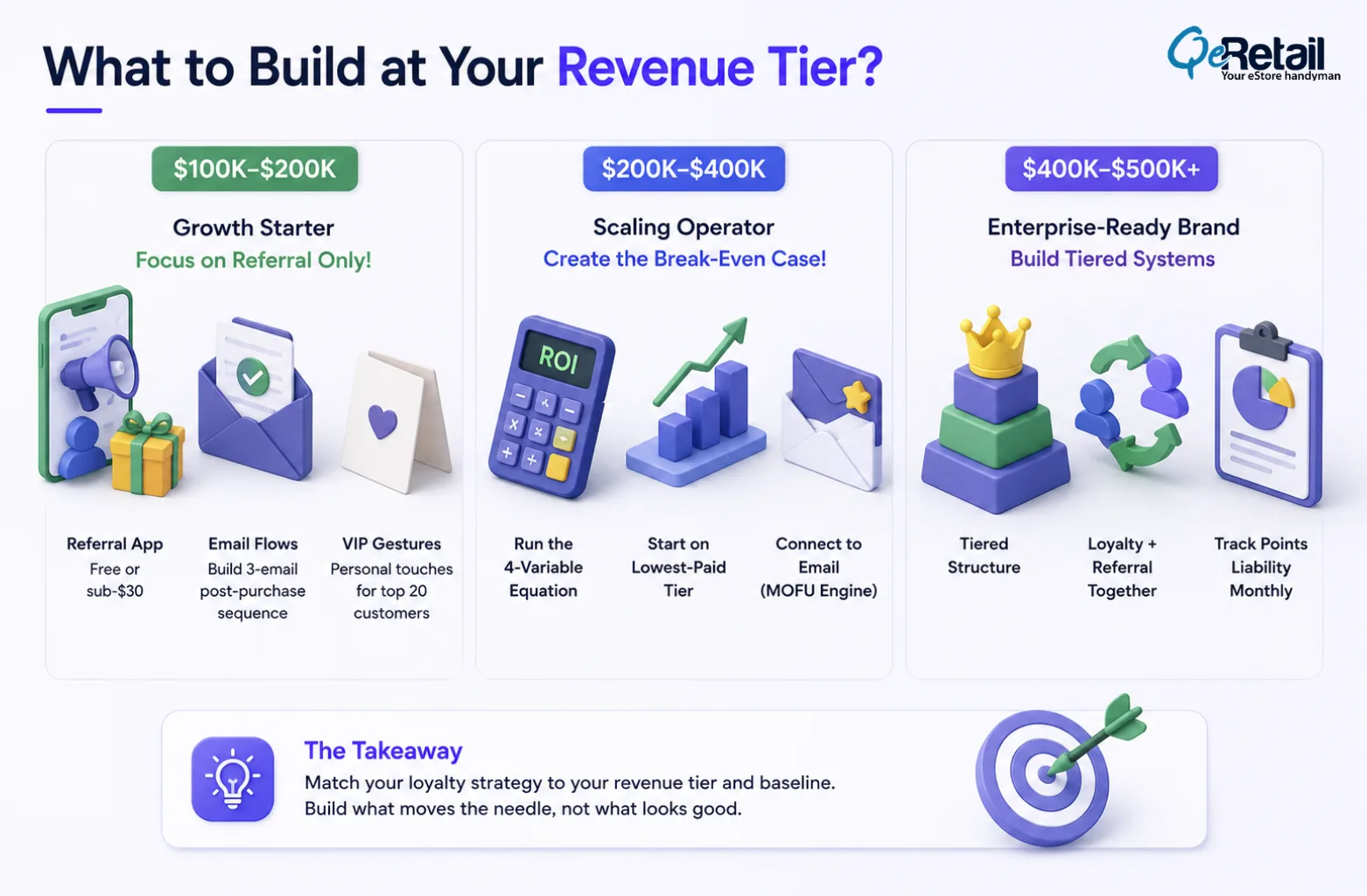
The Growth Starter ($100K–$200K): Focus on Referral Only!
At this tier, a $199 loyalty plan can eat your entire incremental profit. Your constraint is fixed cost, so keep it near zero.
1. Free-tier referral app: Launch a simple give-and-get referral on a free or sub-$30 plan. Two variables are easy to kill if they fail.
2. Post-purchase email flows: Build the three-email post-purchase sequence before any points program. This lifts the repeat rate without liability.
3. Manual VIP gestures: Handwritten notes or surprise upgrades for your top 20 customers. The top 5% of customers drive 35% of ecommerce revenue (Yotpo via Ringly, 2026), and at this size, you know them by name.
What can Shopify store owners do?
Skip paid loyalty entirely until you cross $200K or a 25% repeat rate. Spend the app budget on email instead.
The Scaling Operator ($200K–$400K): Create the Break-Even Case!
Your constraint shifts from cost to proof. Loyalty becomes viable here, but only if your baseline supports it.
1. Run the 4-variable equation: Green-light loyalty only if projected lift covers app plus reward cost within 12 months.
2. Start on the lowest-paid tier: Prove redemption behavior on a $49-class plan before upgrading. Watch order-based pricing cliffs.
3. Connect loyalty to your [MOFU engine](https://www.qeretail.com/blog/shopify-mofu-strategy): Points reminders belong inside your email flows, not in a standalone widget nobody opens.
What can Shopify store owners do?
Set a 90-day kill criterion in writing: if the redemption rate sits under 10% at day 90, pause the program before points liability compounds.
The Enterprise-Ready Brand ($400K–$500K+): Focus on Tiered Systems
At this volume, fixed app cost is noise, and program design is the lever.
Tiered Structure Over Flat Points
Tiered programs deliver 1.8x higher ROI than flat structures, with VIP-tier members generating 73% higher AOV, $435 versus $291. Build three tiers, with the top tier accessible to roughly your top 10% of spenders.
Loyalty Plus Referral as One System
Stack them: reward referral activity with loyalty points. Referred customers already make 2x more purchases; enrolling them in your loyalty flow at first purchase compounds both curves.
What can Shopify store owners do?
Assign a monthly owner for points liability reporting. At this scale, unredeemed points are a real balance-sheet item, not a rounding error.
How to Break Even With Loyalty Programs?
Instead of just looking at the monthly fee of a loyalty app, merchants should evaluate the program like a CFO by comparing the behavior of members versus non-members.
1. Calculating Your Loyalty Budget Ceiling
Want your break-even number fast? Pull two things: current order count, baseline repeat purchase rate. Run the math on what a 3-5% lift in that repeat rate would actually generate. Whatever dollar figure comes out, that’s your loyalty budget ceiling. Full stop. The program has to clear that number, or it’s not worth building.
2. Calculating Net Incremental Revenue Lift
Real ROI isn’t just new revenue coming in. Net it against what running the program actually costs, liabilities included. Here’s the formula.
Revenue Drivers:
- Active Customer Base (N): how many customers are actually active in your database right now.
- Enrollment Rate (E): the share who bother to join. Promote it well, and you should land 25-40% enrollment within the first 90 days. Below that, something’s off with onboarding.
- Member Lift: the gap in repeat purchase rate (RPR) and average order value (AOV) between members and non-members.
Costs & Liabilities:
- Software Costs (CSaaS): yearly cost of the loyalty app, or upkeep on a custom build. Most standard brands land $200-$1,500 a month.
- Reward Redemption Costs: real dollar value of rewards customers actually claim. Usually 1-3% of member revenue, not more.
- Point Liabilities (Lpoints): every unredeemed point sitting on your books is a liability, cashed in or not.
- Margin Dilution (Ddilution): profit handed away by discounting purchases people were going to make anyway. Stings because it’s invisible until you run the number.
The “Build or Skip” Decision
Run the numbers. Projected Net Incremental Revenue under total costs? Answer’s Skip Protocol, don’t launch. Mathematically honest call, even if not the fun one. Especially true for low-purchase-frequency brands or thin, price-sensitive margins, where points just dilute profit.
Flip the conditions, though: strong repeat purchase potential, earning ratios calibrated right to unit economics, and this math compounds fast. A program built right can return 4x to 10x on platform spend inside 12 months.
Final Thoughts
Most stores treat loyalty and referral as checkbox features, something every “real” brand has. So they install first and rationalize later. That order is backward, and app fees plus reward liability quietly tax margins that were already thin.
Stores that win run the math first. They know their baseline repeat rate. They know their break-even order count. They know their kill criteria, and all three exist before the app ever goes live.
However, you didn’t build a retention system. You bought a monthly subscription to a discount, and the invoice just doesn’t say that on it. QeRetail runs this exact underwriting for Shopify stores, from baseline audit to program design that clears break-even.
Book a free strategy session with QeRetail, and we’ll map your break-even number before you spend another dollar on the widget.
Frequently Asked Questions
How Much Does A Shopify Loyalty Program Actually Cost?
What Repeat Purchase Rate Do I Need Before Launching A Loyalty Program?
Are Referred Customers Really More Valuable Than Paid-Ad Customers?
How Long Until A Loyalty Program Pays For Itself?
Can A Two-Person Team Run Loyalty And Referral Together?
Table of Contents