Your ad accounts are not the problem.
Your dashboards are not lying either.
The payload arriving at Meta, GA4, and Klaviyo just got quieter, and most $100K-$500K Shopify stores have not noticed yet.
You keep running paid traffic against an attribution surface that quietly went dark.
Your old thank-you page used to fire your Pixel, your CAPI relay, your Klaviyo trigger, the affiliate snippet, that one post-purchase upsell script your last agency built.
Half of that infrastructure is gone now.
The other half runs in a sandbox that strips the fields those tools need to do their job.
This guide walks you through the 12 specific failures killing your reported ROAS in 2026, and the audit sequence to get your numbers honest again before Shopify auto-upgrades the rest of your store in January.
This Guide Covers:
- The 12 pixel, tag, and tracking failures every Shopify store should audit in 2026
- Why did your Meta CAPI match rate fall off a cliff with no error in the logs
- Web Pixels’ sandbox rules that quietly break GA4 enhanced ecommerce
- A revenue-tier audit playbook for $100K to $500K stores
- Five FAQs answering what merchants ask most after the migration
Key Action Points:
- Run a 12-point pixel audit before the January 2026 auto-upgrade
- Verify the Meta CAPI match rate above 70 % inside Events Manager
- Rebuild Klaviyo customer sync as a Custom Pixel with declared consent
- Replace legacy GTM purchase tags with Customer Events subscriptions
- Confirm Customer Privacy API consent matches every pixel declaration
- Map every legacy script to its Web Pixels equivalent before the auto-wipe

Why Checkout Extensibility Quietly Broke Your Tracking
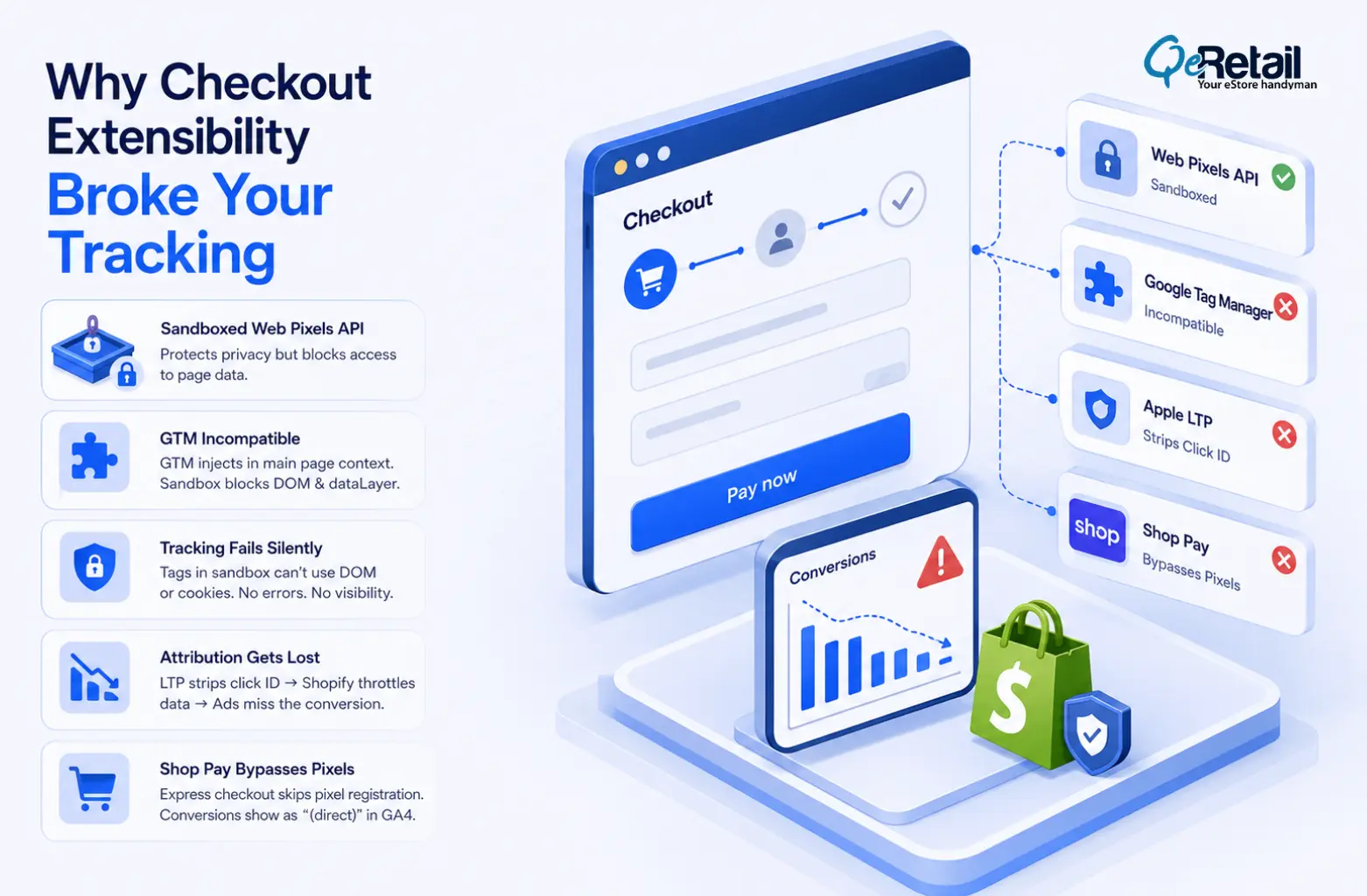
Shopify’s shift to a sandboxed Web Pixels API protected privacy but destroyed conversion tracking—and marketers still don’t understand why. GTM is incompatible with the architecture. Legacy setups scraped the DOM for order totals, customer names, and product details. The sandbox hides the window and document from custom code. GTM injects scripts into the main page context and reads dataLayer.
That pipeline is gone. Tags inside the sandbox cannot access the storefront DOM or third-party cookies. Tracking fails silently with zero debugging visibility. In January 2026, Shopify flipped App Pixels’ default from “Always on” to “Optimized”.
When Apple’s Link Tracking Protection strips a click ID, Shopify assumes no valid attribution signal exists and throttles or pauses data sharing. Shopify records the order, but ad platforms never receive the signal.
Shop Pay accelerates checkout through an express flow, bypassing pixel registration entirely. High-converting transactions vanish from browser-side pixels and land as “(direct)” traffic in GA4.
What do the August 2025 and 2026 deadlines actually change?
In August 2025, the PII pass-through to legacy scripts was killed. Meta cannot match conversions without email or phone. Even Web Pixels API migrations fail on a race condition: the pixel fires before the init object populates customer PII, leaving anonymized events and near-zero match rates.
CMPs operate in the storefront DOM. The checkout sandbox cannot read consent cookies set on the main storefront. Tracking either fires without consent flags (GDPR violations, PII exposure) or locks indefinitely in “Waiting for Consent” total conversion blackout for users who opted in.
6 Failures Killing Shopify Revenue in 2026
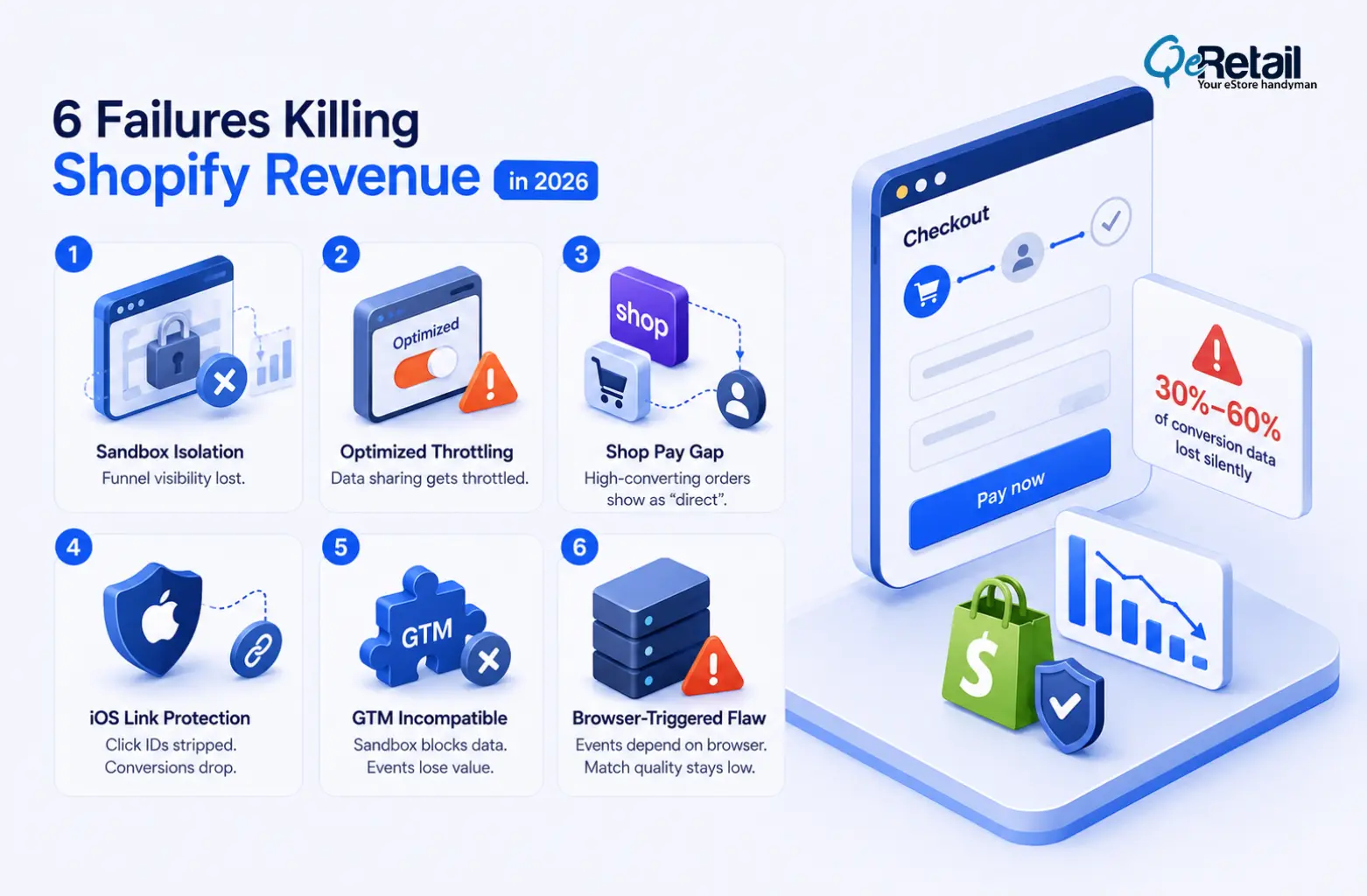
Shopify’s shift to a sandboxed checkout environment solved privacy concerns. It created 12 silent tracking failures that quietly erase 30% to 60% of your conversion data and break attribution across every ad platform.
1. Sandbox Isolation and Funnel Visibility Loss
Checkout pages now run in an isolated iframe with zero access to the storefront dataLayer. GTM breaks the moment a user enters checkout. Middle-funnel events like begin_checkout and add_payment_info vanish entirely. The gap between Shopify’s order counts and ad-platform-reported conversions hits 30% or higher.
Expert Take:
GTM was never designed to operate across isolated iframes. Most merchants don’t realize their funnel tracking ended in January 2026 the moment they upgraded.
Quick Wins:
- Audit your GA4 funnel report: compare Shopify order count to Google Ads reported conversions for the past 30 days.
- Migrate critical events to Web Pixels API with an explicit payload structure rather than relying on GTM.
- Map begin_checkout to a backend server event using Shopify’s Webhooks API instead of browser-side tracking
2. The “Optimized” Data Sharing Throttling Mechanism
January 2026: Shopify flipped the default App Pixel setting from “Always on” to “Optimized”. If a click ID (fbclid, gclid) is missing or a tracking script is blocked, Shopify assumes no valid attribution signal exists and throttles or pauses data sharing.
Expert Take:
This default change killed more tracking than any technical failure because it was invisible. Merchants saw pixels fire in browsers, but never received the signal confirmation on the platform side.
Quick Wins:
- Change the App Pixel setting from “Optimized” to “Always on” in the Shopify admin immediately
- Run a 7-day iOS vs. Android conversion comparison: iOS will show 35% to 45% lower platform-reported ROAS
- Set up direct Meta Conversions API integration, bypassing the pixel-throttling layer entirely
3. The Shop Pay Attribution Gap
Shop Pay drives 50% higher conversion rates but routes through an express flow that bypasses pixel registration entirely. Without explicit Web Pixels API registration or backend CAPI integration, these transactions land as “(direct)” traffic in GA4. High-volume stores lose 15% to 20% of total revenue into this black hole.
Expert Take:
Shop Pay is your highest-converting checkout method and simultaneously your biggest attribution blind spot. Every dollar of Shop Pay revenue you report as direct is a dollar you can’t attribute back to an ad campaign.
Quick Wins:
- Add Shop Pay button registration using shopPayButtonClickedevent in Web Pixels API
- Tag all Shop Pay orders with a custom dimension in GA4 to separate attribution modeling.
- Implement backend CAPI for Shop Pay transactions using order webhooks with email as the match key
4. iOS Link Tracking Protection and Click-ID Decay
Apple strips click IDs from URLs in Safari Private Browsing, Mail, and Messages. When IDs vanish, Shopify’s “Optimized” mechanism throttles remaining PII. Conversion gaps reach 60% for high-income demographic targeting because these users rely on Safari Private.
Expert Take:
This is a compounding failure. Apple’s privacy protection triggers Shopify’s throttling mechanism, which then reduces the data reaching Meta and Google. You lose signal twice.
Quick Wins:
- Run cohort analysis: segment Safari Private users separately and measure their conversion reporting gap
- Implement first-party data collection using email signup forms before checkout to capture match keys
- Switch primary attribution to server-side CAPI, where first-party email becomes the match key, not click IDs
5. GTM Sandbox Incompatibility
Developers try forcing GTM into Custom Pixels. The sandbox blocks DOM access and third-party cookies. GTM tags cannot find data. Preview Mode and Tag Assistant cannot debug inside the sandbox. Events reach GA4 without product names, transaction IDs, or values.
Expert Take:
GTM’s architecture assumes full DOM access. The sandboxed checkout makes GTM architecturally obsolete for eCommerce tracking. Most merchants haven’t accepted this yet.
Quick Wins:
- Disable all GTM tags firing on the checkout and Thank You pages immediately.
- Migrate to the native Web Pixels API for all checkout events (purchase, payment info, contact info)
- Test each migrated event in Shopify’s Web Pixel debugger before deploying to production.
6. The “Fatal Flaw” of Browser-Triggered Server Events
Native Meta and TikTok integrations claim to be server-side but rely on a browser-side Web Pixel on Thank You pages to send server instructions. If the customer closes the tab or an ad blocker stops the pixel, the server instruction never fires. Event Match Quality scores remain between 4.0 and 6.0.
Expert Take:
“Server-side” integration that depends on the browser is a marketing term, not an architecture. True server-side means the event fires from your backend without waiting for a browser signal.
- Implement native Conversions API using Shopify order webhooks instead of relying on Thank You page pixels.
- Validate webhook delivery in Meta’s Conversions API event manager (should show 95%+ delivery rate)
- Use server-side hashed PII matching (email, phone, address) instead of click ID matching.

Final Thoughts
Your dashboards aren’t lying. The payload is. Checkout extensibility moved tracking into a sandbox for privacy, not your convenience. Stores auditing the 12 failures and rebuilding pixels as Web Pixels integrations regain clarity in 30 to 60 days.
Waiting costs another full quarter. ROAS reporting no longer matches your bank account. If you haven’t audited since August 2025, you’re operating blind. QeRetail runs a 12-point audit for Shopify stores in your range, identifies silent failures, and rebuilds pixels before auto-upgrade closes. Book a free consultation.
Frequently Asked Questions
Why Is My Meta Pixel Not Firing On Shopify Checkout After The Extensibility Upgrade?
Why Does GA4 Show Fewer Purchases Than My Shopify Admin?
What Happens At Checkout? Liquid Scripts After August 26, 2026?
How Do I Migrate Google Tag Manager To Shopify Customer Events?
How Do I Verify Meta Capi Is Sending Checkout_completed Events Correctly?
Table of Contents