AI search engines are not simply looking for brands with good SEO. They are looking for brands they can confidently understand, verify, and cite. Gartner predicts traditional search engine volume will drop 25% by 2026 as generative AI tools replace queries that used to run through Google. That shift changes who gets recommended, and why.
Most Shopify store owners still treat AI visibility as an SEO problem. However, ranking and being recommended are not the same job. A search engine ranks pages. An AI assistant makes a judgment call on your behalf, and it only makes that call when it has evidence to back it up.
So, here is the question worth sitting with: if an AI assistant had to recommend your brand to a shopper right now, what evidence would it need to trust that recommendation? If you cannot answer that in one sentence, the rest of this guide is for you.
Key Action Points:
- Audit your product pages for the seven trust signals AI systems actually use before adding more content volume
- Check whether your returns policy, shipping promise, and product claims match what customers actually experience
- Replace superlative claims (“best,” “premium,” “eco-friendly”) with specific, sourced, verifiable numbers
- Pull your Google Business Profile, Shopify store, marketplace listings, and review platforms side by side and check for contradictions.
- Run the five-part AI Trust Audit below and score your store honestly, section by section

AI Doesn’t Trust Your Brand, It Trusts the Evidence Around It
Traditional ranking rewarded backlinks, keyword density, and page speed. AI search works on a different logic entirely, built on retrievability, credibility, and corroboration. The system has to find your information, believe it, and confirm it against other sources before it will put your brand in front of a shopper.
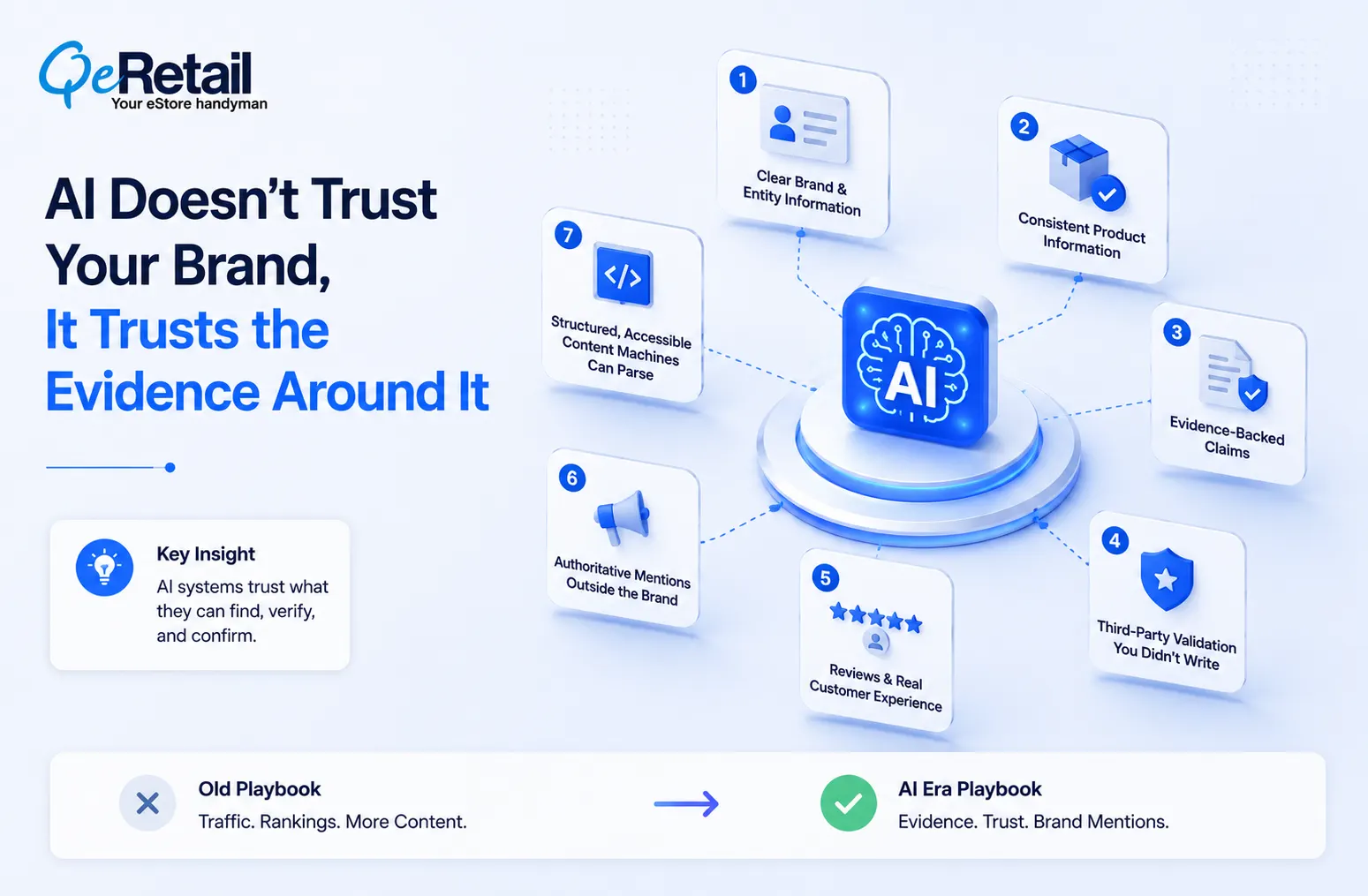
The reason behind such a scenario is simple. A ranking algorithm just has to decide what to show. An AI assistant has to decide what to say, in its own words, with its own reputation attached. That is a higher bar, and it changes what “optimization” actually means.
Seven things feed that bar directly:
- Clear brand and entity information
- Consistent product information across every channel
- Evidence-backed claims instead of adjectives
- Third-party validation the brand did not write itself
- Reviews and real customer experience
- Authoritative mentions from sources outside the brand
- Structured, accessible content a machine can parse without guessing
However, most merchants still measure success by traffic and rankings alone. So, they keep publishing more content while an AI assistant quietly skips their brand for a competitor with thinner content but clearer evidence.
The 7 Trust Signals AI Search Engines Can Actually Use
This is the framework the rest of this guide builds on. Each signal maps to something an AI system can actually extract, verify, or cross-check, not something that sounds good in a brand deck.
1. Clear Product and Brand Information
An AI system has to answer seven questions about your product before it will recommend it: what you sell, who it is for, its attributes, its price, its availability, its use cases, and what makes it different from the next option. If any of those seven require a shopper to dig, the AI system will not dig either.
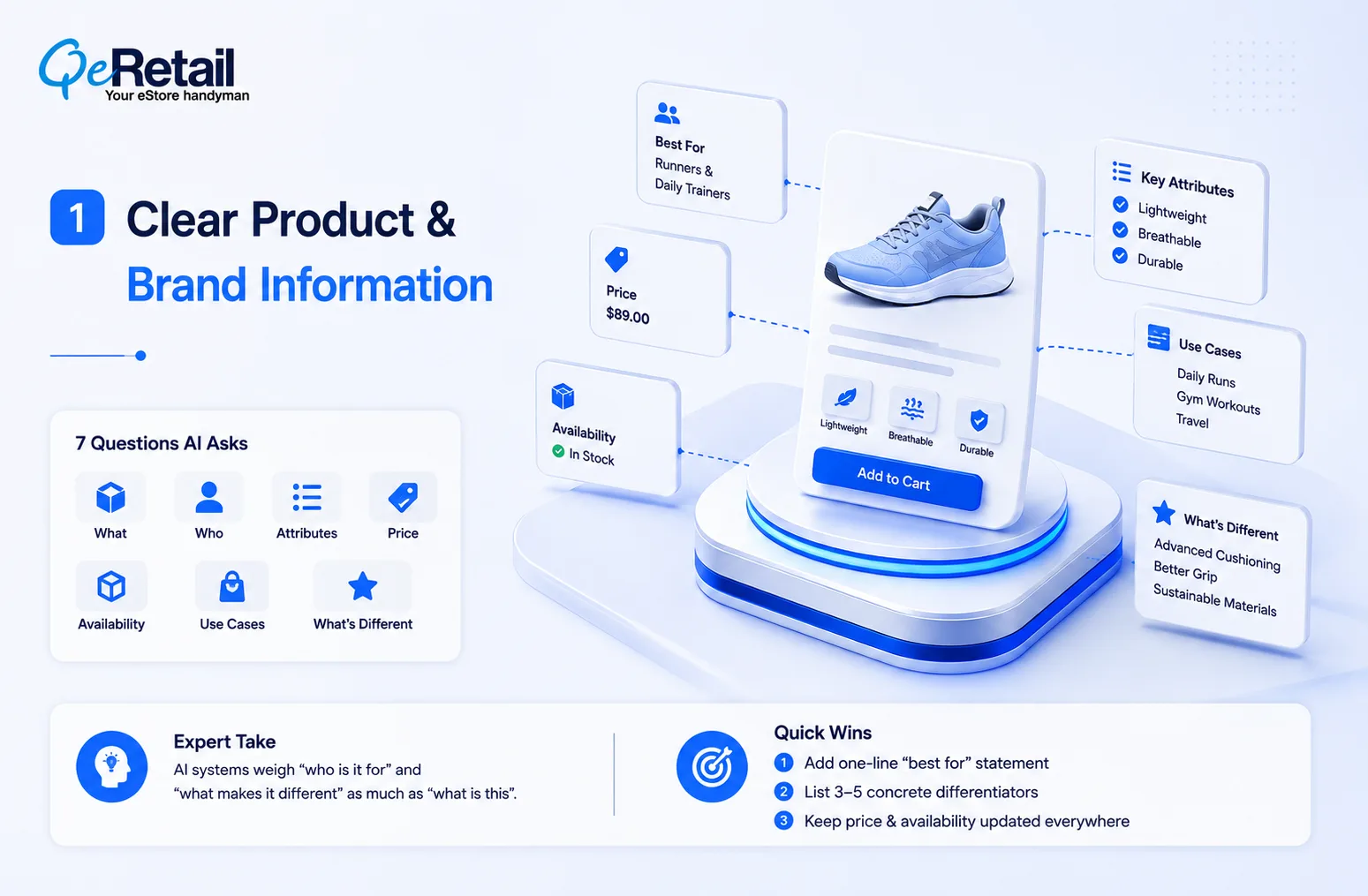
It moves to the competitor whose page answers all seven in the first few lines.
For Shopify stores, this usually breaks down at the attribute and differentiator level. Titles are clear. Prices are clear. But “who is this for” and “what makes it different” often live nowhere except a founder’s head.
Expert Take:
Most product description sections answer “what is this” and stop. AI systems weigh “who is it for” and “what makes it different” just as heavily, because those two answers are what separate a recommendation from a generic listing. Skip them, and your product becomes interchangeable with anyone else’s.
Quick Wins:
- Add a one-line “best for” statement to every product page
- List 3-5 concrete differentiators, not adjectives, per product
- Confirm price and availability are current on every channel, not just your Shopify store
2. Consistent Information Across the Web
AI systems corroborate. They check your website against your product feeds, your marketplace listings, your reviews, your social profiles, your retail partners, and any editorial mentions of your brand. Consistency between all of those is what earns confidence. Inconsistency creates uncertainty, and an uncertain system defaults to silence rather than a wrong recommendation.
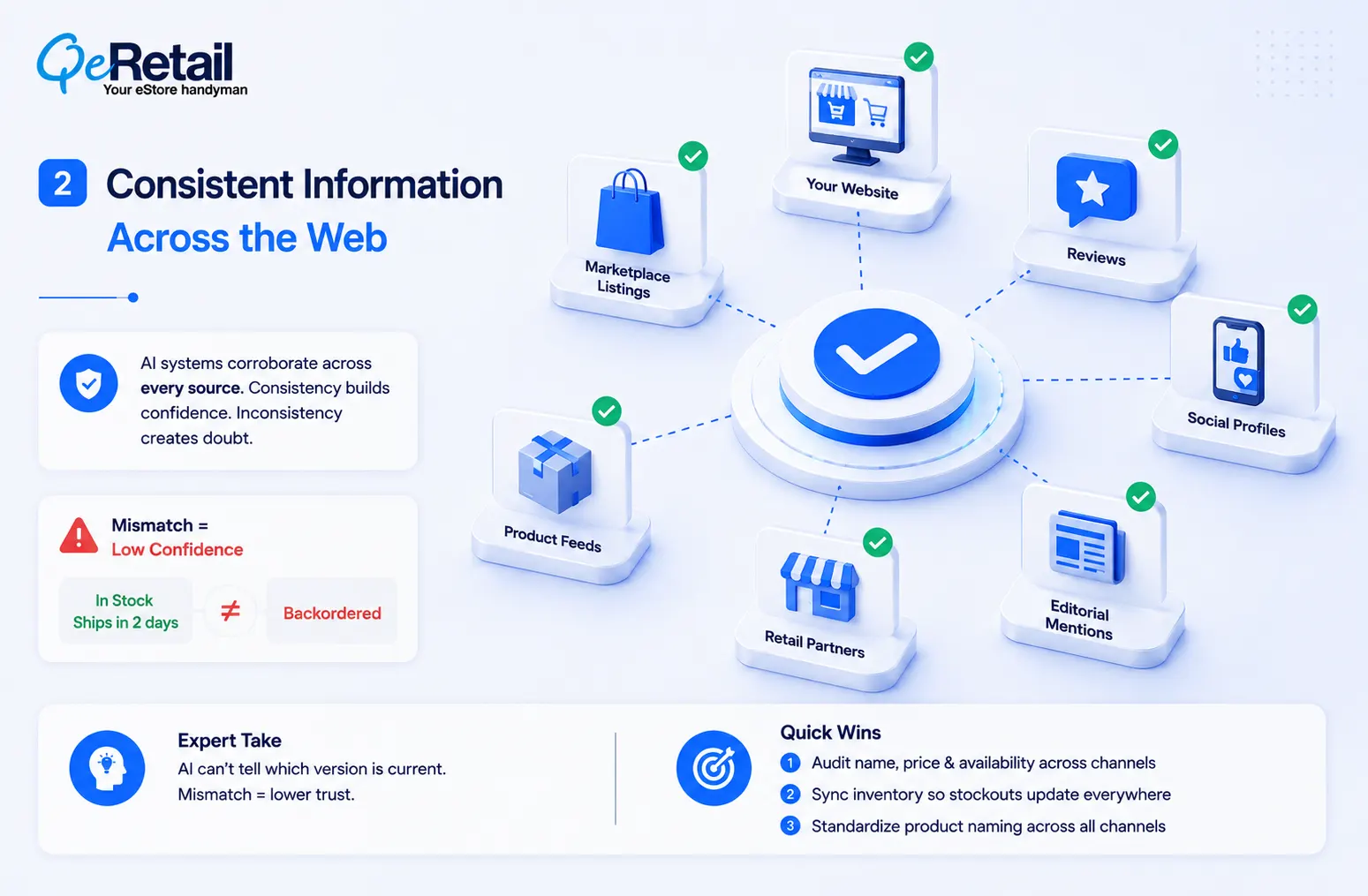
So, a product listed as “in stock, ships in 2 days” on your website and “backordered” on a marketplace is not two minor discrepancies. It is one signal: this brand’s data cannot be trusted at face value.
Expert Take:
Store owners obsess over their own website’s accuracy and ignore marketplace and social listings set up years ago and never touched again. AI systems do not know which version is current. They just see the mismatch and downgrade confidence in both.
Quick Wins:
- Audit your product name, price, and availability across your website, marketplaces, and social shops quarterly
- Sync inventory feeds so stockouts update everywhere, not just on Shopify
- Standardize product naming conventions across every channel you sell on
3. Specific, Verifiable Claims
“The world’s best sustainable sneakers” tells an AI system nothing it can check. “Made with 62% recycled ocean plastic, certified by Global Recycled Standard, manufactured in Portugal” tells it exactly what to verify, cite, and repeat to a shopper with confidence.
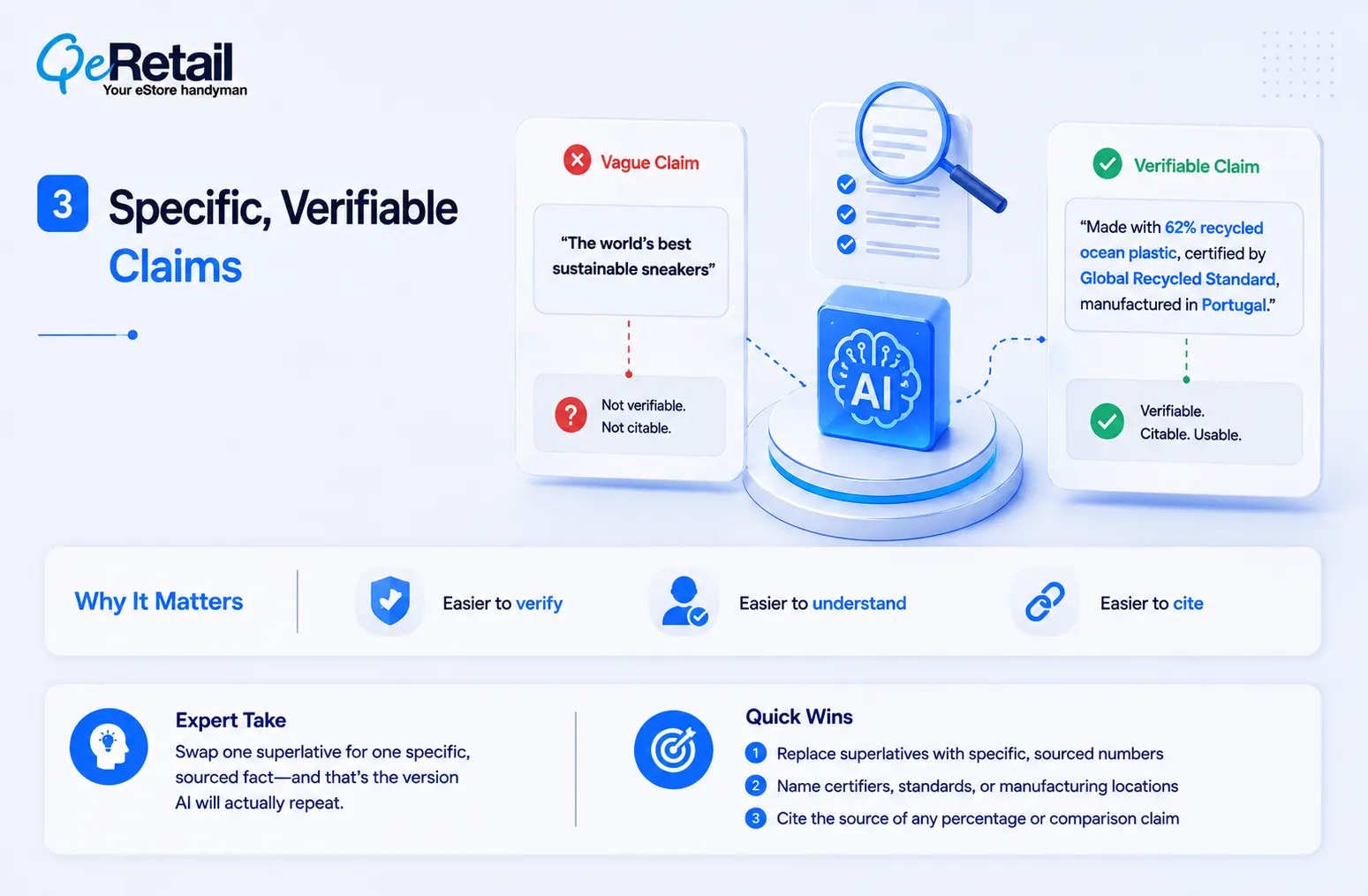
The second version is easier to verify, easier to understand, and easier to cite, because it hands the AI system a fact instead of an opinion. This is the same principle generative engine optimization guidance keeps repeating: content has to be specific, verifiable, self-contained, and context-rich, or it simply does not get used as source material.
Expert Take:
Superlatives are not lies, but they are unusable to a machine that has to justify its answer. “Best” requires a comparison the AI system cannot run. A certification number requires nothing but a lookup. Swap one claim per product page this week and watch which one an AI assistant actually repeats back
Quick Wins:
- Replace every superlative on your top 10 product pages with a specific, sourced number
- Name your certifying bodies, testing standards, or manufacturing locations explicitly
- Cite the source of any percentage or comparison claim you make
4. Independent Proof
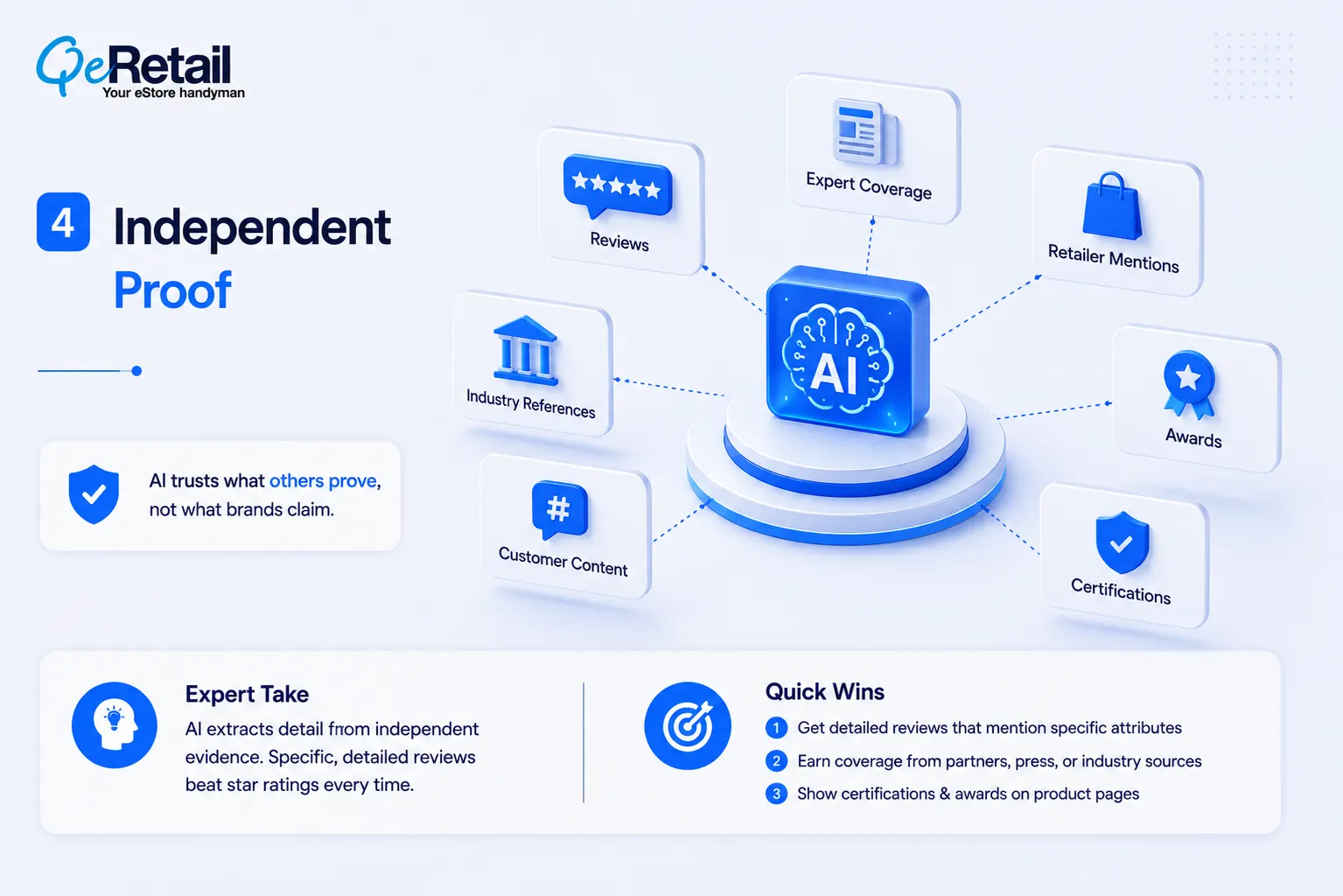
Reviews, expert coverage, retailer mentions, awards, certifications, customer-generated content, and industry references all carry more weight than anything a brand says about itself. Brand claims are not independent evidence. A brand telling an AI system its product is premium is a marketing statement. A retailer, a certifying body, or a thousand verified reviews saying the same thing is corroboration.
Expert Take:
A five-star review count with no detail is weaker evidence than fifty three-and four-star reviews that mention specific product attributes. AI systems extract detail, not stars. A vague glowing review is closer to brand copy than to independent proof.
Quick Wins:
- Actively solicit detailed reviews that mention specific product attributes, not just star ratings
- Pursue coverage from retail partners, trade press, or category-relevant publications
- Surface certifications and awards directly on product pages, not buried in an About page
5. Useful Content That Answers Real Buying Questions
Shoppers ask the same handful of questions before they buy: which product is right for me, what is the difference between A and B, does this fit my use case, what size should I buy, how does it compare, and what happens if I need to return it.
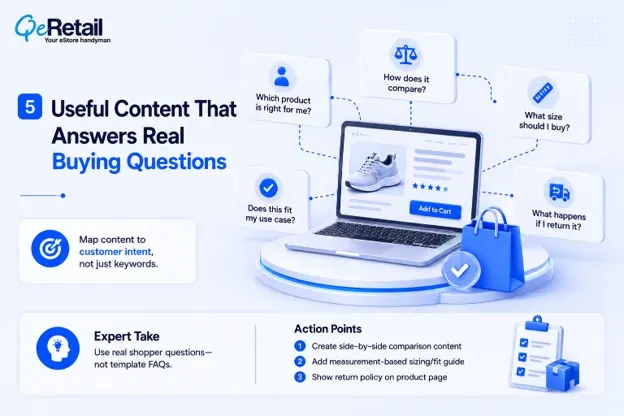
Content built to answer those questions maps to actual purchase intent. Content built to repeat a keyword maps to nothing an AI system finds useful.
This is the same content principle worth restating for every Shopify store: map content to customer intent, not to what the brand wants to say about itself.
Expert Take:
Most FAQ sections answer questions the legal team wanted covered, not questions shoppers are actually asking an AI assistant. Pull your actual customer service tickets and build your FAQ from those, not from a template.
Quick Wins:
- Build comparison content for your top 2-3 competing products, side by side
- Add a sizing or fit guide with specific measurements, not “true to size”
- Publish your return policy in plain language on the product page itself, not three clicks away
6. Product Data That Machines Can Understand
This is not a technical SEO checklist; it is the foundation that makes everything above legible to a machine. Structured product information, consistent attributes, product schema, descriptive titles, variant information, availability, shipping and returns information, and crawlable content all exist for one reason: they let an AI system extract facts without guessing.
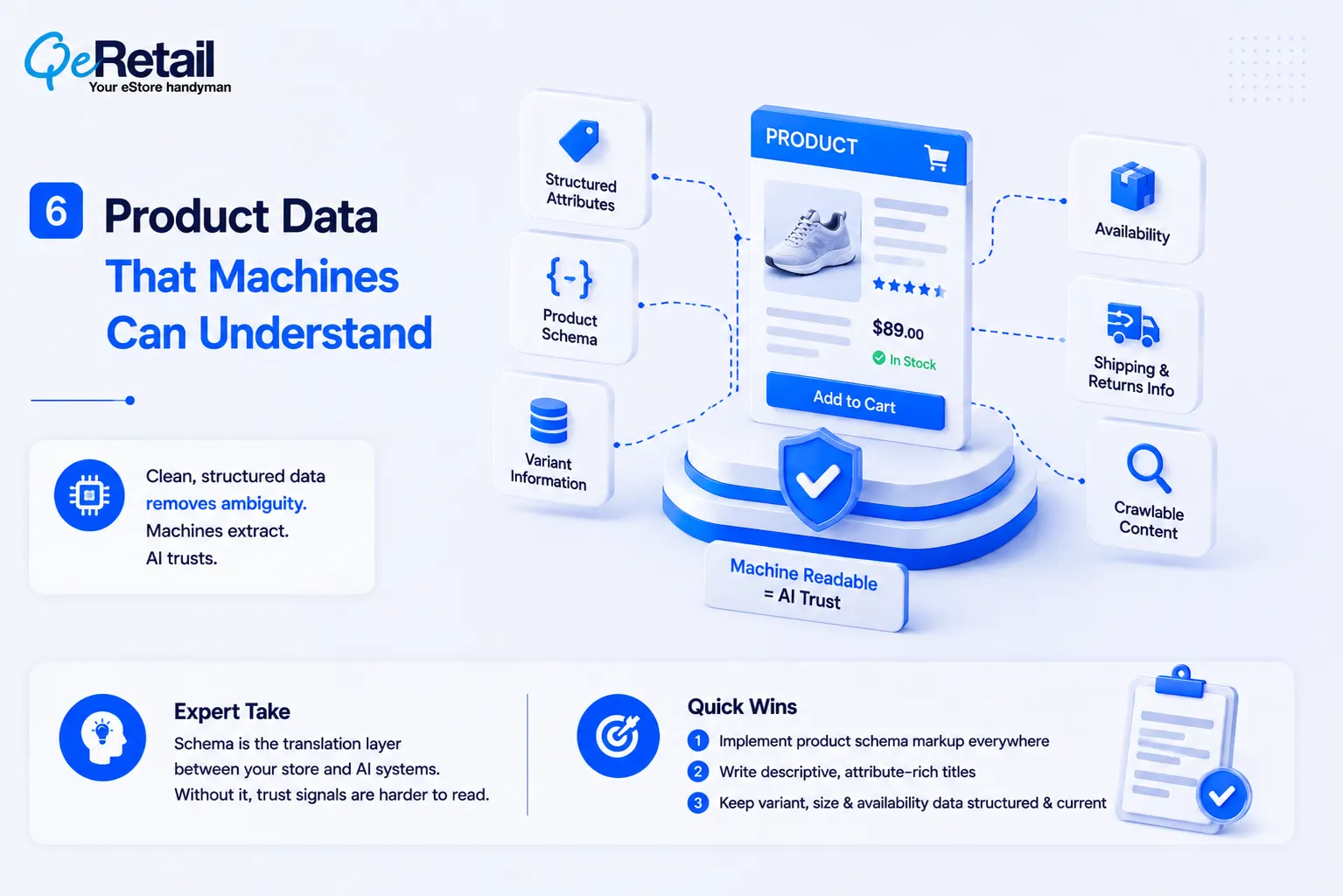
Clean data does not just help search engines crawl faster. It removes the ambiguity that makes an AI system hesitate to cite you at all. A machine cannot verify what it cannot parse.
Expert Take:
Store owners treat schema markup as a technical afterthought handed to a developer once. It is closer to a translation layer between your store and every AI system trying to understand it. Skip it, and every other trust signal on this list gets harder to extract.
Quick Wins:
- Implement product schema markup on every active product page
- Write descriptive, attribute-rich titles instead of brand-first, generic titles
- Keep variant, size, and availability data structured and current, not buried in free text
7. A Brand Experience That Matches Its Claims
This is the signal most content on AI search skips, and it is the one that actually determines whether a shopper becomes a repeat customer. If a brand claims premium, the unboxing and materials should feel premium.
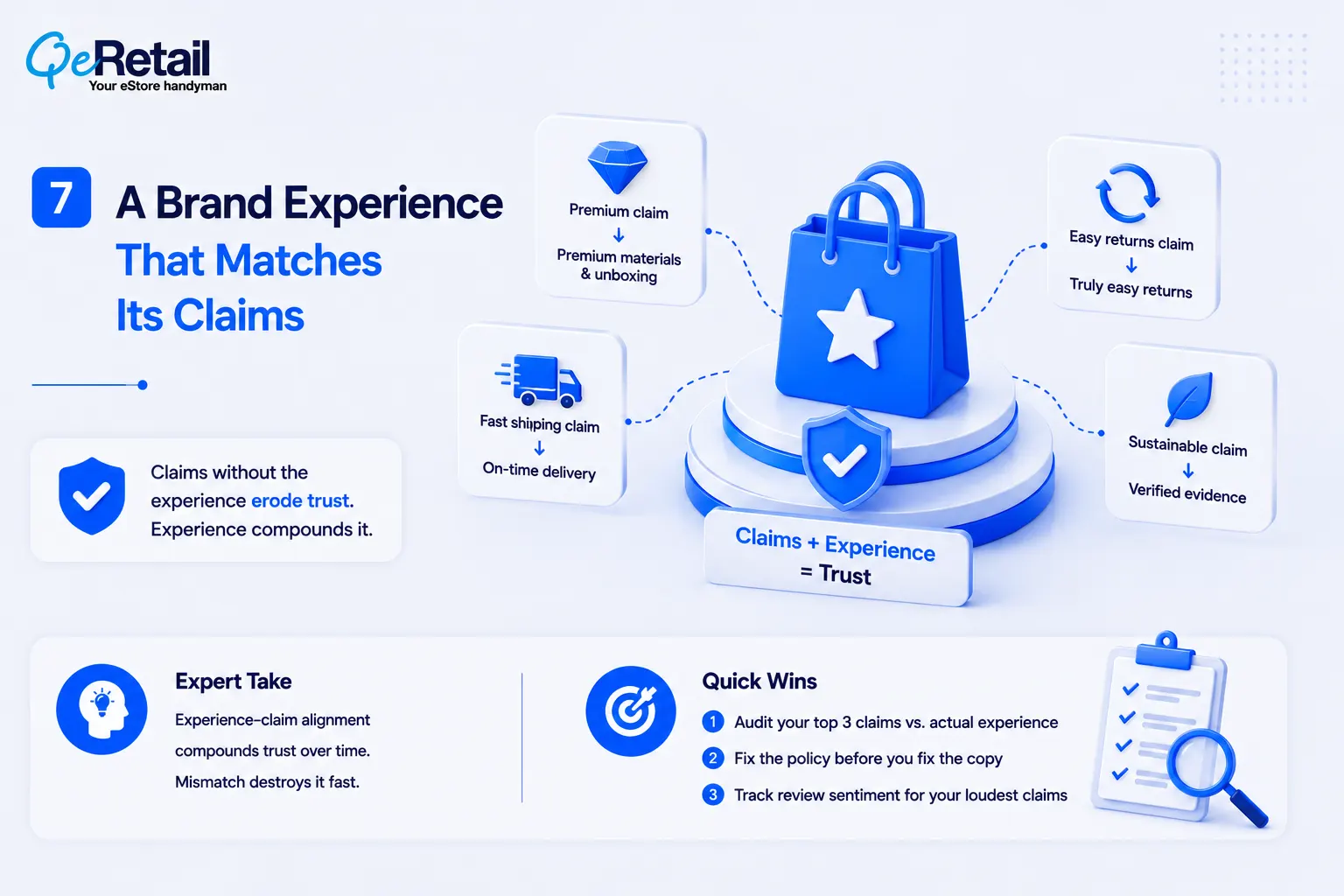
If it claims fast shipping, delivery should support that promise. If it claims easy returns, the policy should actually be easy. If it claims sustainable, evidence should exist and hold up to a search.
A brand cannot manufacture trust through content alone. Content can describe an experience. It cannot substitute for one. So, when the experience and the claim diverge, every other trust signal you have built starts to erode, because the gap eventually shows up in reviews, and reviews are exactly what AI systems weigh as independent proof.
Expert Take:
This is the signal that compounds. A store with average content but a genuinely matching experience earns trust over months, through reviews. A store with excellent content and a mismatched experience loses that trust in one bad review cycle, and AI systems will surface that review cycle for years.
Quick Wins:
- Audit your top three brand claims against the actual customer experience this month.
- Fix the policy before you fix the copy if the two do not match
- Track review sentiment specifically for the claims you make loudest

Make Your Brand Easy to Understand, Verify, and Recommend
AI search visibility is becoming a trust problem, not just an SEO problem. The brands that win the next cycle of eCommerce will not be the ones that publish the most content. They will be the ones a machine can understand, verify, and recommend without hesitation.
Be clear. Be consistent. Be useful. Be verifiable. Deliver what you promise. Every one of the seven trust signals above traces back to those five words.
Book a free consultation, and we will run the AI Trust Audit against your actual product pages, not a template.
Frequently Asked Questions
What Makes an eCommerce Brand Trustworthy To AI Search Engines?
How Does AI Decide Which eCommerce Brands To Recommend?
Does SEO Still Matter For AI Search?
Do Product Reviews Influence AI Recommendations?
Does Structured Data Help AI Understand eCommerce Products?
How Can Shopify Merchants Improve Their AI Search Visibility?
Table of Contents