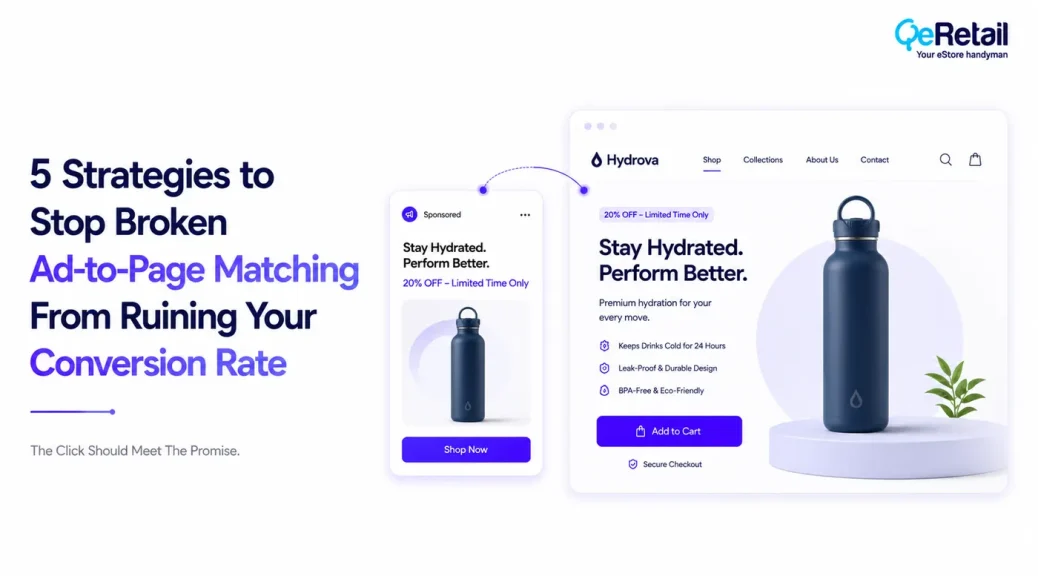
Your paid ads may be attracting the right audience, generating clicks, and driving traffic to your Shopify store. Yet if visitors arrive on a page that does not immediately match what the ad promised, those clicks can quickly turn into lost conversion opportunities.
This problem is often overlooked because businesses tend to evaluate advertising performance and website performance separately. Marketers focus on impressions, clicks, CPC, and campaign targeting, while store teams focus on product pages, checkout, and conversion rates.
The real problem can exist between the two.
When an ad promotes a specific product, offer, benefit, or buying experience but the landing page presents something different, customers have to reassess their decision after clicking. That extra uncertainty can weaken trust and interrupt the momentum created by the advertisement for shopping.
Google specifically recommends making ads and landing pages closely connected and directly relevant, noting that this can improve the chances of conversion.
For growing Shopify stores, improving conversion performance therefore does not always begin with changing the product page or checkout. Sometimes, the biggest opportunity is making sure the page customers reach is actually the page they expected.

Key Action Points Summary
- Match the landing page headline with the core promise of the advertisement
- Send visitors to the most relevant product or collection page
- Keep offers, pricing, products, and promotional messaging consistent
- Align landing-page content with customer intent and buying stage
- Make the expected action immediately visible after the ad click
- Create dedicated landing experiences for high-value campaigns
- Review mobile experiences separately from desktop experiences
- Use campaign-level conversion data to identify weak page matches
- Test different combinations of ad messaging and landing-page content
- Remove unnecessary content that distracts visitors from the advertised offer
Quick Wins: Improve Your Ad-to-Page Matching Today
Before rebuilding your advertising campaigns or redesigning your Shopify store, review what happens immediately after every important ad click.
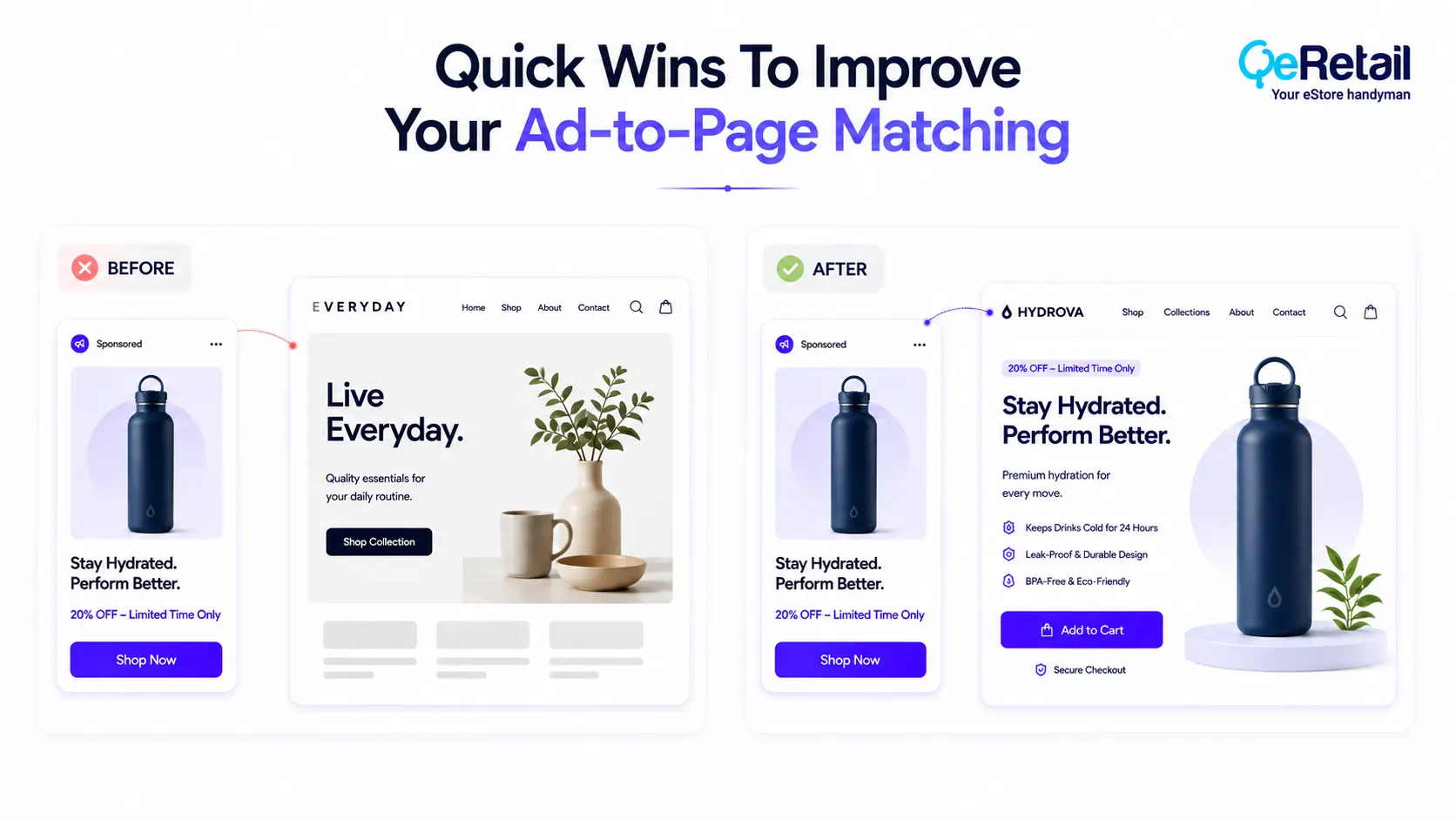
1. Compare Your Ad Headline With Your Landing Page Headline
Take your highest-spending advertisements and compare their primary message with the first headline visitors see after clicking. If the message changes significantly, rewrite the page or adjust the advertisement.
2. Check Where Your Paid Traffic Actually Lands
Review the final URLs attached to your active campaigns. If visitors promoting a specific product or offer are being sent to a generic homepage, collection, or unrelated page, create more relevance between all.
3. Follow The Complete Ad-to-Purchase Journey
Click your advertisements as a customer would and complete the journey without using administrator shortcuts. Look for differences in product, pricing, offer, messaging, navigation, and checkout expectations.
4. Review Your Mobile Landing Experience
Most paid traffic can arrive through mobile devices, making mobile message matching particularly important. Check whether the advertised product, offer, headline, and primary CTA remain immediately visible on smaller screens.
5. Compare Campaign Performance By Destination Page
Do not evaluate an advertisement only by its click-through rate. Compare conversion performance across the landing pages receiving that traffic to identify campaigns where strong clicks are followed by weak purchasing behaviour.
5 Ad-to-Page Matching Strategies Shopify Stores Can Use To Improve Conversions
Paid traffic becomes more valuable when the experience after the click continues the same message that earned the click in the first place. These five strategies can help Shopify stores reduce that gap.
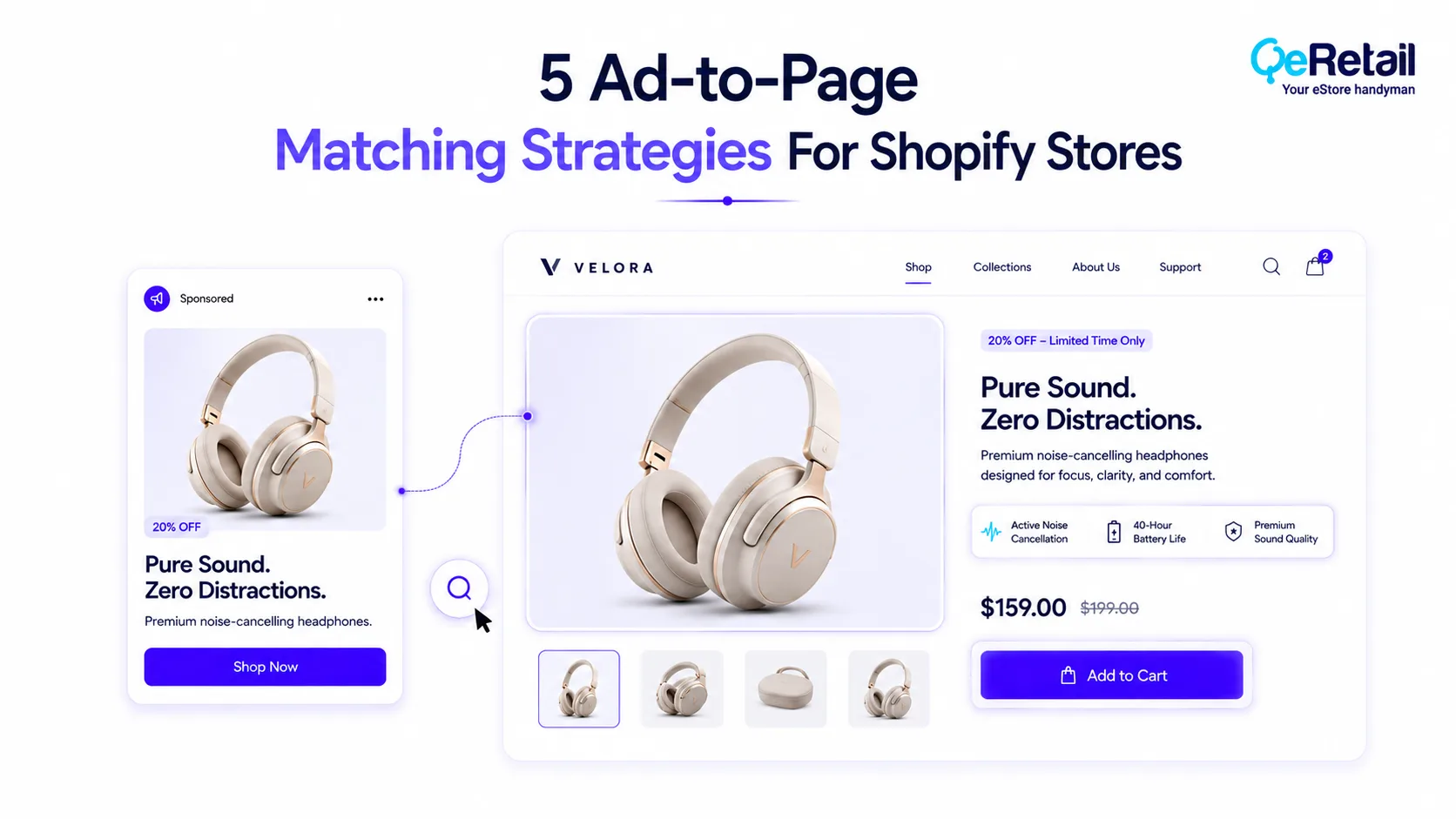
1. Match Your Landing Page With The Ad’s Core Promise
The first few seconds after an ad click are critical because customers need confirmation that they have arrived at the right place.
If the advertisement highlights a particular product, discount, feature, or benefit, that same message should be visible on the destination page without requiring customers to search for it.
What Should Shopify Stores Do To Improve?
- Match the primary headline with the ad message
- Show the advertised product immediately
- Reinforce the same key benefit
- Display advertised offers clearly
- Keep the primary CTA consistent
- Avoid introducing an unrelated message above the fold
Quick Wins:
Copy the primary promise from one of your highest-spending ads and compare it with the first five seconds of its landing page experience.
2. Send Customers To The Right Page, Not Just The Right Store
Getting customers to your Shopify store is only the beginning. Sending them to the correct destination can determine whether their buying intent continues or disappears.
A product-specific advertisement should generally lead customers toward the relevant product experience rather than making them navigate through the homepage.
What Should Shopify Stores Do To Improve?
- Map individual campaigns to relevant destinations
- Use product pages for product-specific ads
- Use collection pages for category-focused campaigns
- Create campaign-specific landing pages when necessary
- Avoid sending every campaign to the homepage
- Review destination URLs regularly
Quick Wins:
Take your five highest-spending campaigns and record their destination pages. If customers need more than one unnecessary step to find what the ad promoted, reconsider the destination.
3. Keep Products, Offers, Pricing, And CTAs Consistent
Customers notice when an advertisement shows one price, but the landing page displays another, when an ad promotes free shipping but the page does not mention it, or when an advertisement uses “Shop Now” while the destination provides no obvious purchasing action.
These inconsistencies create questions at precisely the point where the customer should be moving toward a purchase.
What Should Shopify Stores Do To Improve?
- Maintain consistent product imagery
- Match promotional pricing
- Reinforce advertised discounts
- Display relevant shipping benefits
- Use clear primary CTAs
- Remove expired campaign messaging
Quick Wins:
Select one active promotional ad and compare its product image, price, discount, shipping message, and CTA against the destination page. Fix inconsistencies before full-fledged campaign.
4. Match The Page To Customer Intent, Not Just The Campaign
Two customers can click advertisements for the same product while having very different levels of buying intent.
Someone searching for a specific product may need immediate product information, pricing, reviews, and purchase options. Someone responding to an awareness-focused social advertisement may need more context before they are ready to buy.
Baymard’s research places average eCommerce cart abandonment at 70.19%, showing how frequently purchase journeys lose customers before completion. Better intent matching can reduce unnecessary friction before visitors even reach the checkout stage.
What Should Shopify Stores Do To Improve?
- Identify the intent behind each campaign
- Match page depth to buying readiness
- Provide product information for high-intent visitors
- Add education where customers need more context
- Keep purchase actions visible for ready-to-buy traffic
- Avoid overwhelming visitors with unnecessary information
Quick Wins:
Review your campaigns by intent and ask one simple question: “What does this customer expect to accomplish immediately after clicking?” Then check whether the destination page supports that action.
5. Test Ad And Landing Page Combinations Together
A strong advertisement does not automatically mean a strong campaign.
Likewise, a high-performing product page does not guarantee that it will convert every type of paid visitor. Performance depends on how the message, audience, offer, destination, device, and customer intent work together.
This is why Shopify stores should evaluate ad-to-page performance as a connected journey instead of optimizing each component independently.
What Should Shopify Stores Do To Improve?
- Compare conversion rates by campaign
- Compare landing pages receiving similar traffic
- Test different headlines and offers
- Review mobile and desktop separately
- Monitor engagement after the click
- Use behavioural data to identify friction
Quick Wins:
Find one campaign with strong clicks but weak conversions. Compare it against a stronger campaign and look specifically at the message, destination, mobile experience, and primary CTA.
How QeRetail Helps Improve Shopify Ad-to-Page Experiences
QeRetail helps Shopify businesses identify where advertising promises and store experiences become disconnected, then improve the landing journey so paid traffic has a clearer path toward conversion.
1. Shopify Landing Page Assessment
We evaluate campaign destinations, page structure, messaging, product presentation, navigation, and conversion elements to identify friction between advertising intent and the shopping experience.
2. Conversion-Focused Landing Page Optimization
Our team helps align landing-page content with campaign messaging, customer intent, product benefits, promotional offers, and primary actions to create more consistent post-click experiences.
3. Shopify Theme and Page Customization
We customize Shopify themes and landing experiences to improve information hierarchy, campaign relevance, mobile usability, and purchasing interactions without adding unnecessary design complexity.
4. Campaign-Specific Shopping Experiences
We help businesses create more relevant destination experiences for important campaigns so customers can move from the advertised promise to the intended product or offer with fewer distractions.
5. Continuous Conversion Improvement
We use behavioural insights and conversion performance to identify opportunities for ongoing optimization, helping Shopify stores improve the relationship between paid traffic and on-site customer experience.

Conclusion
Paid advertising does not end when a customer clicks the ad. That click creates an expectation that the Shopify store must immediately confirm.
When advertisements and landing pages tell different stories, businesses can spend more to acquire visitors who were already interested but encounter unnecessary friction after arriving. Improving the connection between the ad promise, landing experience, product information, and purchase action can therefore make existing traffic more valuable.
QeRetail helps Shopify businesses optimize these connected experiences through landing-page assessment, Shopify customization, usability improvements, and conversion-focused optimization.
Contact us to identify where your paid traffic experience may be losing customers before they reach checkout.
Frequently Asked Questions
What Is Ad-To-Page Matching In Shopify?
Why Does Poor Ad-To-Page Matching Reduce Conversion Rates?
Should Every Shopify Ad Have A Separate Landing Page?
How Can I Identify Broken Ad-To-Page Matching?
Can Improving Ad-To-Page Matching Increase Shopify Conversion Rates?
Table of Contents