Black Friday 2025 ran at an average online discount of 28%, and order volumes still came in down 1% year over year. Merchants gave away a quarter of their price and did not buy one extra order with it.
Most stores pick their BFCM discount by looking sideways: check what competitors ran, choose a round number, launch, and then January arrives with revenue that looks fine and a bank balance that does not.
A $100 product sold at $70 did not cost you $30. It changed the contribution you earn on every order, and it set a volume target you never agreed to.
Key Action Points:
- Calculate contribution per order at full price first.
- Run the break-even lift for every discount you are considering.
- Subtract blended CAC before calling an offer profitable.
- Compare every required lift against your last two BFCMs.
- Model contribution in dollars per order, not margin percent.

What a Shopify BFCM Margin Calculator Actually Measures?
Selling price minus COGS is not your margin. It is the first line of a subtraction most stores never finish, and the missing lines decide whether BFCM pays.
The Gross-Margin Mirage
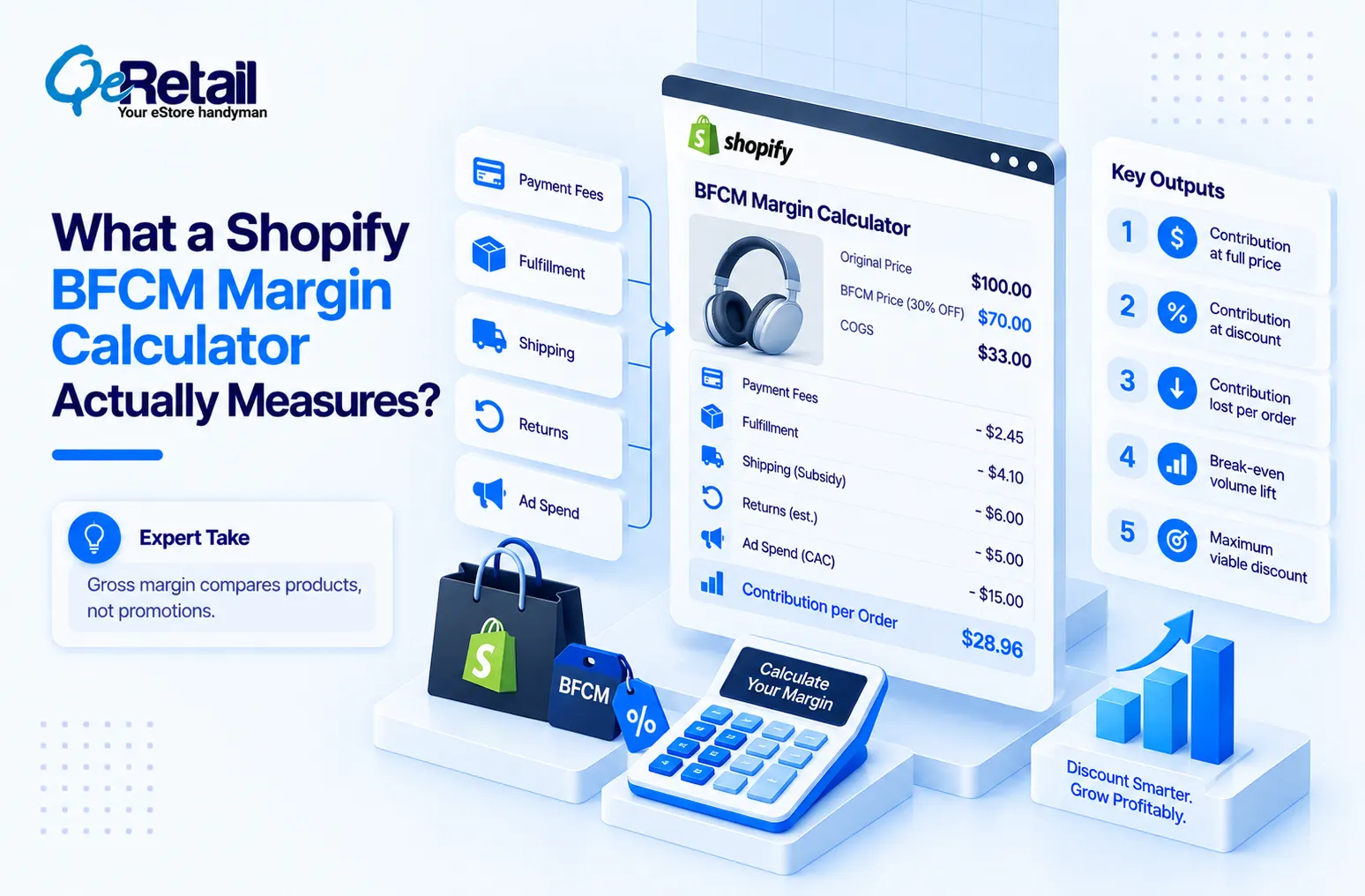
The gross-margin mirage is the belief that price minus product cost describes what an order earns you. Every order also drags a payment fee, pick-and-pack, a shipping subsidy, a share of returns, and a slice of ad spend behind it.
On a $100 product with $33 COGS, gross margin reads 67%, while the same order contributes $28.96 once every variable cost and a $15 blended CAC come out of it.
Expert Take: Gross margin was built to compare products, not to price a promotion. The costs it excludes are exactly the ones that spike during BFCM: subsidized shipping, higher return rates, auction-inflated CAC. Use it for buying decisions. Never for discount decisions.
The Eight Inputs It Needs
| Input | Why it matters |
|---|---|
| Product price | Starting revenue; scales the payment fee |
| Discount % | Revenue sacrificed |
| COGS | Product cost, fixed per unit |
| Payment fees | 2.9% + 30¢ on Shopify Basic; the 30¢ never shrinks |
| Fulfillment / pick-pack | Per-order cost; does not fall with price |
| Shipping subsidy | Thresholds get crossed far more often |
| Returns allowance | 17% of holiday sales come back |
| CAC / ad spend | Decides if the order was worth acquiring |
The Five Numbers It Returns
- Contribution at full price, in dollars per order.
- Contribution at the discount, after returns and CAC.
- Contribution lost per order, the offer’s price tag.
- Break-even volume lift, the extra orders needed.
- Maximum viable discount, where contribution hits zero.
Why Do Most Shopify Stores Misprice Their BFCM Discount?
Shopify merchants cleared $14.6 billion over BFCM 2025, up 27% year over year, at an average order value of $114.70. Strong numbers. They hide two failure patterns.

The Discount-To-Volume Gap
The discount-to-volume gap is the distance between the margin a promotion gives away and the volume it returns. Black Friday 2025 measured it in public: discounts averaged 28%, order volumes fell 1%, units per transaction fell 2%, selling prices rose 7%. Deeper cuts, fewer orders, smaller baskets. The discount was subsidizing demand that was arriving anyway.
The Contribution Cliff
The contribution cliff is the point where each extra discount point removes a disproportionate share of what remains. Your costs are not proportional: COGS scales with units, the payment percentage scales with price, and pick-pack, shipping, and CAC do not move at all when price falls.
Walk the same $100 order down. Contribution after returns and CAC drops from $28.96 to $20.45 at 10% off, $11.94 at 20%, $3.43 at 30%, and-$5.08 at 40%.
Expert Take: Merchants read the cliff backward. They see 40% off as slightly more aggressive than 30% because the numbers sit next to each other. In contribution dollars, 30% off leaves $3.43 and 40% off costs $5.08 on every order you win. One is a thin promotion. The other is paying customers to shop with you.
The Break-Even Volume Test
If a discount cuts contribution per order, how many extra orders bring total contribution back to where it started? Divide full-price contribution by discounted contribution, then subtract one. Start from 1,000 orders at $28.96 each, which is $28,960 of contribution to replace.
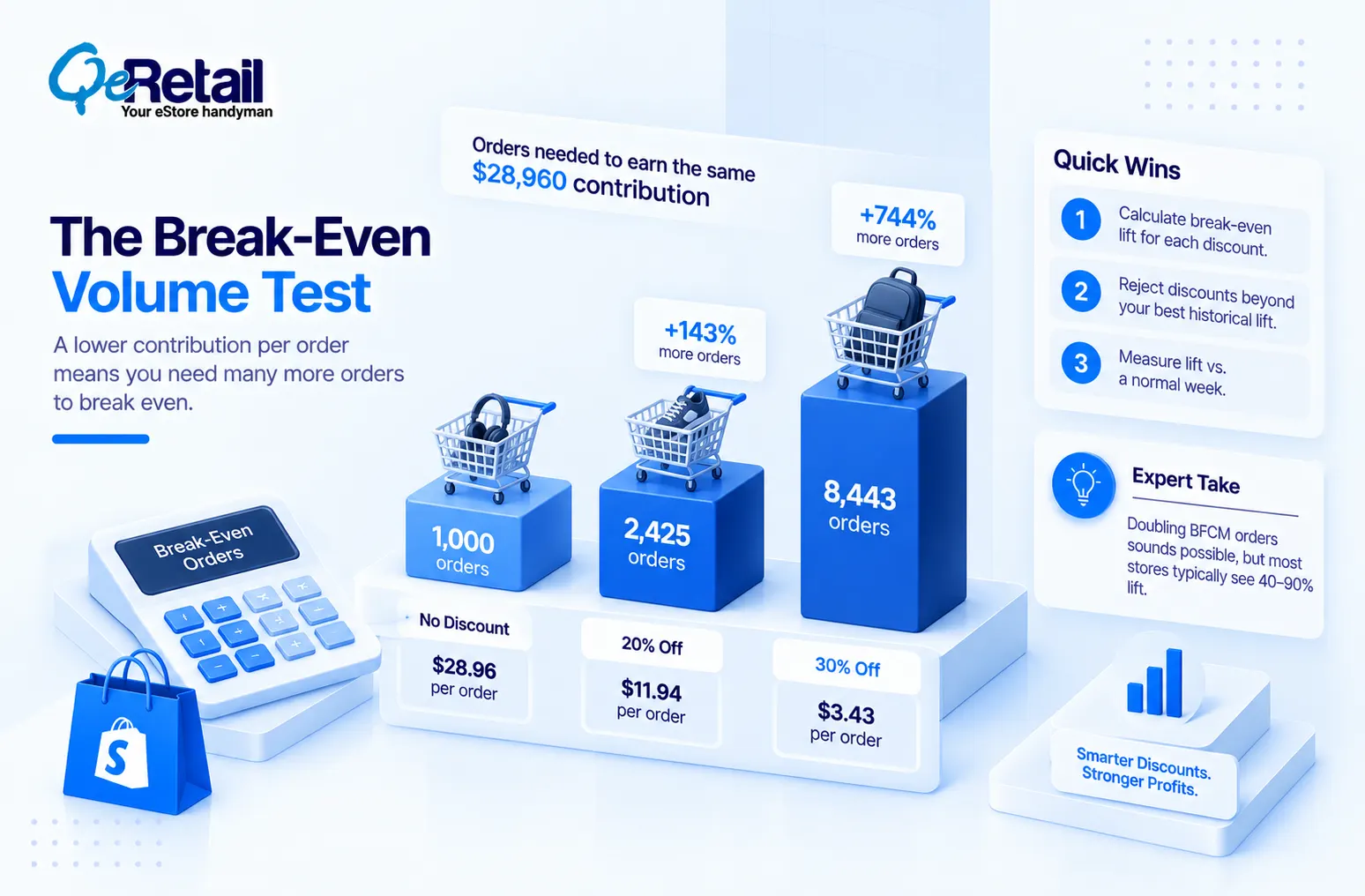
| Metric | No discount | 20% off | 30% off |
|---|---|---|---|
| Selling price | $100.00 | $80.00 | $70.00 |
| Contribution per order | $28.96 | $11.94 | $3.43 |
| Orders needed for $28,960 | 1,000 | 2,425 | 8,443 |
| Required volume lift | 0% | +143% | +744% |
A 20% discount obligates you to more than double your order count, and 30% obligates you to grow it eightfold, in a week when every competitor bids for the same traffic. Not to grow revenue. To stand still on profit.
Expert Take:
Ask any store owner whether they can double BFCM orders, and you get an optimistic yes. Ask what their actual lift was last November, and it usually sits between 40% and 90%. Both are true at once, which is why the promotion feels successful and the quarter does not.
Quick Wins:
- Compute break-even lift for every candidate discount.
- Reject any discount whose break-even lift beats your best historical lift.
- Measure lift against a normal week, not last November.

How Much Can You Actually Afford to Discount?
There is no universally safe discount. Only your ceiling matters, and it moves with your cost structure and acquisition mix.
Merchant profile: $100 price, $33 COGS, payments at 2.9% plus 30¢, $5.00 pick-and-pack, $5.00 shipping subsidy, 12% returns at roughly $25 unrecovered each, $15 blended CAC.
| Discount | Gross margin view | Contribution before CAC | Contribution after CAC | Break-even lift | Verdict |
|---|---|---|---|---|---|
| 0% | $67.00 | $43.96 | $28.96 | 0% | Baseline |
| 10% | $57.00 | $35.45 | $20.45 | +42% | Realistic |
| 20% | $47.00 | $26.94 | $11.94 | +143% | Stretch |
| 30% | $37.00 | $18.43 | $3.43 | +744% | Rarely worth it |
| 40% | $27.00 | $9.92 | -$5.08 | Impossible | Loss per order |
Look at the 30% row. Gross margin reads a comfortable 37%, and acquisition contribution is $3.43, which is what the mirage costs when nobody finishes the subtraction.
10% off needs a 42% lift, which most stores clear. 20% off belongs on products with proven elasticity. 30% off fits slow-moving inventory only. 40% and deeper goes negative; run it as a planned write-down.
True ceiling here: 51.7% before CAC, 34.0% after the $15 CAC. Ad spend is the variable. Not the product.
Stop Guessing at Discounts. Start Pricing the Volume Lift.
Most BFCM planning treats the discount as the decision and the volume as the hope. That runs in the wrong order. The discount is an obligation, and the volume lift is the invoice attached to it.
If you set a percentage and hoped the orders would justify it, you did not price a promotion. You just picked a number.
Part 2 covers what moves your ceiling: CAC, returns, shipping, SKU segmentation, and the decision framework.
Not sure where your numbers land? Book a free consultation, and we will run your contribution margin and break-even lift.
Frequently Asked Questions
What Is a Safe Discount Percentage For Shopify BFCM?
How Do I Calculate Break-Even Volume For a Discount?
Is Gross Margin Enough To Plan a BFCM Discount?
Can a Small Team Run This Before BFCM?
Table of Contents