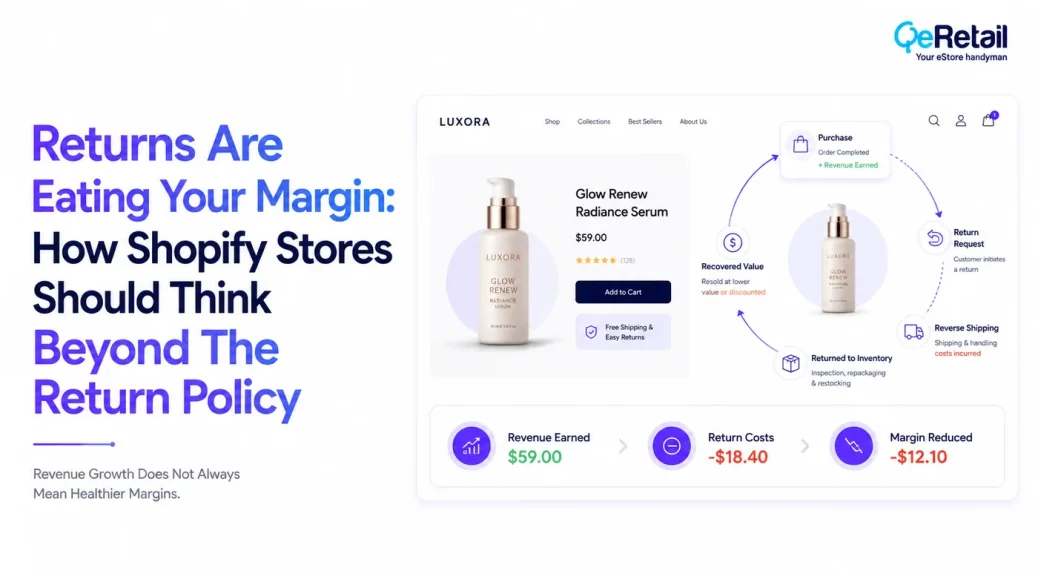
Returns are often treated as an unavoidable part of eCommerce. A customer sends a product back, the store processes the refund, the inventory is updated, and the transaction appears to be closed.
But the financial impact does not end with the refund.
A returned order can involve reverse shipping, payment processing, inspection, repackaging, customer service, inventory handling, discount recovery, and potential markdowns if the product cannot be resold at its original value.
That makes returns more than a customer-service issue. They can become a hidden margin leak.
The scale of the problem is significant. According to the National Retail Federation and Happy Returns, an estimated 19.3% of online sales were returned in 2025, compared with 15.8% across retail overall.
For Shopify stores, this means increasing sales without understanding return-related costs can create a misleading picture of growth.

Key Action Points Summary
- Measure the complete cost of a return instead of tracking only the return rate
- Identify the product, page, fulfillment, or customer-experience issues driving returns
- Improve product information before changing return-policy restrictions
- Segment return rules according to product economics and customer expectations
- Encourage exchanges and retained revenue where appropriate
- Track recovered value from returned inventory
- Review return reasons by product, SKU, category, and acquisition source
- Connect returns data with product-page and merchandising decisions
- Treat return performance as a profitability metric, not only an operational metric
- Review whether your return policy is protecting margin without creating unnecessary purchase friction
Quick Wins: Find Where Returns Are Reducing Your Margin
Before changing your return policy, look at the transactions behind your returns. A few focused checks can reveal whether the problem comes from product expectations, operational costs, or weak recovery.
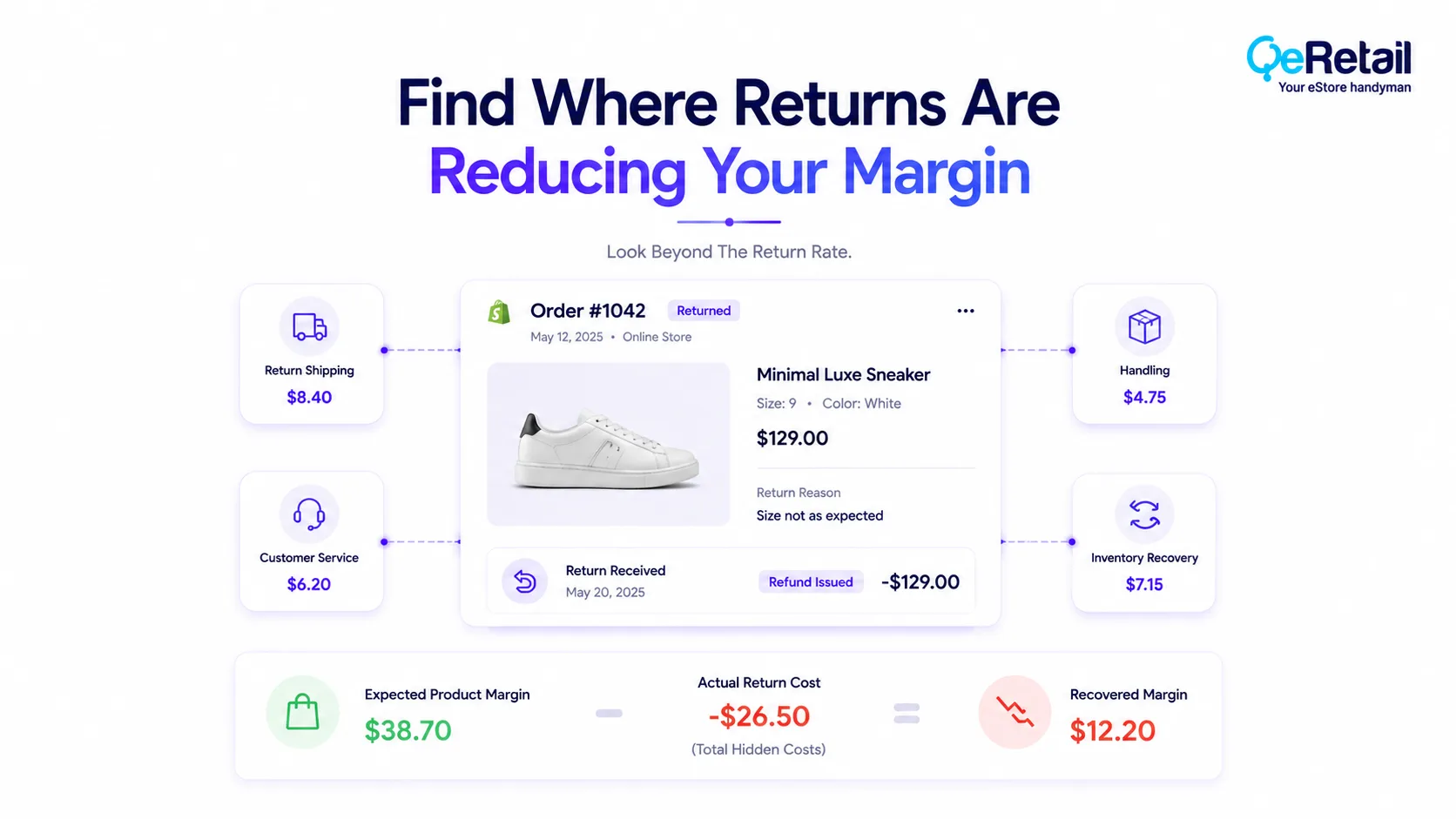
Calculate The Real Cost Of A Returned Order
Add return shipping, handling, payment costs, customer service time, repackaging, discounts, and unrecovered product value to understand the actual financial impact.
Identify Your Highest-Return Products
Sort returned orders by SKU and category to find products creating disproportionate return volume or repeated margin loss.
Review The Reasons Customers Are Returning Products
Group return reasons into issues such as sizing, product expectations, damage, quality, inaccurate descriptions, or change of mind.
Check Whether Returned Products Return To Saleable Inventory
Compare returned units with the number successfully resold at full value, discounted value, or not resold at all.
Compare Refunds With Exchanges And Store Credit
Review how often returns result in full refunds versus exchanges or retained revenue to understand where your current process loses sales.
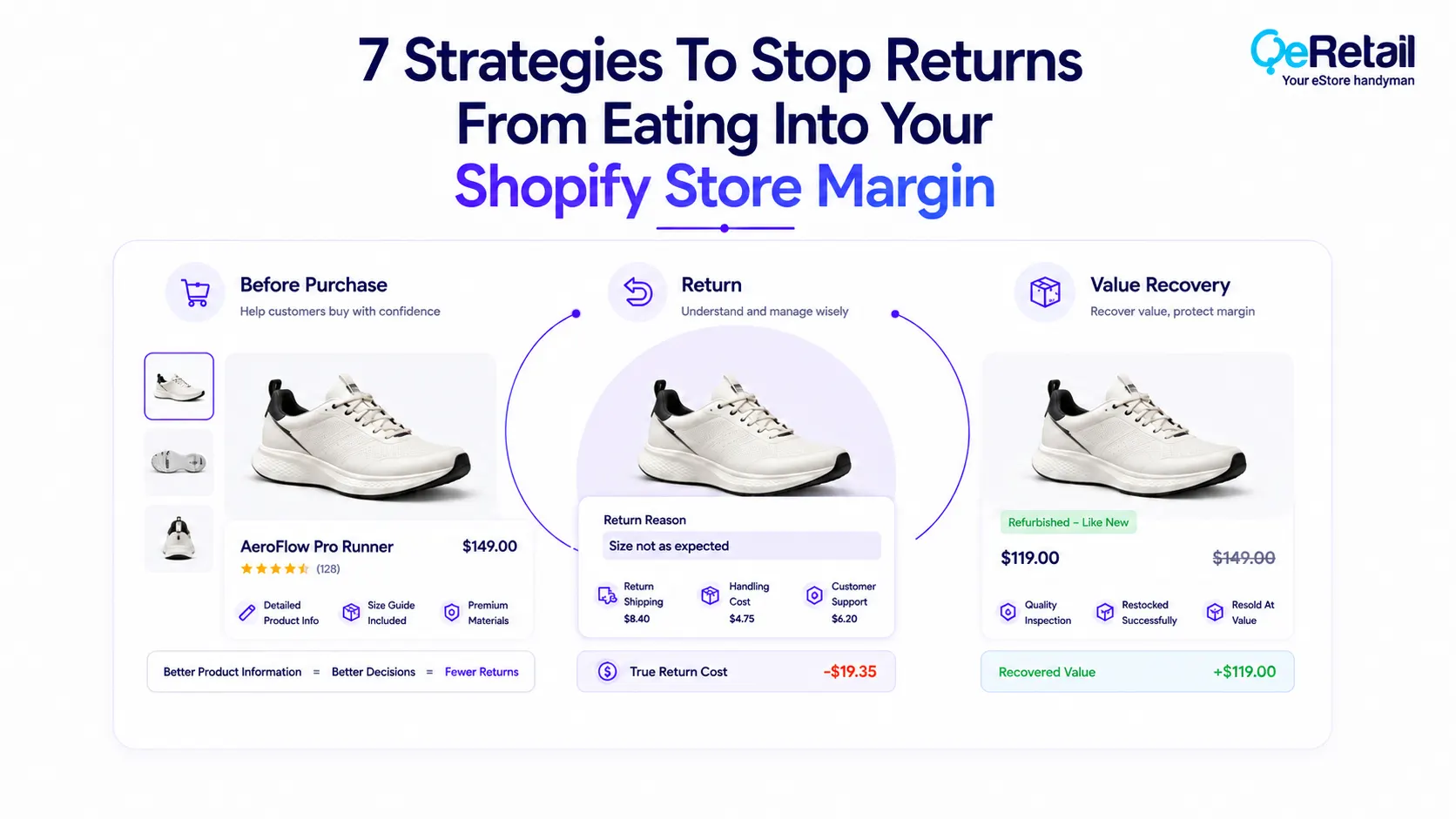
7 Strategies To Stop Returns From Eating Into Your Shopify Store Margin
A return policy controls what happens after a customer wants to send something back. Protecting margin requires understanding what causes returns and what each one actually costs.
1. Measure The True Cost Of Every Return
Return rates show frequency, but they do not show financial impact. Include reverse shipping, handling, payment costs, customer service, repackaging, and lost resale value.
Shopify identifies return shipping, inspection, restocking, and lost resale value as important components of return costs.
What Should Shopify Stores Do To Improve?
- Calculate the complete cost of returned orders
- Include operational and fulfillment expenses
- Track lost product margin
- Compare return costs across products
Quick Wins:
Calculate the complete cost of five recent returns. Compare that amount with the product margin you originally expected to earn.
2. Identify Why Customers Are Returning Products
A high return rate is a symptom, not the root problem. Return reasons can reveal issues with product quality, sizing, descriptions, imagery, or customer expectations.
What Should Shopify Stores Do To Improve?
- Group returns by reason
- Identify recurring product issues
- Review high-return SKUs
- Compare return reasons across categories
Quick Wins:
Take one frequently returned product and compare its top return reasons with the information customers see before purchasing.
3. Improve Product Information Before The Purchase
Customers cannot make an informed decision when important product information is unclear.
Better images, dimensions, specifications, sizing guidance, and product expectations can help reduce avoidable returns before the order happens.
What Should Shopify Stores Do To Improve?
- Improve product descriptions
- Add accurate product dimensions
- Strengthen product imagery
- Provide sizing or compatibility guidance
- Explain important product limitations
Quick Wins:
Review one high-return product page from a customer’s perspective. Identify one missing piece of information that could change their purchase decision.
4. Build Return Rules Around Product Economics
Different products create different return costs. Large, customized, seasonal, or low-resale-value products may require different return considerations.
What Should Shopify Stores Do To Improve?
- Identify expensive-to-return products
- Review eligibility by product type
- Define appropriate return conditions
- Communicate restrictions before purchase
- Avoid applying identical rules everywhere
Quick Wins:
Identify your five most expensive products to process as returns and review whether your current policy protects their economics.
5. Make Exchanges Easier Where They Make Sense
A return does not always need to become lost revenue. Customers who still want the product may simply need another size, variant, or alternative.
Loop Returns reported that 73.6% of its merchants offered exchanges in 2026, showing how widely exchanges are being used as a retention strategy.
What Should Shopify Stores Do To Improve?
- Make exchanges easy to find
- Support size and variant changes
- Recommend relevant alternatives
- Measure revenue retained through exchanges
- Consider store credit where appropriate
Quick Wins:
Review recent returns and identify how many customers wanted a different product rather than a complete refund.
6. Recover More Value From Returned Inventory
A returned product is not necessarily a complete financial loss. Its eventual resale value can determine how much margin the store actually recovers.
Products may return to full-price inventory, discounted inventory, liquidation, or become unsellable.
What Should Shopify Stores Do To Improve?
- Track returned inventory outcomes
- Measure resale value after returns
- Identify products frequently losing value
- Improve inspection and restocking processes
- Reduce unnecessary markdowns
Quick Wins:
Compare the original selling price with the actual value recovered from your recently returned products.
7. Use Return Data To Improve The Store
Return data can reveal problems beyond the returns process. Repeated complaints may point toward product pages, merchandising, fulfillment, packaging, or product quality.
The goal is to use returns as feedback rather than treating every return as an isolated transaction.
What Should Shopify Stores Do To Improve?
- Track return reasons by SKU
- Compare return rates by category
- Connect returns with product-page issues
- Review fulfillment-related complaints
- Feed recurring insights into store improvements
Quick Wins:
Choose one high-return product and compare its return reasons, reviews, product-page content, and fulfillment history before deciding what to change.
How QeRetail Helps Shopify Stores Reduce Return-Related Margin Loss
QeRetail helps Shopify businesses look beyond the return policy and identify where product experiences, store usability, and operational workflows may be contributing to unnecessary returns.
Shopify Store And Product Page Assessment
We review product-page structure, information hierarchy, product presentation, usability, and customer expectations to identify areas where unclear information may contribute to avoidable returns.
Conversion-Focused Product Experience Optimization
Our team helps improve product information, visual presentation, navigation, and purchasing interactions so customers can make more informed decisions before placing an order.
Shopify Theme And Store Customization
We customize Shopify themes and store experiences to improve product discovery, information clarity, mobile usability, and customer interactions without adding unnecessary complexity.
Return Journey And Customer Experience Improvements
We help businesses create clearer post-purchase experiences so customers can understand return and exchange options while reducing unnecessary friction throughout the process.
Data-Led Store Improvement
We help connect customer behaviour and store performance insights with practical Shopify improvements, allowing businesses to identify recurring problems and prioritize changes that can support healthier margins.

Conclusion
Returns are a signal that can reveal weaknesses across product information, merchandising, fulfillment, customer expectations, and the post-purchase experience.
A store that only changes its return policy may control the process without addressing the reasons behind the returns.
The stronger approach is to understand what each return really costs, identify why customers send products back, recover more value where possible, and use those insights to improve the shopping experience before the next order is placed.
QeRetail helps Shopify businesses turn these insights into practical store improvements across product experiences, theme usability, customer journeys, and conversion-focused optimization.
Contact us to identify where returns may be quietly reducing your Shopify store’s profitability.
Frequently Asked Questions
Why Are Returns A Problem For Shopify Store Margins?
Should Shopify Stores Charge Customers For Returns?
How Can Shopify Stores Reduce Returns Without Making Their Return Policy Stricter?
Are Exchanges Better For Shopify Stores Than Refunds?
What Return Metrics Should Shopify Stores Track?
Table of Contents