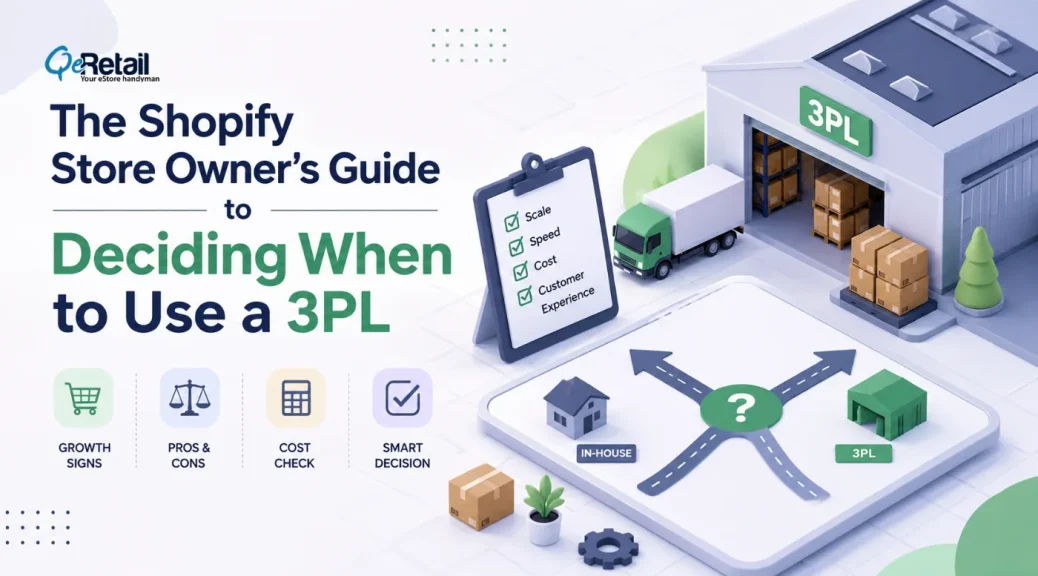
If you are selling about 200 orders a month, you will spend 15-20 hours a week on fulfillment. As a Shopify store owner with more than $100k in revenue, spending such a major part of their business operations time on the fulfillment function can create a major impact.
Not to mention, the whole concept of performing this operation manually becomes a bottleneck, rather than saving money. That’s a job you applied for but didn’t take up, that’s a part-time job. It’s time you’re not spending on product anymore, on ads anymore, on the partnerships you’ve long wanted to pursue.
Most owners read that number, nod, and proceed to tape over the boxes anyway, since they feel that they are more likely to endanger a stranger than to exhaust themselves.
It’s not a willingness; it’s a trust. Nobody tells you what “good” is or what it costs or when the math turns into math. This guide helps you do that: when to use a third-party logistics provider, the cost you’ll incur, and how to choose a third-party logistics provider that won’t destroy your delivery guarantee.
This Guide Covers:
- What a 3PL actually does inside your Shopify stack
- The three signals that mean it’s time to switch
- How 3PL pricing is built, and where the money hides
- What to prioritize by your order volume
- How to evaluate a partner before you sign
Key Action Points:
- Track your weekly fulfillment hours; 15+ is your switch signal
- Stop treating shipping as a task and start treating it as a cost line
- Calculate your true cost per order before comparing any quotes
- Demand real-time Shopify inventory sync, not batch updates
- Verify order accuracy and same-day cutoff SLAs in writing
- Match the partner to your product type, not just their price

What is a 3PL (And What it Actually Does)?
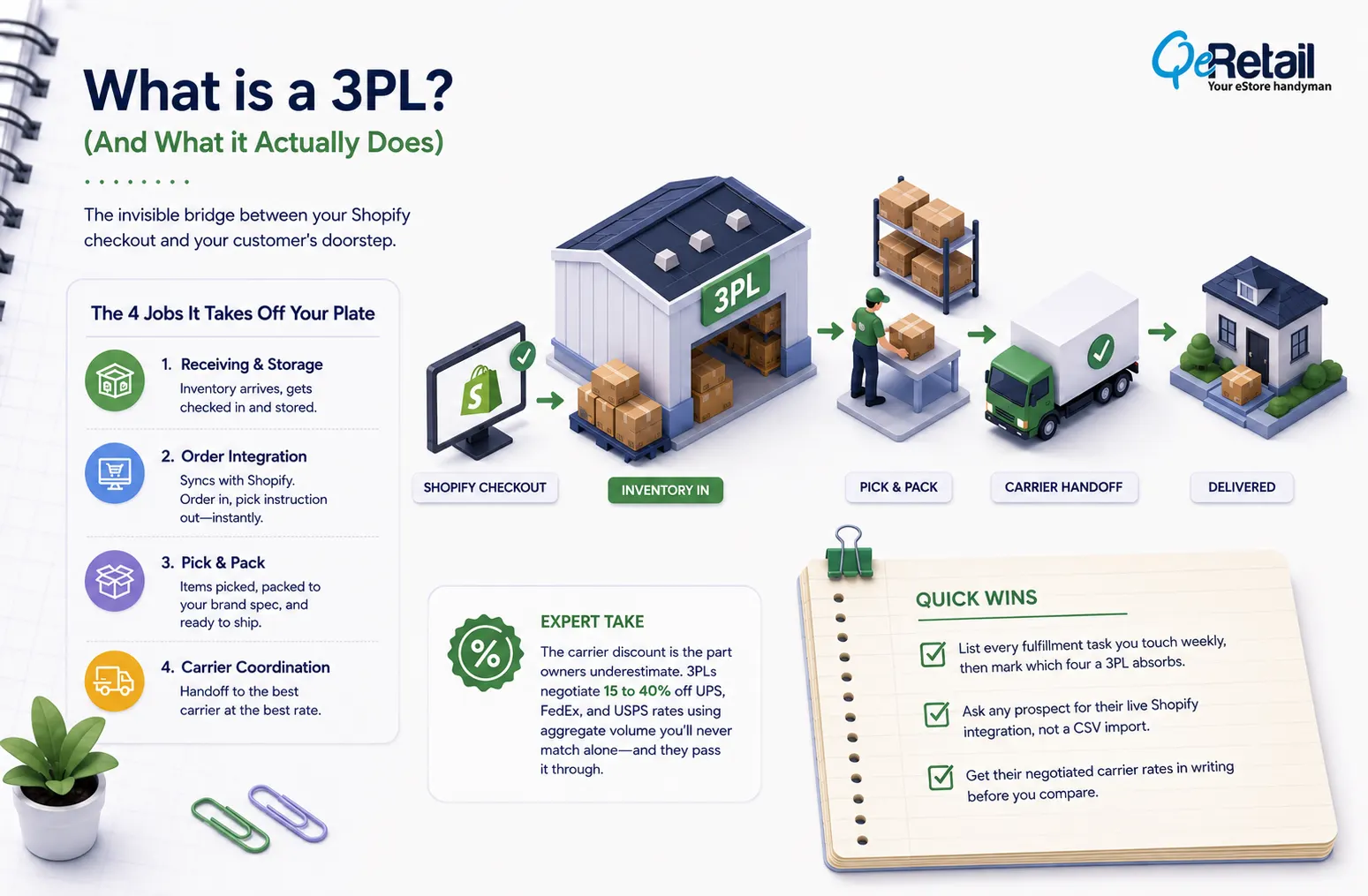
A 3PL isn’t a warehouse you rent. It’s the invisible bridge between your Shopify checkout and your customer’s doorstep. You send inventory in; orders go out; you stop touching boxes. The value isn’t storage. It’s what happens the moment someone clicks “buy.”
The Four Jobs It Takes Off Your Plate
A real 3PL handles receiving and storage, order integration, pick and pack, and carrier coordination. Its system syncs directly with Shopify, so the pick instruction fires the second a customer checks out. Staff pull the item, pack it to your brand spec, and hand it to a carrier. No spreadsheet. No end-of-day trip to the post office.
Expert Take:
The carrier discount is the part owners underestimate. 3PLs negotiate 15 to 40 % off UPS, FedEx, and USPS rates using aggregate volume you’ll never match alone, and they pass it through. On some accounts, the discount quietly covers the entire pick-and-pack fee.
Quick Wins:
- List every fulfillment task you touch weekly, then mark which four a 3PL absorbs.
- Ask any prospect for their live Shopify integration, not a CSV import
- Get their negotiated carrier rates in writing before you compare
When Should You Switch to a 3PL?
Nobody switches too early and regrets it as much as they regret switching too late. The signals are loud once you know them. There are three.
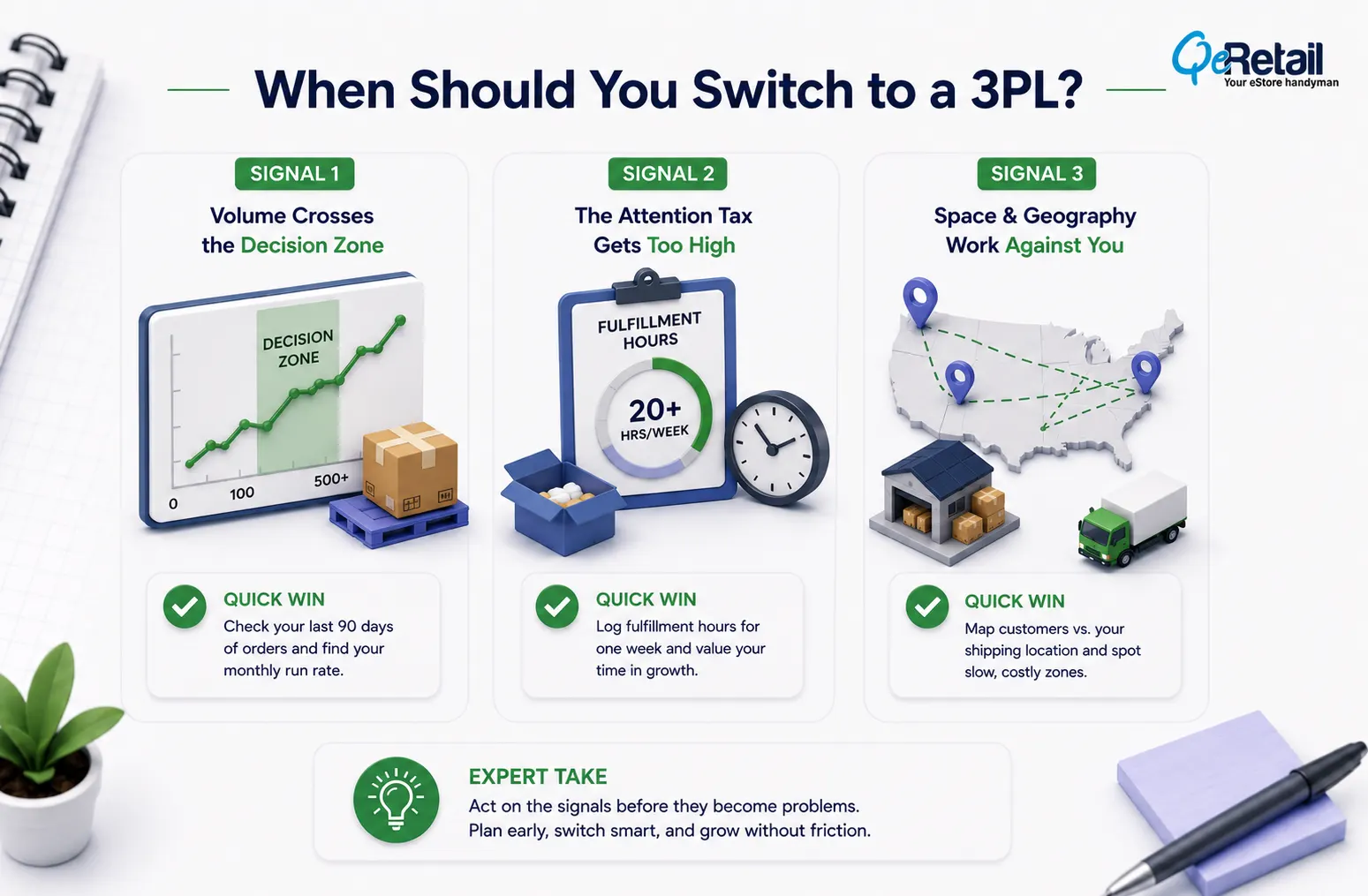
Signal 1: Volume crosses the decision zone
Merchants hit the “decision zone” between 100 and 500 orders per month. Below that, self-fulfillment is often fine. At 500+ orders, the scale efficiency and shipping discounts of a 3PL almost always beat doing it yourself. That’s not a preference. It’s arithmetic.
Expert Take:
The 100-to-500 band isn’t a waiting room. It’s where you should be interviewing partners, not where you should be stalling. Onboarding a 3PL takes weeks. If you wait until 500 orders to start looking, you’ll be drowning through the exact quarter you were trying to grow.
Quick Wins:
- Pull your last 90 days of order counts and find your monthly run rate
- If you’re inside 100-500, start shortlisting now, not at 500
Signal 2: The attention tax gets too high
When you’re spending more than 20 hours a week on picking, packing, and labeling, you’re not saving money. You’re losing it. Every one of those hours is an hour stolen from product development and marketing, the two things that actually grow the store.
Expert Take:
Founder hours are the most expensive labor in your business, and you’re paying yourself minimum wage to tape boxes. The self-fulfillment “savings” is a mirage. It’s priced in the cheapest hours, not the ones you’re actually burning.
Quick Wins:
- Log your fulfillment hours for one week, honestly
- Multiply those hours by what your time is worth in growth, not in wages
Signal 3: Space and geography start working against you
When the garage is full, or the spare room is stacked to the ceiling, physical space stops being a metaphor and starts being a ceiling. Shipping everything from one location also means slow, expensive delivery to customers on the far coast. A distributed 3PL network turns that into a strength.
Expert Take:
Single-location shipping doesn’t just cost more. It caps your conversion. Shoppers abandon carts over slow delivery estimates, so your one warehouse in Ohio is quietly losing you California customers before they ever see the packing quality you’re so proud of.
Quick Wins:
- Map where your customers are versus where you ship from
- Flag your slowest and priciest delivery zones as switch triggers

How Does 3PL Pricing Actually Work?
3PL pricing looks confusing because it’s built to scale, not to be simple. Unlike a fixed warehouse lease, it’s pay-as-you-go. It converts fixed overhead into variable cost that rises and falls with your sales. Four line items make up almost every invoice.
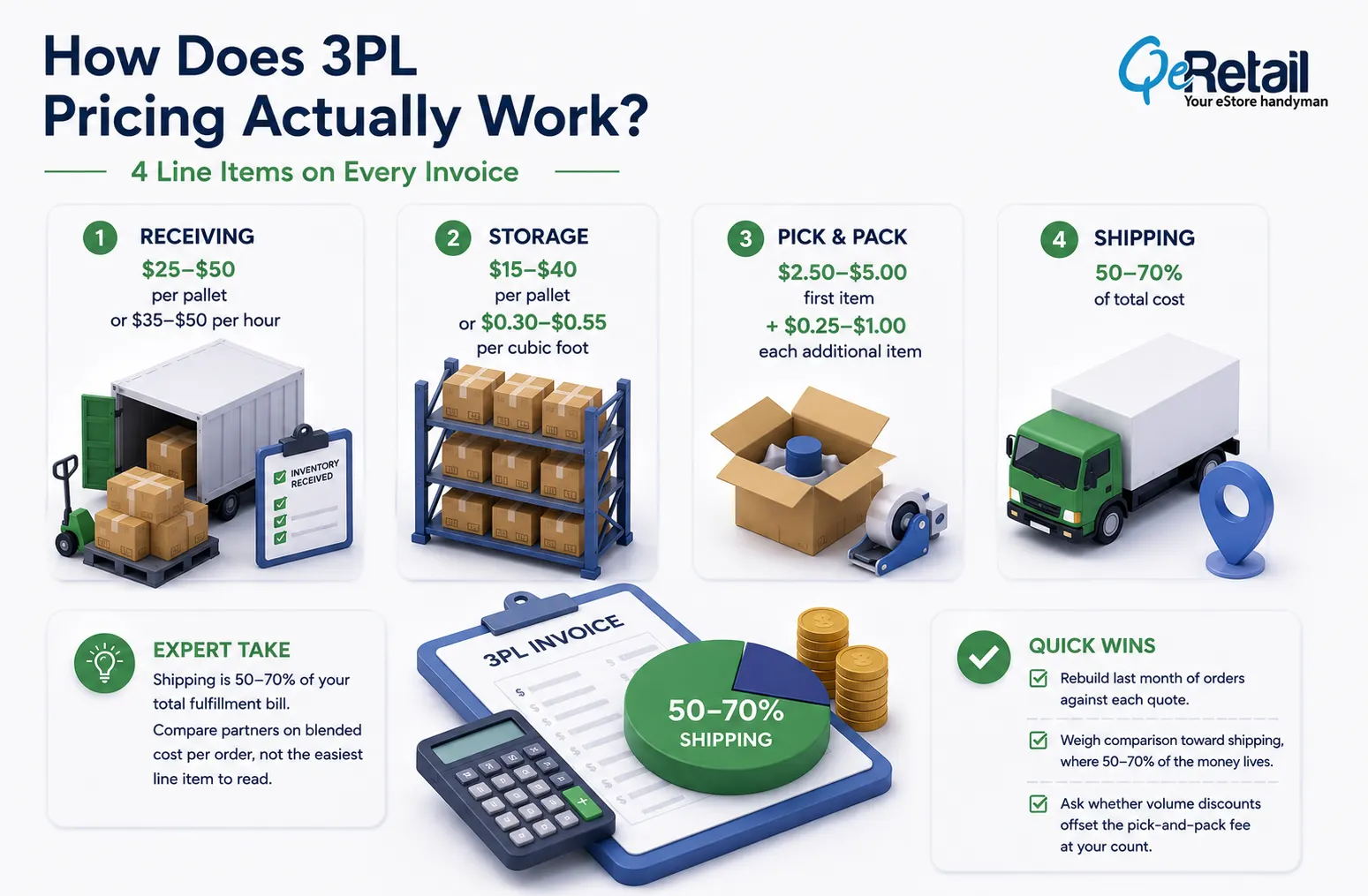
The Four Line Items On Every Invoice
Receiving fees run roughly $25 to $50 per pallet, or $35 to $50 per hour, to log new inventory in. Storage is billed monthly by space used, usually $15 to $40 per pallet or $0.30 to $0.55 per cubic foot. Pick and pack typically carries a base fee of $2.50 to $5.00 for the first item, plus $0.25 to $1.00 for each additional item in the order. Shipping is the big one.
Expert Take:
Shipping is 50 to 70% of your total fulfillment bill, so obsessing over a 20-cent pick fee while ignoring shipping rates is optimizing the wrong number. Compare partners on blended cost per order, not on the line item that’s easiest to read.
Quick Wins:
- Rebuild your last month of orders against each quote’s four line items
- Weigh your comparison toward shipping, where 50-70% of the money lives
- Ask whether volume discounts offset the pick-and-pack fee at your count
How to Evaluate a 3PL Partner?
Choosing the wrong 3PL is expensive and disruptive, and you feel it in customer complaints, not spreadsheets. Four things separate a partner from a liability.
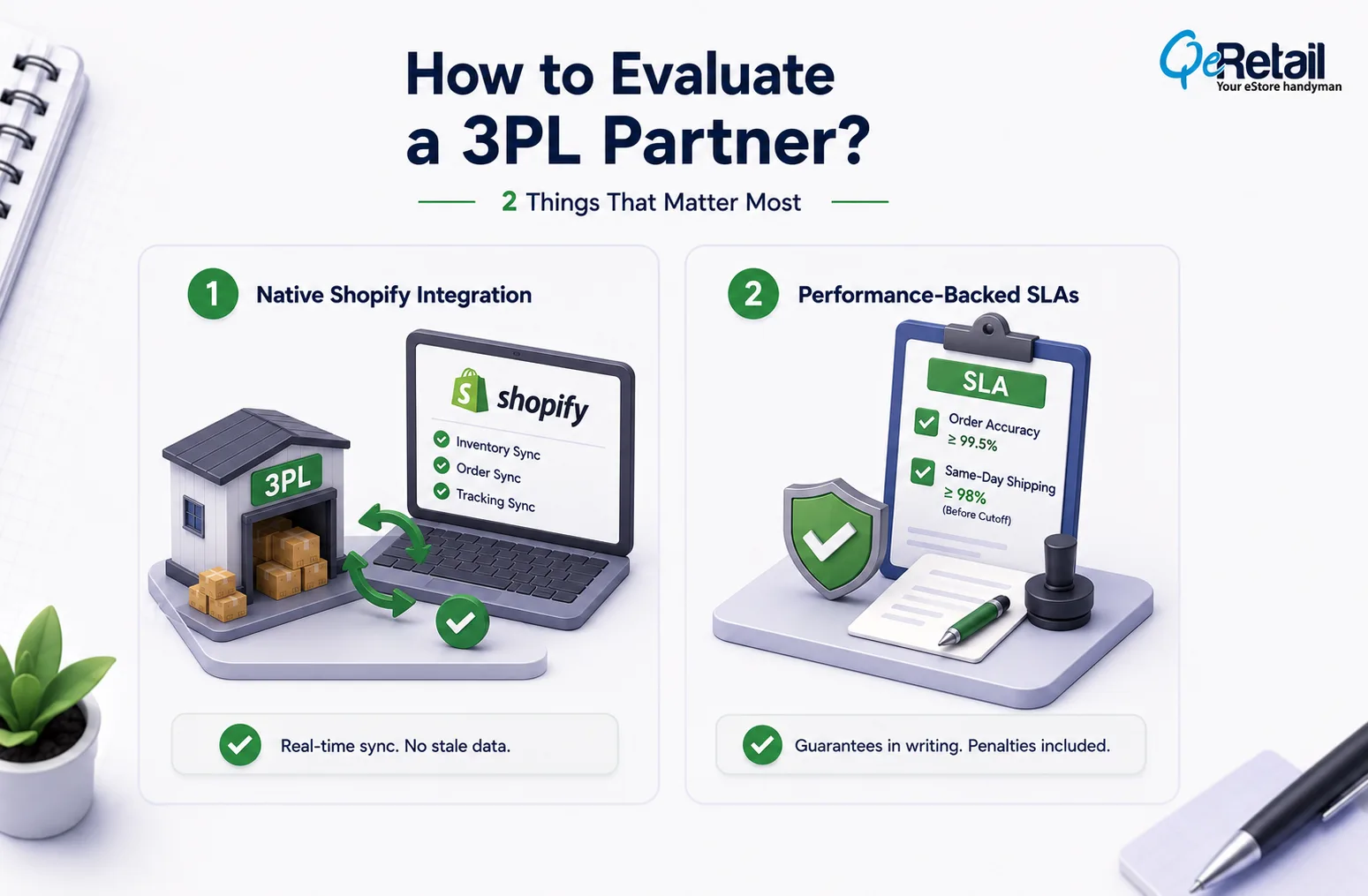
Native Shopify integration
Look for real-time inventory and tracking sync, not batch updates that go stale overnight. If the integration lags, your storefront oversells, and your customers find out before you do.
Expert Take:
“Shopify integration” on a sales page can mean a nightly CSV upload. Ask them to show you the live sync in a screen share. If they hesitate, the integration is a spreadsheet wearing a costume.
Performance-Backed SLAs
A reputable partner guarantees 99.5% or higher order accuracy and 98% or higher same-day shipping for orders placed before their cutoff. Guarantees, in writing, with penalties.
Expert Take:
An SLA without a penalty clause is a wish. If there’s no financial consequence when they miss the cutoff, the number on the page means nothing on your worst Monday.
Stop Shipping From Your Garage. Start Scaling.
Most store owners treat fulfillment as a chore to survive, not a system to design. So they wait. They pack boxes at 11 p.m. and call it discipline.
Here’s the reframe. If you’re doing 300 orders a month by hand and telling yourself you’re saving money, you didn’t build a lean operation; you just bought yourself a warehouse job.
The stores that switch on time turn shipping into a compounding advantage. Faster delivery. Fewer errors. Every founder hour you claw back goes straight into the work that grows revenue.
The switch is a math problem before it’s an ops one, and that’s exactly what we pressure-test in a B2B eCommerce strategy session: your true cost per order, your switch timing, and whether a 3PL pays off at your volume yet.
Frequently Asked Questions
When Should a Shopify Store Switch To a 3PL?
How Much Does a 3PL Cost For a Shopify Store?
Do 3PLs Really Get Cheaper Shipping Rates?
What SLAs Should I Demand From a 3PL?
Can a Small Team Handle The Switch To a 3PL?
Table of Contents