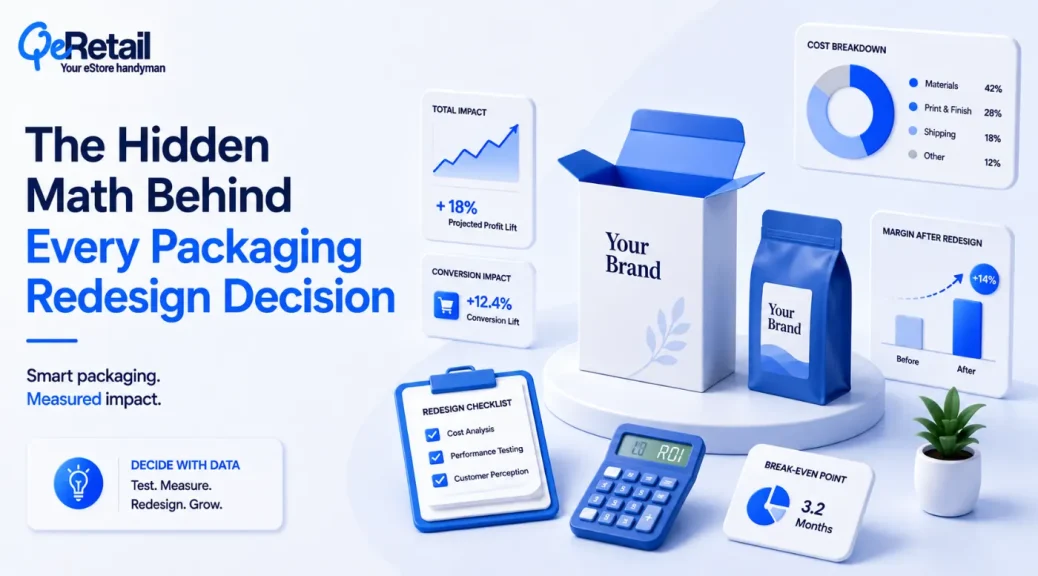
Packaging costs for your Shopify stores look like another cost, right?
But is it just another addition to the cost sheet?
Or
A revenue source you are missing out on?
You’ve probably priced out a packaging redesign and shelved it.
The quote looked big, the payoff looked vague, and nobody on your team could turn “nicer unboxing” into a number your CFO would sign off on.
That’s the gap.
Packaging ROI can’t be measured in numbers without considering the branding advantage. Framed as branding budget, the packaging costs can actually help you cut down customer acquisition costs.
This piece frames packaging as what it actually is: a conversion, retention, and unit-economics lever you can model before you spend a dollar.
This Guide Covers:
- Why packaging spend gets miscategorized as a soft cost
- What a redesign actually changes in your funnel
- How to model the payback period before committing
- What to track after launch so the ROI claim holds up
Key Action Points:
- Separate packaging cost into functional, protective, and experiential line items before pricing a redesign
- Track unboxing-driven repeat purchase rate for 90 days post-launch
- Build a payback model using unit cost delta against average order value, not total spend
- Test one redesign element at a time on a subset of SKUs before a full rollout
- Fix return-driving packaging failures before investing in premium unboxing
- Send a post-purchase survey tagged specifically to packaging perception

What is Packaging ROI?
Packaging ROI is a measurable shift that you can track in three numbers: return rate, repeat purchase rate, and average order value.
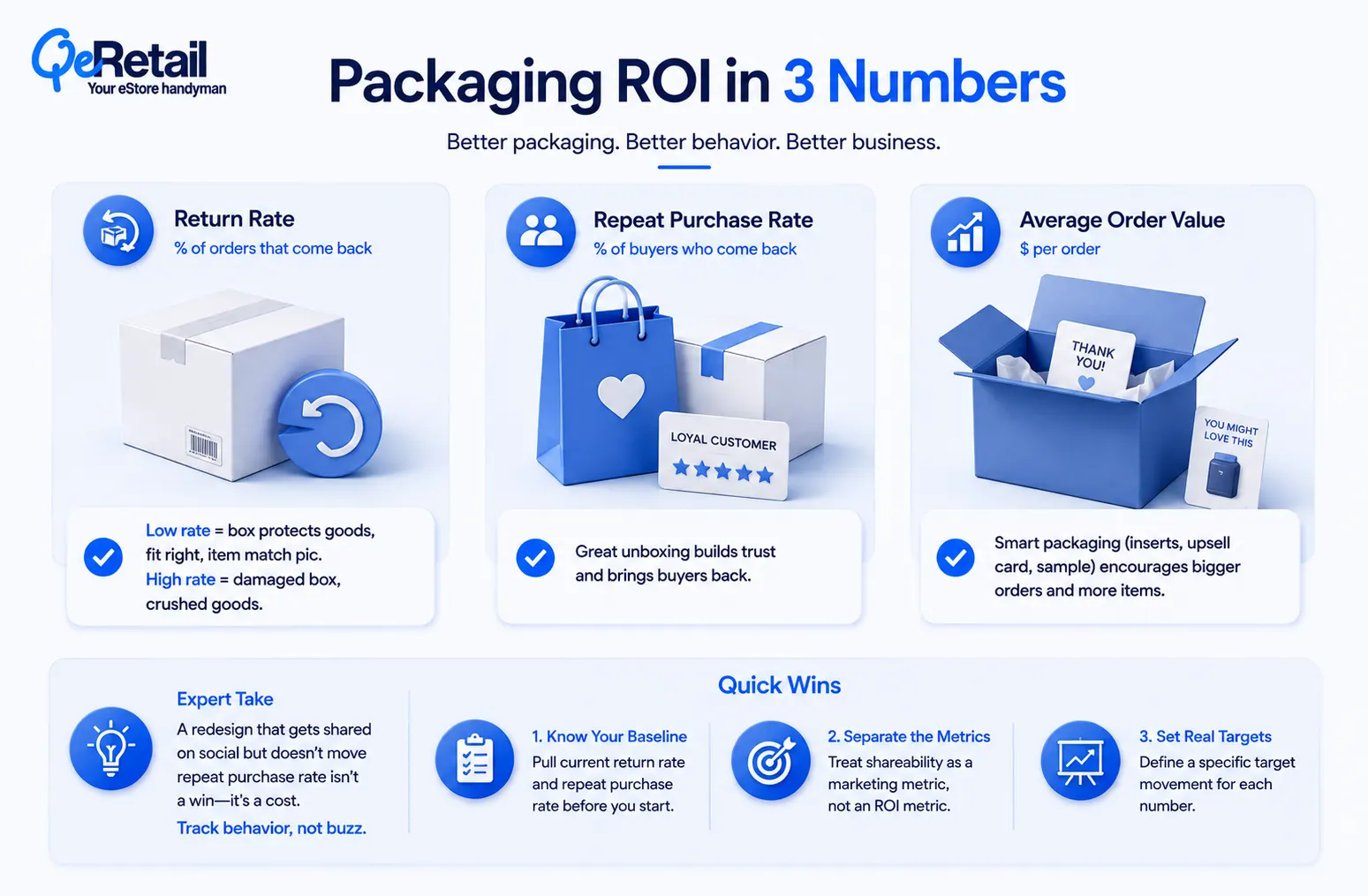
1. Return Rate: % of orders that come back. Low rate = box protects goods, fit right, item match pic. High rate = box is damaged, or goods are crushed.
2. Repeat Buy Rate: % of buyers who come back and buy again. Good unboxing feel = buyer trusts more, returns for more.
3. Avg Order Value: $ per order. Nice box (inserts, upsell card, sample) pushes buyers to add more items or buy bigger.
Most teams evaluate packaging on aesthetics. The right lens to judge packaging is whether the box changes behavior downstream, not whether it photographs well.
Expert Take:
A packaging redesign that gets shared on social but doesn’t move repeat purchase rate isn’t a win; it’s a marketing expense wearing an ROI costume. Track the behavior, not the buzz.
Quick Wins:
- Pull your current return rate and repeat purchase rate as your baseline before any redesign work starts
- Separate “shareability” as a marketing metric, not an ROI metric
- Set a specific target movement for each number, not a vague “improve experience” goal
Why This Isn’t The Same as Brand Spend?
Brand spend builds awareness. Packaging spend, done right, builds a specific behavioral outcome tied to an order you already paid to acquire. That distinction is the whole argument for treating it as ROI, not overhead.
Expert Take:
If you can’t name which of the three numbers a packaging change is supposed to move, you’re not ready to spend on it yet. Name the number first.
Why Most Shopify Stores Get the Math Wrong?
They calculate the wrong side of the equation. Cost is easy to quote. Payoff is hard to model. So the decision gets made on cost alone.
Calculating Cost Without Calculating Payback
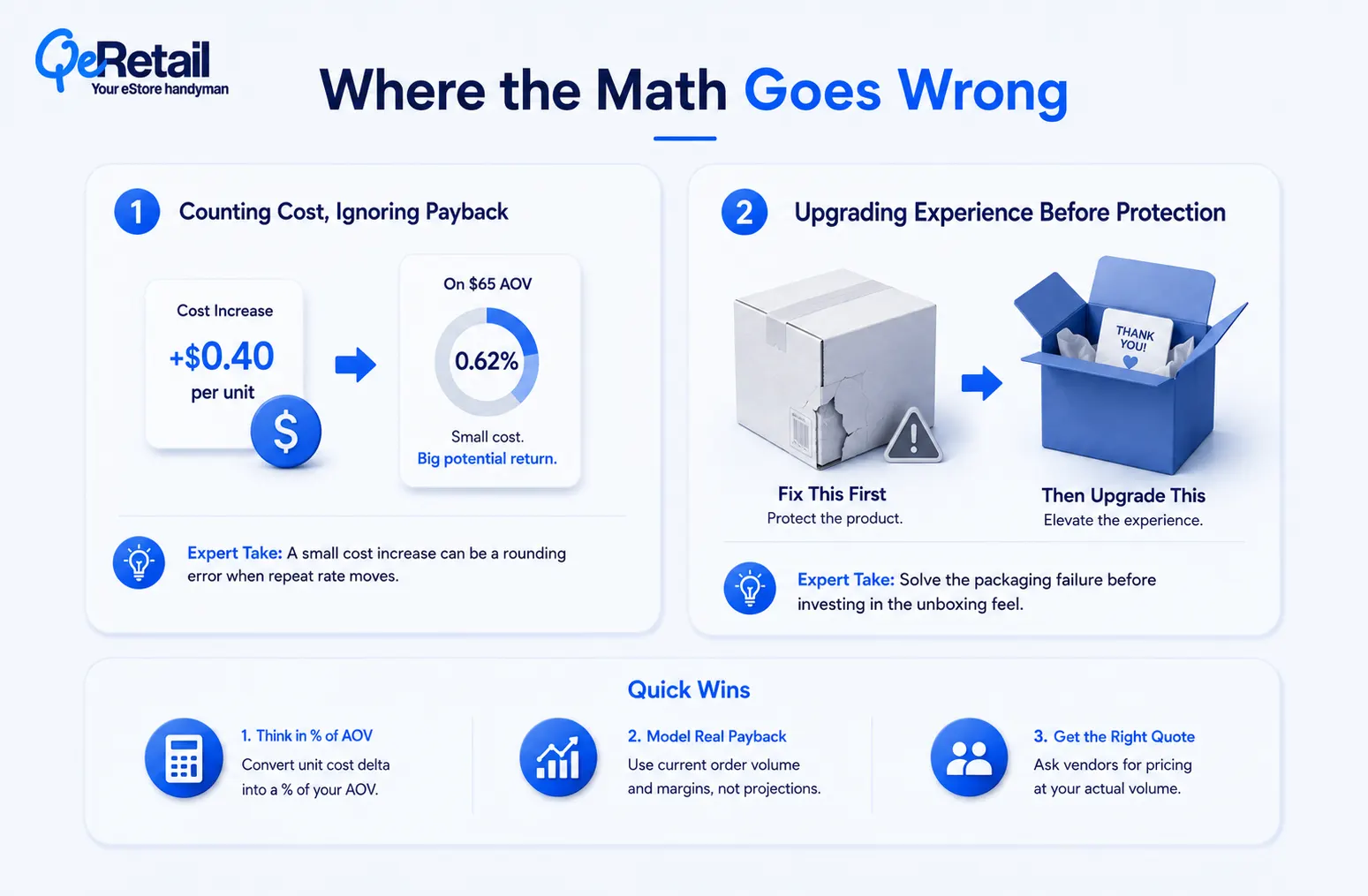
A quote from a packaging vendor gives you unit cost. It never gives you the payback period against your actual order volume and margin. Store owners see the unit cost jump and stop there.
Expert Take:
A $0.40 per-unit cost increase sounds bigger than it is until you run it against average order value. On a $65 AOV order, that’s not a pricing problem; it’s a rounding error if repeat rate moves even slightly.
Quick Wins:
- Convert unit cost delta into a percentage of AOV before rejecting a redesign on price alone
- Model payback against current order volume, not projected volume
- Ask the vendor for cost at your actual order volume, not a generic quote tier
Confusing Premium Packaging With Protective Packaging
But is a nicer box actually the problem, or is the current box failing at its basic job first? If customers are returning products because of damage in transit, no amount of experiential upgrade fixes that. (If your redesign brief doesn’t mention damage rates, you’re solving the wrong problem.)
Expert Take:
Premium unboxing on top of a packaging failure is lipstick on a support ticket. Fix the failure mode before you fix the feeling.
Quick Wins:
- Convert unit cost delta into a percentage of AOV before rejecting a redesign on price alone
- Model payback against current order volume, not projected volume
- Ask the vendor for cost at your actual order volume, not a generic quote tier
The Three-Layer Packaging Value Framework
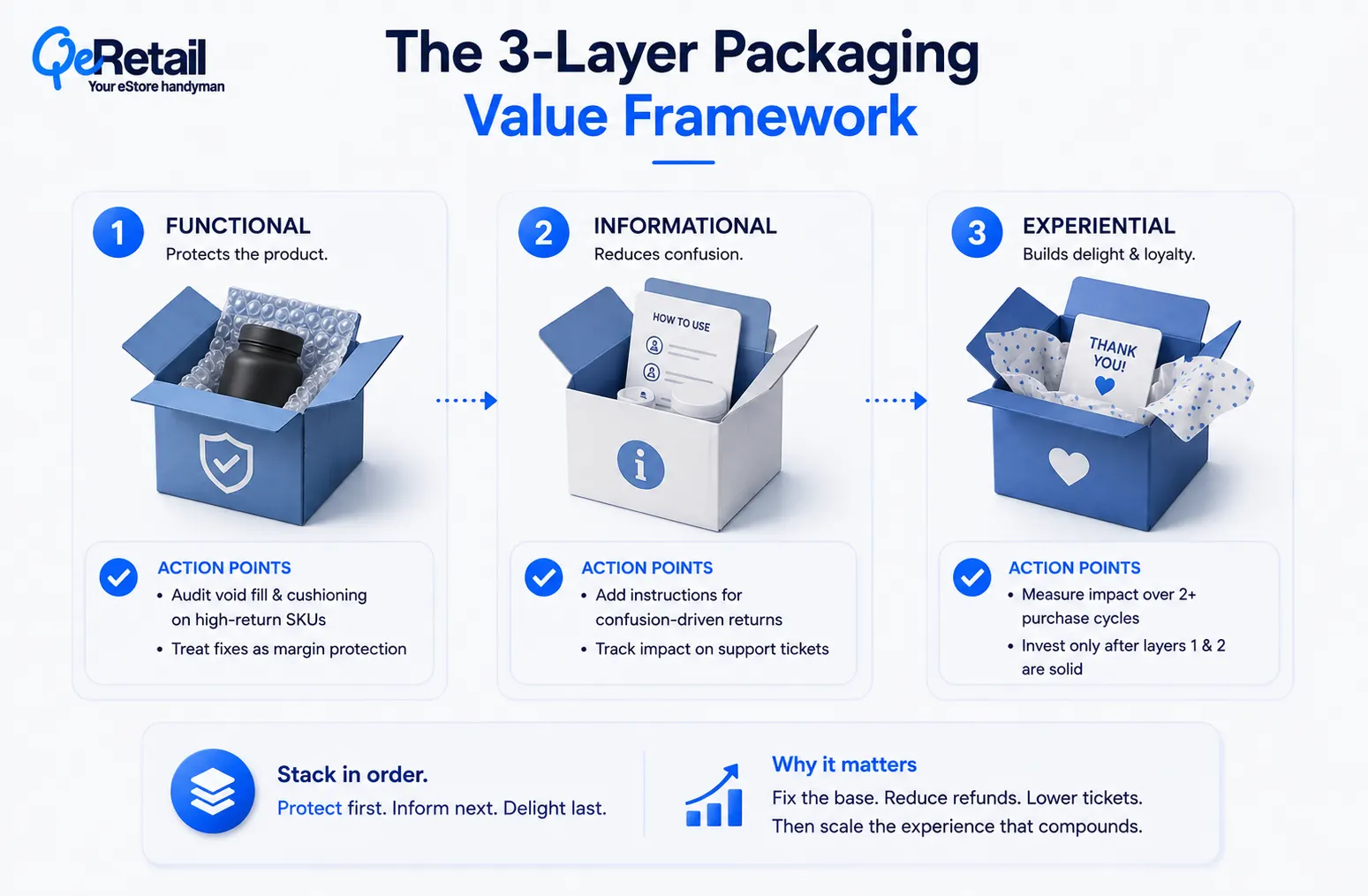
Packaging value isn’t one thing. It’s three layers stacked on top of each other, and most stores only ever address the bottom one.
Layer One: Functional
This is the layer that stops products from breaking. It’s unglamorous, and it’s the one that actually protects your margin, because a damaged product refund costs more than the box that would have prevented it.
Action Points:
- Audit your current void fill and cushioning against your highest-return SKUs
- Treat functional fixes as a margin-protection project, not a design project
Layer Two: Informational
Packaging that tells the customer what they bought, how to use it, and what to do next reduces support tickets and return requests tied to confusion, not product quality.
Action Points:
- Add usage or care instructions inside the box for any SKU with confusion-driven return codes
- Track whether informational inserts reduce support ticket volume over the following billing cycle
Layer Three: Experiential
This is the unboxing layer, the one that gets photographed and shared. It’s real, but it’s the smallest lever of the three for stores under $500K in revenue, because it depends on volume to compound.
Action Points:
- Treat experiential redesign as a retention play measured over two or more purchase cycles
- Don’t greenlight experiential spend until functional and informational layers are solid

Final Thoughts
Most stores either skip packaging spend entirely or greenlight a full redesign based on a mood board. Neither is a strategy. It’s a coin flip with your margin.
The stores that get this right treat packaging like any other spend decision: name the number it’s supposed to move, model the payback before committing, and test before rolling out. That discipline is what turns a design expense into a measurable lever.
If you’ve redesigned your packaging and still can’t say what it did to your repeat purchase rate or return rate, you didn’t run an ROI project; you ran a design project. You need a partner who treats packaging as part of your unit economics, not a separate creative decision. If that’s where you’re stuck, book a strategy session and we’ll walk through the numbers together.
Frequently Asked Questions
How Do I Know If My Packaging Is Actually Hurting My Return Rate?
What Should I Fix First, Functional Or Experiential Packaging?
Can A Small Team Run A Packaging Roi Test Without Hiring An Agency?
How Long Before A Packaging Redesign Shows Up In The Numbers?
Does Packaging Roi Apply The Same Way To Every Product Category?
Table of Contents