A buyer asks an agent for women’s sneakers, adds a pair to cart, and receives the men’s version. It ends in a refund, not a ranking drop.
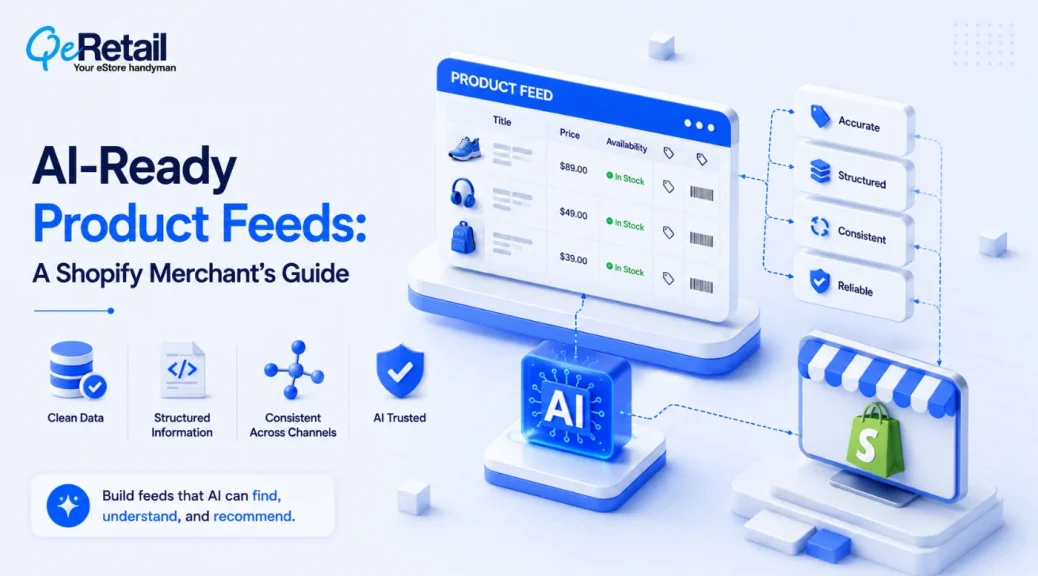
Most merchants still treat the product feed as an advertising asset. However, it is now the input to a machine deciding whether your product gets recommended at all. Adobe Analytics recorded 4,700% growth in AI-driven visits to US retail sites year over year.
The reason behind such a scenario is simple- your feed was built to win a keyword match, not to answer a question about fit or constraint. This piece helps you overcome the constraints of a conventional product feed in the era of AI commerce.
This Guide Covers:
- What AI commerce actually needs from product data
- Why marketing copy fails as feed data
- The feed fields that matter more now, ranked against the old priorities
- A practical audit and a three-tier action plan by store revenue
Key Action Points:
- Rewrite product titles as precise identity strings, not keyword stacks
- Move every physical attribute out of description prose and into structured fields
- Document use cases, compatibility, and constraints as explicit data
- Sync price, inventory, and variant availability across storefront, feed, and schema
- Audit shipping and return rules for machine readability, not just legal coverage
- Run a quarterly consistency check between your feed, your structured data, and your live pages

Your Product Feed Was Built for Search, Not AI
A traditional feed satisfies a matcher: title, description, price, image, availability, category. Keyword matching asks whether your listing resembles a query. AI-assisted discovery asks whether your product is the right choice for a stated constraint.
A matcher needs tokens. An agent needs facts it can compare. So, the burden of proof moved upstream, and OpenAI’s Instant Checkout puts a million Shopify merchants into a surface where the product page is optional.
Expert Take:
Ranking systems reward ambiguity because it widens your match surface. Recommendation systems punish it, so “premium waterproof travel work laptop bag” gets excluded from the comparison set, not ranked lower inside it.
What AI Commerce Needs From Product Data
Your feed now carries identity, precise attributes, use cases, compatibility, dimensions, materials, variants, real-time availability, pricing, delivery constraints, machine-readable returns, and review signals. The issue at hand is not field count.
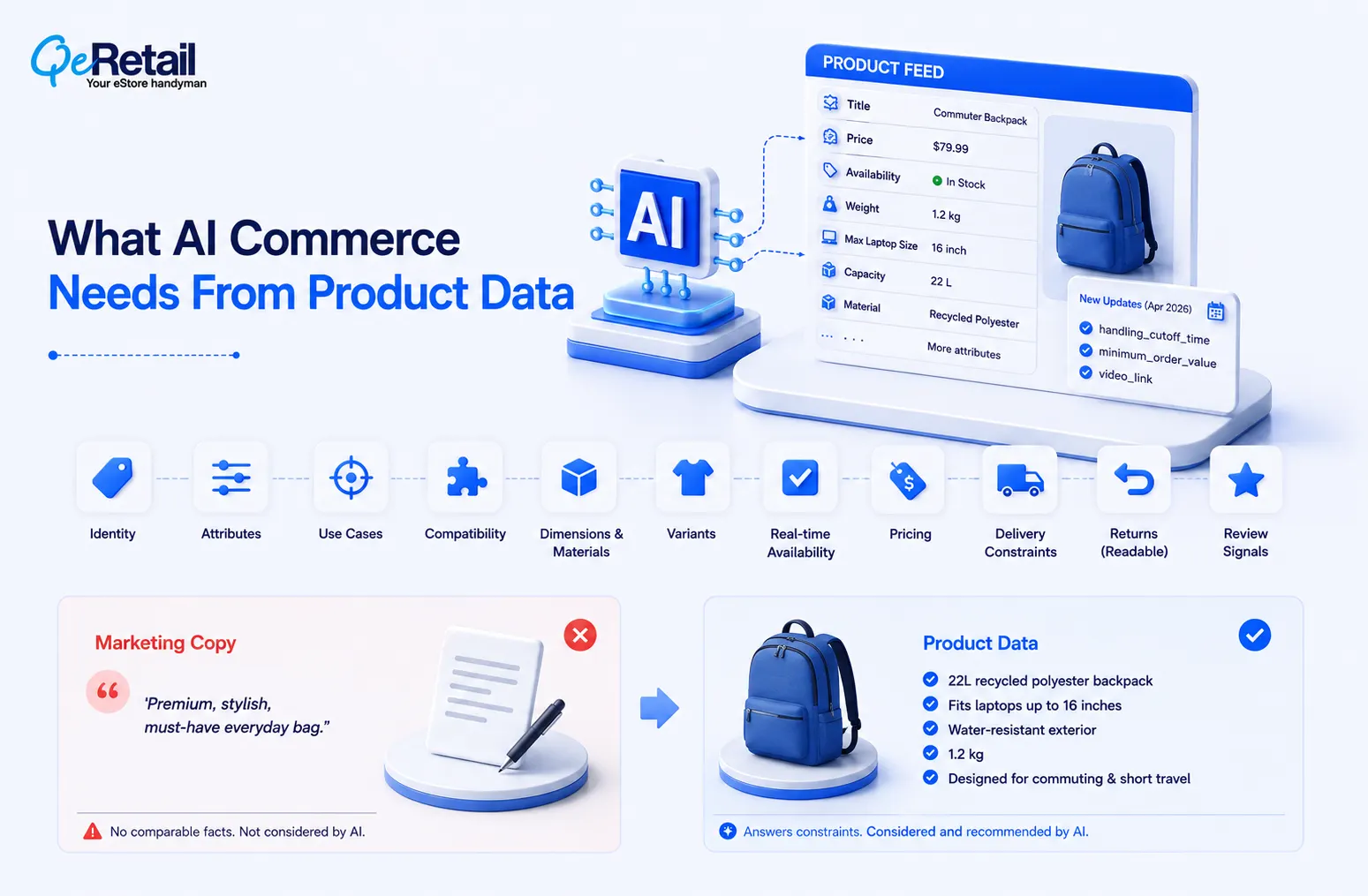
It is whether the fields let a system reason. Google’s April 2026 Merchant Center update adds handling_cutoff_time, minimum_order_value, and video_link, each removing an assumption the system used to guess at.
Marketing Copy is Not Product Data
Written for humans: “Premium, stylish, must-have everyday bag.” Written for a decision system: “22L recycled polyester backpack, fits laptops up to 16 inches, water-resistant exterior, 1.2 kg, designed for commuting and short travel.”
The first carries zero comparable facts. So, when a shopper wants a commuter backpack under 1.5 kg fitting a 16-inch laptop, it is not rejected. It is never considered. The second answers four constraints at once: capacity, fit, weather tolerance, weight. Keep persuasion on the product page; keep the feed factual.
The Product Feed Fields That Matter More in AI Commerce
Every row on the right adds a verification step the left skipped. Price alone lets a system quote you. Price plus availability lets it commit.
| Traditional priority | AI-commerce priority |
|---|---|
| Product title | Precise product identity |
| Keywords | Attributes plus context |
| Description | Structured factual detail |
| Price | Price plus availability |
| Images | Images plus descriptive metadata |
| Category | Category plus taxonomy context |
| SKU | Variant-level identity |
| Inventory | Real-time availability |
| Shipping | Delivery constraints |
| Returns | Machine-readable policies |
Shopify’s catalog team is blunt about variant identity: “Surfacing wrong results is worse than incomplete results; buyers can forgive missing a variant, but they won’t forgive getting the wrong product.
From Product Attributes to Product Context
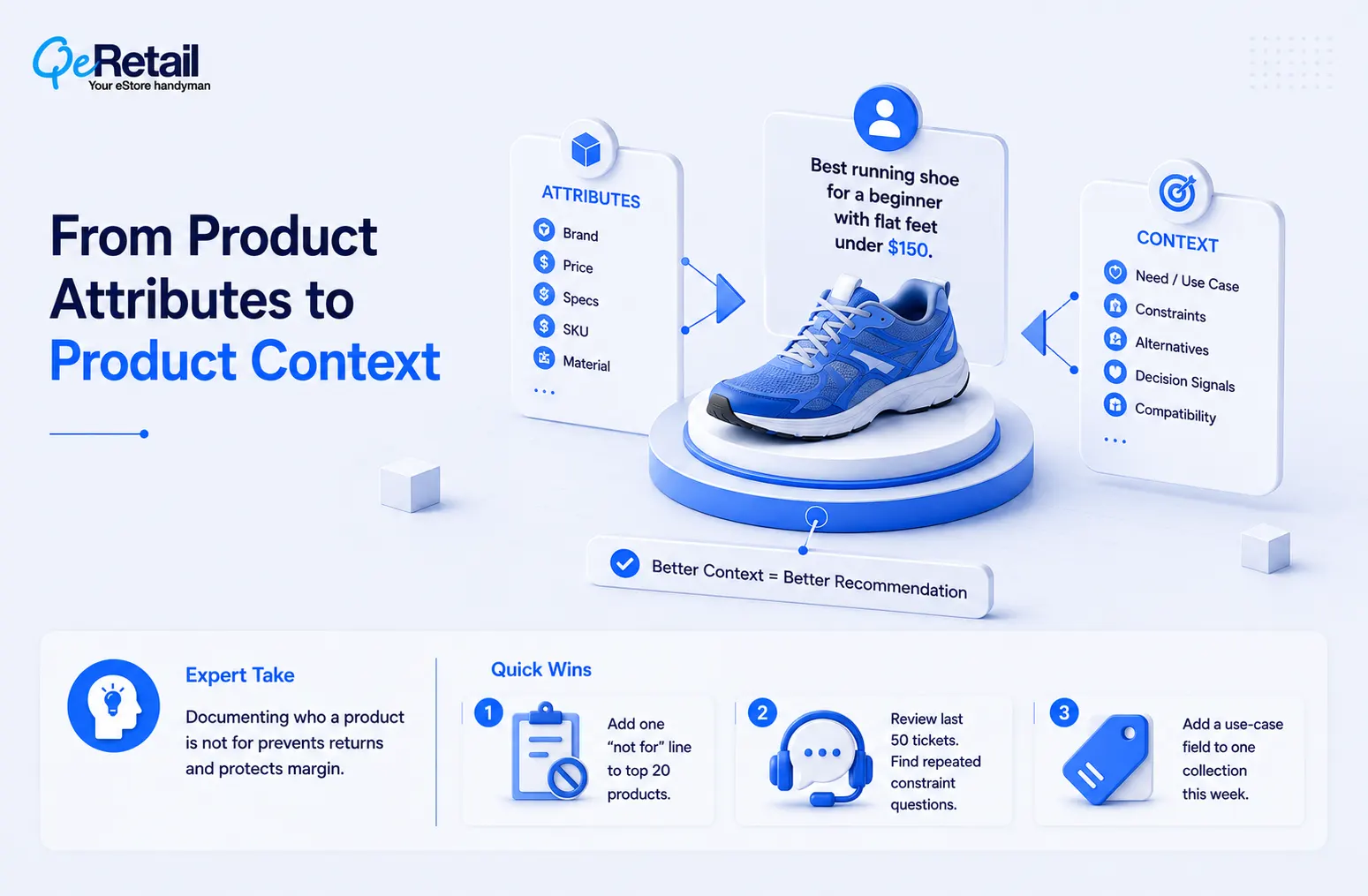
Attributes describe the product. Context describes the situation it belongs in: product, need, use case, constraint, alternative, decision. Take a real query- “best running shoe for a beginner with flat feet under $150.” Brand, SKU, and price answer one sixth of it. So, the merchant with the right shoe loses to one with a worse shoe and better context.
Expert Take:
A recommendation that produces a return costs shipping both ways plus a trust penalty in the channel. Documenting who a product is wrong for is a margin decision disguised as data entry.
Quick Wins:
- Pull your top 20 revenue products and write one “not for” line on each. Flat feet, wide toe box, humid climates, anything the returns data already tells you. Put it in the description body, not a hidden metafield.
- Read your last 50 pre-purchase support tickets and count how many are constraint questions rather than spec questions. Every repeated question is a context field your feed is missing.
- Add a use-case field to your product template and populate it for one collection this week. Not a category label. The situation the buyer is in when they need it.
Product Feeds Must Become Consistent Across the Stack
Your product data lives in Shopify admin, Google Merchant Center, marketplaces, the feed file, structured data, inventory, shipping rules, and policy pages. When those disagree, a shopper checks the page. A machine cannot resolve it, so it lowers confidence or drops the product.
Expert Take:
Every merchant assumes the feed app is the source of truth. It is a transformer applying mapping rules nobody reviewed in eighteen months, and those overrides are your actual product data.
Quick Wins:
- Open your feed app and export the active mapping and override rules. Read them. The ones you cannot explain are the ones rewriting your catalog.
- Take five products and compare four surfaces side by side- Shopify admin, the feed file, the rendered structured data, and the live product page. Log every mismatch. Five products will find you a systemic pattern, not five one-off errors.
- Run your Merchant Center diagnostics and treat item-level warnings as data defects rather than platform noise. Disapprovals get attention; warnings are where confidence quietly leaks.
Feed Freshness Becomes a Commerce Problem
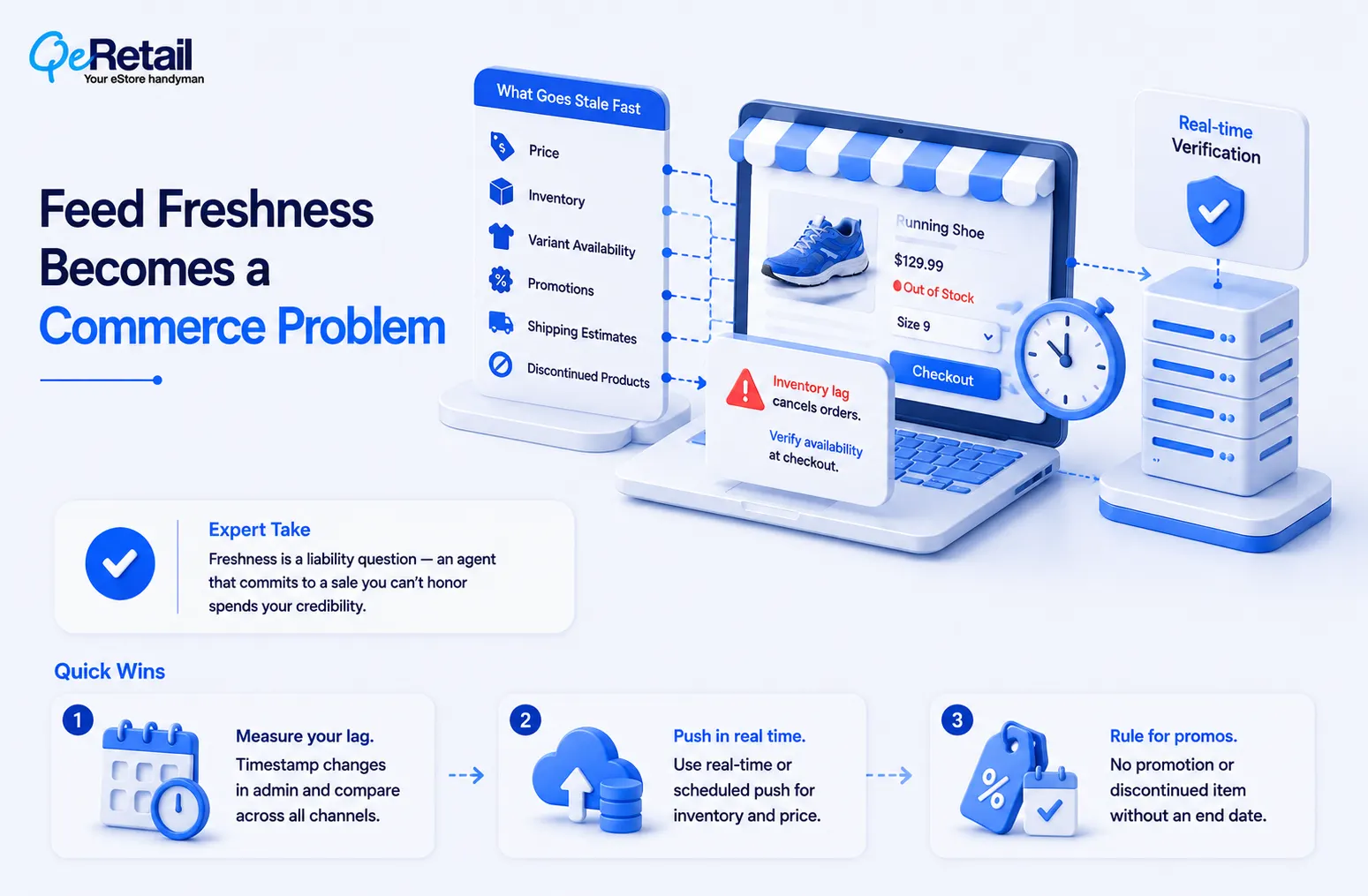
Six things go stale faster than most feeds update: price, inventory, variant availability, promotions, shipping estimates, discontinued products. Inventory lag cancels orders an agent already committed to. Variant lag is worst: the parent looks in stock while the size the shopper needs is not. Agentic checkout completes in seconds, so availability has to be verified at the transaction, not at the last sync.
Expert Take:
Freshness is not a sync frequency problem. It is a liability question- an agent that commits to a sale your system cannot honor has spent your credibility in a channel where you have no support queue to recover it.
Quick Wins:
- Measure your actual lag before changing anything. Timestamp a price change in admin, then check when it appears in the feed, in Merchant Center, and on the marketplace listing. The gap you find is your real exposure window.
- Move inventory and price to a real-time or scheduled push rather than a daily full-file rebuild. Full rebuilds are for catalog structure. Volatile fields need their own faster path.
- Set a hard rule for promotions and discontinued products- nothing goes live in a campaign until its end date exists in the feed. Expired promo data outlives the promotion and creates a mismatch at checkout.
A Practical AI-Commerce Product Feed Audit
Run this against your twenty highest-revenue SKUs first.
- Can a machine identify exactly what this product is?
- Are all important attributes explicit, not implied in prose?
- Are variants unambiguous, with a full attribute set each?
- Are dimensions, materials, and compatibility documented?
- Are use cases clear, including who it is not for?
- Is inventory current at variant level?
- Are shipping and return rules accessible as data?
- Does feed data match the storefront on price, stock, title?
- Does structured data match the feed, field for field?
- Is stale or promotional language polluting factual fields?
Expert Take:
Audit bestsellers first. They carry the traffic and channel weight, so a fix there compounds.

What Shopify Merchants Should Do to Optimize Product Feeds for AI Commerce?
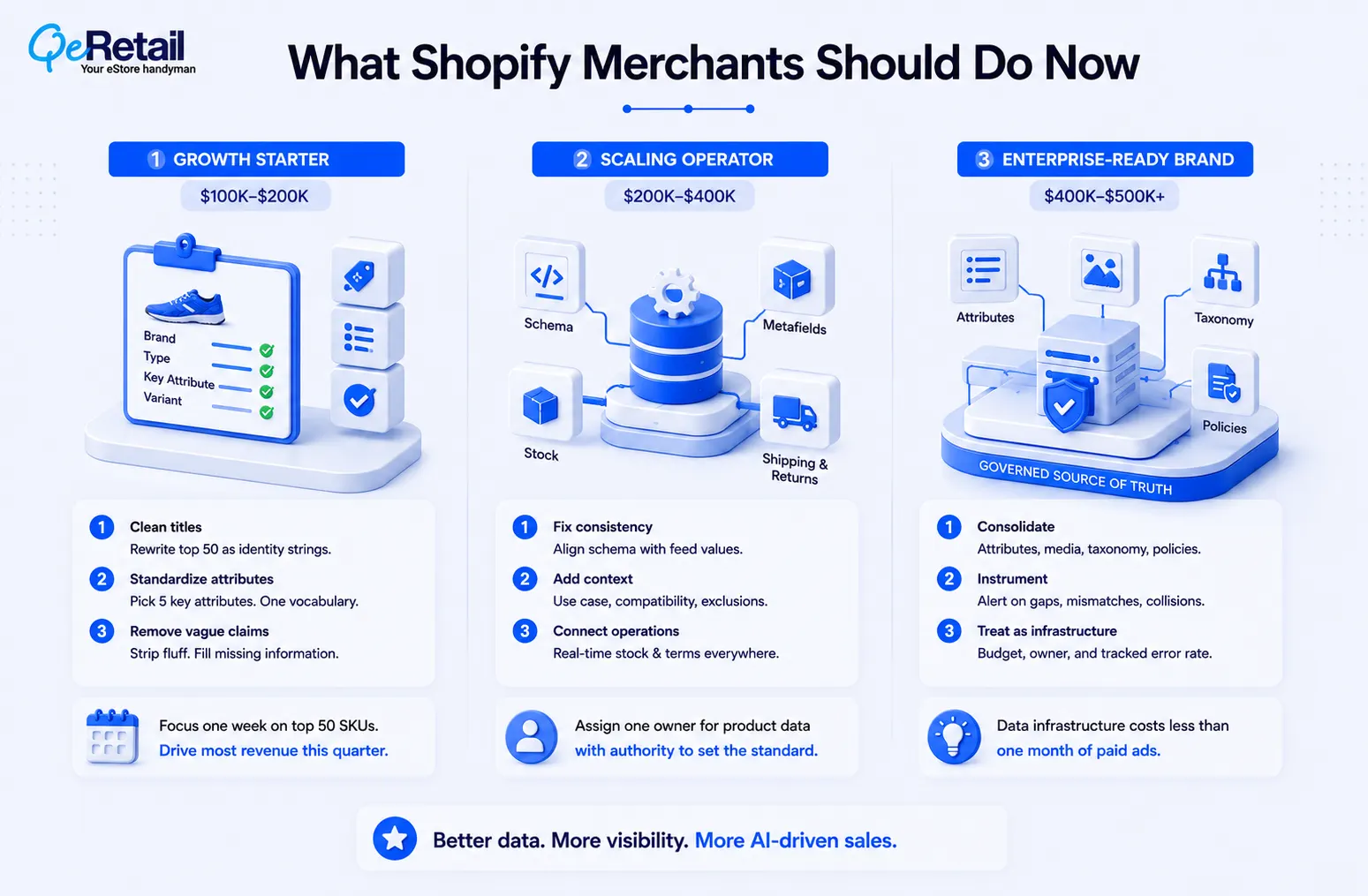
The Growth Starter ($100K–$200K): Clean the Basics!
Your constraint is time, not tooling.
1. Clean titles: Rewrite your top 50 titles as identity strings- brand, type, key attribute, variant.
2. Standardize attributes: Pick five attributes that matter in your category, populate them in one vocabulary.
3. Remove vague claims: Strip unfalsifiable adjectives, fill missing product information.
What can Shopify store owners do? Spend one week on the top 50 SKUs. They carry most of your revenue, so the return lands the same quarter.
The Scaling Operator ($200K–$400K): Connect the Sources
Your constraint is drift. You have more channels than governance.
1. Fix consistency: Align Product schema with feed values, field for field.
2. Add context: Add metafields for use case, compatibility, and exclusions, then push them to the feed.
3. Connect operations: Wire real-time stock and structured shipping and return terms into every channel.
What can Shopify store owners do? Assign one named owner for product data, with authority to reject listings that miss the standard.
The Enterprise-Ready Brand ($400K–$500K+): Build the Layer
Consolidate attributes, media, taxonomy, and policy data into one governed source, then syndicate outward. Instrument the feed like uptime, alerting on missing attributes, price mismatches, variant collisions, and schema drift. Product data becomes infrastructure, not marketing copy.
Expert Take: That means a budget line, an owner, and a tracked error rate. Most brands here spend more on one month of paid acquisition than a full overhaul costs.
Stop Publishing Catalogs. Start Publishing Decisions.
Most merchants are still optimizing a document built to win an auction. The feed gets keyword-tuned, the copy gets a persuasion pass, and the record still cannot say whether the bag fits a 16-inch laptop.
If you added attributes last quarter and a machine still cannot tell your medium from your large, you did not fix your product data; you just filled in more boxes.
The winning feed is not the one with the most data. It is the one giving a system enough reliable context to make the right product decision.
Not sure where your product data sits?
Book a free consultation, and we will audit your feed, schema, and storefront for the conflicts keeping you out of AI recommendations.
Frequently Asked Questions
What Is an AI-Ready Product Feed?
How Is An AI-Commerce Product Feed Different From A Traditional Product Feed?
Which Product Attributes Matter Most For AI Commerce?
Do Shopify Merchants Need A Product Information Management (Pim) System To Prepare For Ai Commerce?
How Often Should Product Feed Data Be Updated For AI Commerce?
How Can I Tell If My Shopify Product Feed Is Ready For AI Commerce?
Table of Contents